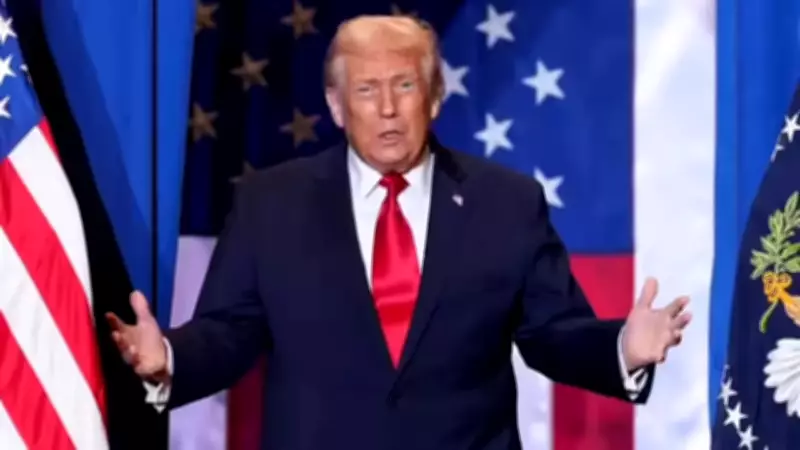
Trump Issues Stark Ultimatum to Iran Over Critical Oil Shipping Lane
US President Donald Trump delivered one of his most aggressive warnings yet to Iran on Sunday, explicitly stating he was considering "blowing everything up and taking over the oil" if Tehran fails to reach an agreement to reopen the strategically vital Strait of Hormuz. The president's comments came during an interview with Fox News, where he emphasized the urgency of the situation.
Escalating Threats Amid Regional Tensions
Speaking directly about the ongoing negotiations, Trump declared, "I think there is a good chance tomorrow, they are negotiating now. If they don't make a deal and fast, I'm considering blowing everything up and taking over the oil." This warning represents a significant escalation in rhetoric as tensions continue to mount across the Middle East following the conflict that erupted on February 28 after US-Israeli strikes targeted Iranian positions.
The president's threats extend beyond the Strait of Hormuz confrontation. Trump has also warned of potential strikes on Iran's critical infrastructure, specifically announcing on his Truth Social platform: "Tuesday will be Power Plant Day, and Bridge Day, all wrapped up in one, in Iran. There will be nothing like it!!!" In characteristically blunt language, he added, "Open the F*****' Strait, you crazy b******s, or you'll be living in Hell - JUST WATCH! Praise be to Allah."

Background of the Current Crisis
The current standoff stems from Iran's decision to largely block the Strait of Hormuz, a critical chokepoint through which approximately one-fifth of the world's oil passes daily. This action has disrupted regional stability and created significant volatility in global oil markets. Iran has also launched attacks against Israel and neighboring Gulf states, prompting urgent diplomatic efforts to de-escalate the situation.
Adding complexity to the crisis, Trump recently celebrated what he called the "miraculous" rescue of a seriously wounded US airman from deep inside Iranian territory. Iranian authorities claim to have foiled this rescue attempt and have distributed images of destroyed aircraft, though they have not denied that US forces successfully extracted the airman. According to US media reports, some transport planes involved in the operation were deliberately destroyed to prevent them from falling into Iranian hands.
Regional Fallout and International Concern
The conflict has expanded beyond direct US-Iran hostilities, with attacks reported against critical infrastructure in multiple Gulf nations:
- United Arab Emirates
- Bahrain
- Kuwait
Additionally, US diplomatic facilities in Iraq have been targeted, while Lebanon has become increasingly drawn into the conflict. According to AFP reports, Israel has conducted strikes in southern Lebanon and southern Beirut, resulting in several civilian casualties.
A particularly concerning development occurred last Saturday when a strike near Iran's Bushehr nuclear plant killed a guard and prompted Russia, which partly operates the facility, to evacuate 198 workers. Russian officials condemned the attack as "an evil deed," while Iranian authorities warned that further attacks on nuclear facilities could produce radioactive fallout affecting capital cities throughout the Gulf region.
Contrast Between Political Escalation and Daily Life
Despite the escalating threats and military actions, daily life in Tehran appears largely normal according to recent observations. Residents have been seen picnicking and flying kites near iconic landmarks, highlighting the stark contrast between the political and military escalation at the national level and the continuation of ordinary routines in Iran's capital city.
The situation remains fluid as diplomatic efforts continue alongside military posturing. The international community watches closely as the standoff over the Strait of Hormuz threatens not only regional stability but also global energy security and economic stability.