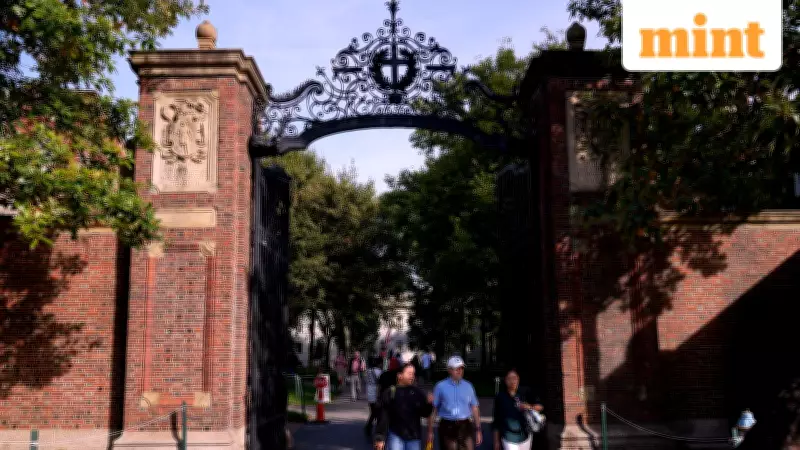
Trump Escalates Feud with Harvard, Announces $1 Billion Lawsuit
Former President Donald Trump has declared his intention to sue Harvard University for a staggering $1 billion in damages, marking the latest and most dramatic escalation in a months-long battle between his administration and the prestigious Ivy League institution. The conflict centers on allegations of antisemitism and disputes over diversity practices at the university.
Social Media Announcement Follows Failed Settlement Talks
Trump made the announcement overnight on his Truth Social platform, shortly after The New York Times reported that his administration had dropped its demand for a $200 million payment from Harvard to settle the dispute. In his posts, Trump criticized both the newspaper and the university, writing, "Strongly Antisemitic Harvard University has been feeding a lot of 'nonsense' to The Failing New York Times." He added, "This case will continue until justice is served. We are now seeking One Billion Dollars in damages, and want nothing further to do, into the future, with Harvard University."
Trump did not provide specific details on how or when he plans to pursue the $1 billion lawsuit. Harvard University has not issued an immediate response to requests for comment regarding this latest development.

Background of the Administration's Crackdown on Universities
The feud between the Trump administration and Harvard dates back to criticisms of the university's handling of pro-Palestinian protests on campus and debates over diversity, equity, and inclusion programs. This assault was part of a broader conservative campaign aimed at reversing what they perceive as a progressive takeover of American education.
- Shortly after taking office in early 2025, Trump vowed to crack down on what he termed "woke ideology" at universities.
- This led to a series of legal threats, funding freezes, and cuts to grants across the higher-education sector.
- In April last year, Trump revoked approximately $2 billion in research grants to Harvard and imposed a freeze on its federal funding.
- Harvard responded by suing the government, arguing that no administration should dictate what private universities teach, whom they admit or hire, or which areas of study they pursue.
- A Boston federal judge later overturned the funding cuts, ruling that the government had violated Harvard's free-speech rights.
Broader Impact on Higher Education Institutions
Trump's targeting of Harvard is not an isolated incident. His administration has launched a crackdown on several prominent American universities, disrupting their operations, raising questions about institutional autonomy, and highlighting the complex relationship between academia and the federal government.
- In November, Cornell University agreed to pay $60 million to settle its dispute with the administration.
- Similar deals were reached by Brown and Columbia universities to resolve their conflicts.
- The government has pulled billions of dollars in federal research funds, threatened tax-exempt statuses, and attacked the ability of schools to enroll international students.
According to The New York Times, Harvard had rejected the idea of a $200 million payment earlier this week because it was wary of backlash from liberal students and faculty. This rejection prompted Trump's critical social media posts and the announcement of the $1 billion lawsuit.
Harvard's Response and Ongoing Campus Reforms
Amid the ongoing dispute, Harvard has released its own reports on campus antisemitism and anti-Muslim bias, which painted a critical picture of the school's political and academic climate. The university has stated that it has taken steps to address antisemitism and discrimination on campus, though these measures have not appeased the Trump administration.
Before Trump's latest remarks, the administration had been in discussions with Harvard over a potential deal to unfreeze federal funding. However, with the announcement of the $1 billion lawsuit, these talks appear to have reached a new impasse, further straining relations between one of America's most powerful political figures and one of its oldest educational institutions.