

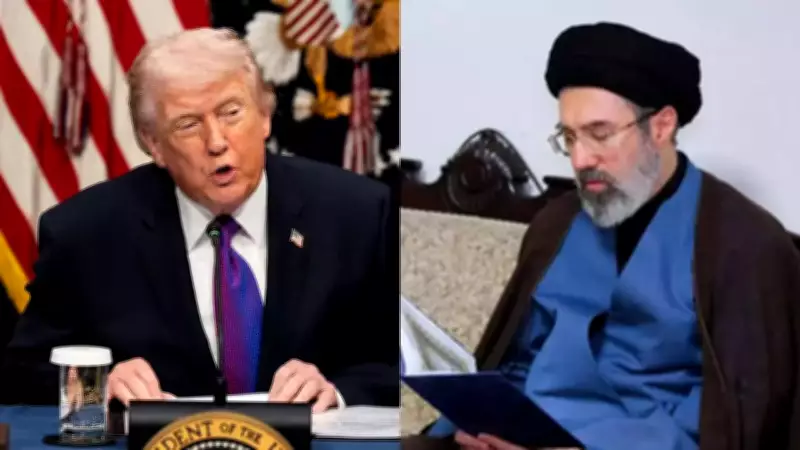
Trump Expresses Doubts About Iran's New Leadership and Peace Prospects
Former United States President Donald Trump stated on Tuesday that he does not believe Iran's new Supreme Leader, Mojtaba Khamenei, can "live in peace." Mojtaba Khamenei, who is the son of the late Supreme Leader Ali Khamenei, has assumed leadership amid escalating tensions in West Asia. Trump's comments come as the regional conflict shows no signs of abating, with military engagements continuing unabated.
Potential for Negotiations Hinges on Terms
In an interview with Fox News, Trump indicated that he might be willing to engage in talks with Iran, but emphasized that any dialogue would depend entirely on the conditions set forth. "It's possible I would be willing to talk with Iran, but that it depends on the terms," Trump remarked. He further mentioned during a Monday evening interview that he had heard Tehran was eager to negotiate, suggesting a potential opening for diplomatic efforts despite the ongoing hostilities.
Trump's Assessment of the Conflict and Warnings to Tehran
Trump described the war in West Asia as a "short-term excursion" that he believes will conclude soon, although he did not provide a specific timeline. He issued a stern warning to Iran, stating that if the country attempts "anything cute," the United States would respond decisively. "If they do anything bad, that would be the end of Iran and you'd never hear the name again," Trump asserted during a CBS interview.

He characterized the conflict as "very complete," claiming that Iran has depleted its military capabilities. "They have no navy, no communications, they've got no air force," Trump said, underscoring his view of Iran's weakened state. Despite this, he acknowledged that while the US and its allies have achieved significant victories, more work is needed to secure ultimate success.
Trump's Vision for Victory and Regional Dynamics
Trump declared that the United States and its allies have "already won in many ways," but stressed the necessity of continuing efforts to achieve a definitive victory. "We go forward more determined than ever to achieve ultimate victory that will end this long-running danger once and for all," he stated. He portrayed the US as a resilient nation that will not be intimidated by threats, reinforcing his commitment to national security.
Additionally, Trump argued that if the US and Israel had not preemptively attacked Iran, Tehran would have initiated aggression first. This perspective highlights the proactive stance he advocates in dealing with perceived threats from Iran, framing military actions as necessary defensive measures.
Broader Context of the West Asia Conflict
The ongoing war in West Asia has involved multiple actors, including recent incidents such as an attack on the UAE embassy in Iraq and Hezbollah drone strikes targeting Israel. These developments contribute to the complex geopolitical landscape, where Trump's comments reflect the high stakes and volatile nature of US-Iran relations. His remarks underscore the challenges in achieving peace and the conditional nature of potential diplomatic engagements, as the conflict continues to impact regional stability and international affairs.






