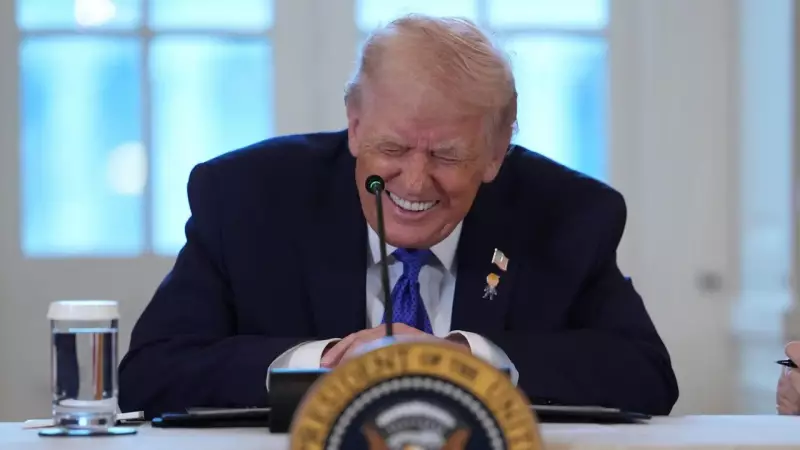
In a move that has sent shockwaves through diplomatic circles, former US President and MAGA leader Donald Trump declared himself the 'Acting President' of Venezuela via a social media post on Monday. The statement, widely perceived as a mockery of the besieged South American nation and the United Nations, has ignited a firestorm of criticism and concern about the future of US foreign policy.
A Declaration of Control and Global Reactions
Trump's provocative declaration is not an isolated remark but part of a series of actions targeting Venezuela. He had previously stated that Washington would 'run' Venezuela, tasking Secretary of State Marco Rubio—now sarcastically dubbed the 'Viceroy' of Venezuela—with coordinating governance. This coordination is supposedly with US-designated interim President Delcy Rodríguez, who was formerly Vice-President under the abducted leader Nicolás Maduro.
Trump openly threatened Rodríguez, warning she would 'pay a very big price, probably bigger than Maduro' if she failed to grant US corporations 'total access' to Venezuelan oil and other resources. The circumstances of Rodríguez's current cooperation with the US remain unclear, raising questions about whether it is voluntary or under duress.

The global response has been sharply divided. While nations like China, Russia, and Brazil have condemned the US takeover, others including Argentina, Ecuador, and Israel have offered support. A significant bloc, comprising the EU, UK, and India, has adopted a stance of strategic acquiescence, stopping short of outright condemnation. Critics argue this middle ground may embolden further aggressive actions.
Domestic Criticism and Expanding Ambitions
Within the United States, voices beyond the MAGA base are expressing deep alarm. Brian Berletic, a former US Marine and geopolitical analyst, called the self-appointment 'unhinged criminality' meant to prime the American public for wider transgressions. He framed the situation as a 'life and death struggle' against a 'nuclear-armed criminal enterprise,' highlighting growing fears over Trump's stated threats to enact regime change in Cuba and Venezuela and even invade Greenland.
Political analyst and MAGA critic Ben Norton labeled the US an 'imperial gangster regime.' This criticism extends to corporate circles, as evidenced by Trump's public rebuke of Exxon Mobil. He expressed displeasure with the oil giant's reluctance to return to 'uninvestible' Venezuela, stating on Air Force One, 'I'll probably be inclined to keep Exxon out... They're playing too cute.'
A 'Dream Military' and New Fronts
This hardline approach coincides with Trump's recent call for a staggering 50% increase in the US military budget, which already exceeds $1 trillion—more than the combined spending of the next ten nations. He frames this as building a 'Dream Military' for 'very troubled and dangerous times.'
Simultaneously, Trump has turned up the heat on other nations. He claimed Cuba is 'going down for the count' due to economic crisis and loss of Venezuelan fuel subsidies. On his Truth Social platform, he declared, 'THERE WILL BE NO MORE OIL OR MONEY GOING TO CUBA – ZERO!' and suggested Secretary of State Marco Rubio could become president of a 'free' Cuba.
Regarding Iran, Trump stated that the country had contacted the US to propose talks, a move he attributed to Iran being 'tired of being beat up by the United States.' This comes after he warned Tehran he was looking 'very seriously' at military options.
The events of the past week paint a picture of a potential future Trump administration willing to openly assert direct control over sovereign nations, leverage economic and military might unabashedly, and challenge long-standing international norms. The world's response, particularly the strategic silence from some quarters, is being watched as a critical factor that could shape this aggressive new chapter in geopolitics.