

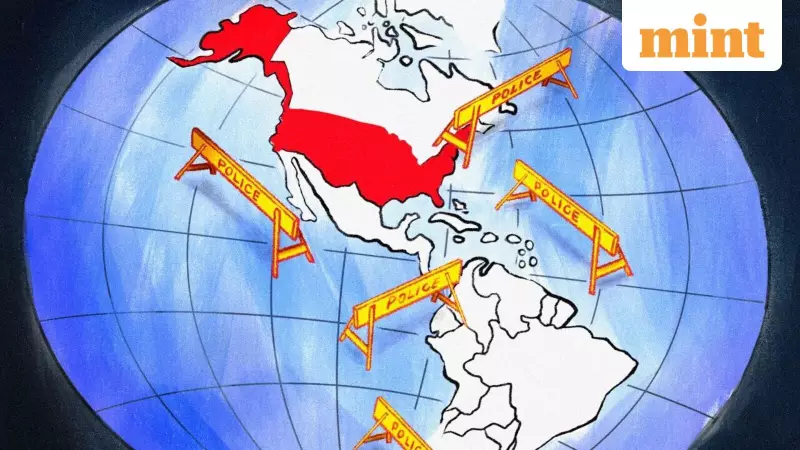
In a seismic shift for regional geopolitics, the administration of US President Donald Trump has heralded a new era of assertive dominance in the Western Hemisphere. The audacious military operation that captured Venezuela's autocratic leader, Nicolás Maduro, from his Caracas compound and extradited him to face trial in New York is the clearest signal yet of this hardline strategy.
Call it the return of the 'Big Stick' school of foreign policy, a direct throwback to the era of President Theodore Roosevelt. For the Trump administration, ensuring that the United States is the sole dominant power in its own backyard is now the paramount national security interest.
The 'Donroe Doctrine': A New Blueprint for Hemispheric Control
The policy, dubbed the 'Donroe Doctrine' by Trump allies, explicitly aims to push back against any non-hemispheric actors, particularly China and Russia, while resurrecting Roosevelt's argument for the US right to intervene to protect its interests. This marks a dramatic pivot from decades of what was often benign neglect, where Washington's focus was on distant wars in the Middle East.

The timing of the operation against Maduro was starkly symbolic. It occurred mere hours after a Chinese delegation, led by Special Representative Qiu Xiaoqi, met with him in Caracas. Beijing's Foreign Ministry reacted with unusual force, stating it was "deeply shocked and strongly condemns the U.S.'s blatant use of force against a sovereign state."
Under Trump's second term, Latin America has rapidly moved from a strategic backwater to center stage. U.S. Southern Command, based in Miami, now finds itself on the front lines with expanded resources and mission. There is a surge in Washington for Latin America expertise, from intelligence agencies to lobbying firms previously focused elsewhere.
Regional Reactions: Allies, Pushback, and Clear Warnings
The new muscular approach is creating immediate ripple effects across the Americas. Pro-U.S. leaders like Argentina's Javier Milei and El Salvador's Nayib Bukele are benefiting, while leftist governments are under direct pressure.
Following Maduro's capture, Trump warned Colombia's leftist President Gustavo Petro that he could be next, citing the country's role as the world's top cocaine producer. Petro, a former guerrilla, responded fiercely, calling the U.S. action a violation of Latin American sovereignty.
However, the policy is not without significant risks and limits. It has sparked concern among European allies; Danish Prime Minister Mette Frederiksen warned that any U.S. move on Greenland would mean the end of NATO, a stance backed by the UK.
Within Latin America, while most oppose Maduro, there is deep-seated resentment towards a return to unfettered U.S. interventionism. "It puts the region on edge," said Michael Shifter of the Inter-American Dialogue. "It hits a nerve in a region that has seen more than its share of military interventions."
The critical test will be whether this intervention leads to a genuine democratic transition in Venezuela. Success could provide moral cover; failure would be seen as a mere resource grab for Venezuela's vast oil reserves and deepen regional wariness.
Architects, Methods, and the Limits of Power
Trump has staffed his administration with key figures focused on the region, most notably Secretary of State Marco Rubio, the son of Cuban immigrants and the main architect of this approach. Influential ally Steve Bannon summed up the mindset: "If you’re going to have hemispheric defense, you’ve got to secure Latin America."
The administration has invoked a post-9/11 playbook, designating nearly a dozen Latin American drug cartels as foreign terrorist organizations. By branding them the "al Qaeda of the Western Hemisphere," officials have rallied domestic support for a more aggressive posture.
Yet, U.S. power has its limits, as seen in Brazil. After Trump imposed tariffs and sanctioned judicial authorities to protect ally Jair Bolsonaro, Brazil's Supreme Court sentenced the former president to 27 years. President Lula da Silva declared, "Brazil is a sovereign country... and it will not take orders from anyone." Trump was forced to accept defeat.

The potential upside for the U.S. is clear: increased oil supplies, fewer drugs and migrants, and dislodging rivals from the region. But the gamble is immense, risking a sustained backlash across a hemisphere with a long memory of Yankee imperialism. The era of the 'Big Stick' is unequivocally back, setting the stage for a turbulent new chapter in inter-American relations.





