

UPSC Key 2026: Critical Analysis of Current Affairs for Civil Services Aspirants
As UPSC aspirants gear up for the 2026 examinations, understanding the interplay of international diplomacy, domestic policy shifts, and historical legacies becomes paramount. The latest developments, including President Donald Trump's Board of Peace initiative, the Draft National Electricity Policy 2026, data protection regulations, and the enduring influence of Netaji Subhas Chandra Bose, offer rich material for both Preliminary and Main examinations. This comprehensive guide delves into these topics, providing context, relevance, and strategic insights to enhance your preparation.
Trump's Board of Peace: India's Diplomatic Tightrope
Relevance for UPSC: This topic aligns with the Preliminary Examination's focus on current events of national and international importance and the Mains Examination's General Studies-II syllabus, which covers the effects of policies and politics of developed and developing countries on India's interests.
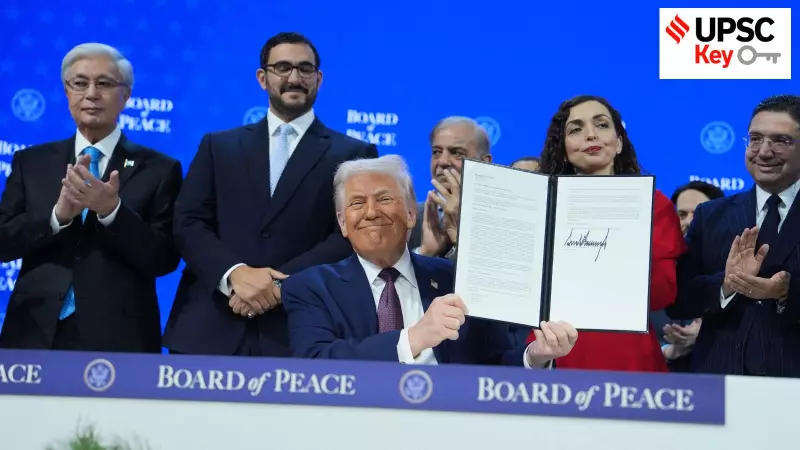
What's the ongoing story? US President Donald Trump unveiled his Board of Peace at the World Economic Forum in Davos, Switzerland, on January 22, 2026, as part of a 20-point Gaza peace plan. India, however, adopted a cautious stance, neither declining nor accepting Trump's invitation to Prime Minister Narendra Modi to join the board. This decision reflects Delhi's strategic balancing act amid complex geopolitical dynamics.

Key Points to Ponder:
- What constitutes Trump's 20-point Gaza peace plan, and how does it differ from previous international efforts?
- What are the intended roles and functions of the Board of Peace, and how might it challenge existing multilateral frameworks like the United Nations?
- What are the primary concerns associated with the Board of Peace, particularly regarding its legitimacy and potential to undermine global institutions?
- Analyze the arguments for and against India's participation in the Board of Peace, considering factors such as strategic autonomy, diplomatic relations, and regional stability.
- Review India's historical stand on the Israel-Palestine conflict and its advocacy for a negotiated two-state solution.
- Examine the role of the United Nations in addressing the Israel-Hamas war and the implications of the Board of Peace for UN-led processes.
Key Takeaways:
- India's hesitation stems from multiple factors: assessing the board's composition, with countries like Saudi Arabia, Egypt, Israel, UAE, Turkey, and Jordan joining, while major European powers and UN Security Council permanent members like Russia, China, France, and the UK abstain.
- The board's longevity is uncertain, tied to Trump's presidency, raising questions about its sustainability beyond his term.
- India's commitment to multilateralism and the UN framework could be tested if the board positions itself as a parallel body, potentially eroding global governance structures.
- Delhi is wary of the board's potential expansion into other conflicts, such as the India-Pakistan dynamic, which could compromise India's strategic autonomy.
From the Ideas Page: Opinions are divided. Some argue that joining the board would grant India a voice in Gaza's reconstruction and enhance its global influence, while others caution that participation might undermine India's anti-colonial principles and moral credibility in the Global South.
Data Protection: Shorter Timelines for Big Tech Compliance
Relevance for UPSC: This issue pertains to the Preliminary Examination's current events and the Mains Examination's General Studies-II, focusing on government policies and interventions in various sectors.
What's the ongoing story? The Ministry of Electronics and IT (MeitY) is considering reducing the compliance timeline for Big Tech companies, such as Meta, Google, and Amazon, under India's Digital Personal Data Protection Act, 2023, from 18 months to 12 months. This move aims to differentiate between large corporations and startups, though it may face resistance from the industry.
Key Points to Ponder:

- What are the salient features of the Digital Personal Data Protection Act, 2023, and how does it compare to international standards like the GDPR?
- Define 'significant data fiduciaries' and explain the criteria used to designate them, including volume, sensitivity, and risks to national security.
- Discuss the concept of data localization and its importance for digital sovereignty and cybersecurity in India.
- Examine the right to privacy as a fundamental right, referencing the landmark Supreme Court judgment that established this principle.
- Analyze concerns regarding the potential dilution of the Right to Information (RTI) Act due to provisions in the data protection law.
Key Takeaways:
- The proposed shorter timeline targets 'significant data fiduciaries,' requiring them to conduct annual data protection impact assessments and ensure algorithmic compliance.
- Penalties for data breaches could reach up to Rs 250 crore, emphasizing the government's focus on robust data security measures.
- The Act has faced criticism for granting broad exemptions to government agencies on grounds of national security, raising questions about accountability and transparency.
- This policy shift reflects an effort to create a tiered compliance framework, acknowledging that larger companies often have more resources to meet stringent regulations.
Draft National Electricity Policy 2026: A Nuclear Pivot
Relevance for UPSC: This topic is crucial for the Preliminary Examination's current events and the Mains Examination's General Studies-II, covering government policies in the energy sector.
What's the ongoing story? Following the enactment of the SHANTI Act, which opens India's nuclear sector to private players, the Draft National Electricity Policy (NEP) 2026 signals a significant shift toward nuclear power as a substitute for coal-based thermal generation. This aligns with India's climate commitments and energy security goals.
Key Points to Ponder:
- What are the key provisions of the SHANTI Act, and how do they facilitate private participation in nuclear energy?
- Assess India's current nuclear power status and its role in the national energy mix, considering challenges like high capital costs.
- Explain Small Modular Reactors (SMRs) and their potential advantages over conventional nuclear reactors in terms of flexibility and cost.
- Analyze the financial health of distribution companies (discoms) in India and the reforms proposed in the draft policy to address issues like AT&C losses.
- Discuss the implications of exempting manufacturing enterprises and Railways from cross-subsidy charges when procuring power through open access.
Key Takeaways:
- The draft policy aims to increase nuclear capacity to 100 GWe by 2047, leveraging advanced technologies like SMRs and encouraging captive use by industries.
- It proposes an index-linked automatic tariff revision mechanism to ensure timely cost recovery for power utilities, addressing revenue gaps.
- Nuclear projects will be eligible for Green Bond funding, supporting India's transition to low-carbon energy pathways.
- The policy emphasizes repurposing retired thermal plant sites for nuclear generation, optimizing infrastructure and reducing environmental impact.
Netaji Subhas Chandra Bose: Legacy and Relevance
Relevance for UPSC: This subject is integral to the Preliminary Examination's history of India and the Indian National Movement and the Mains Examination's General Studies-I, focusing on the freedom struggle.
What's the ongoing story? On Netaji's birth anniversary, observed as Parakram Diwas, the nation reflects on his contributions to India's independence. His leadership of the Indian National Army (INA) and advocacy for women's participation, as seen in the Rani of Jhansi Regiment, highlight his progressive vision.
Key Points to Ponder:
- Evaluate Netaji's role in the freedom struggle, contrasting his methods with Mahatma Gandhi's approach of non-violence.
- Discuss the formation and impact of the INA, including key figures like Shah Nawaz Khan, Prem Kumar Sehgal, and Gurbaksh Singh Dhillon.
- Explore the contributions of Tamil leaders like Pasumpon U Muthuramalinga Thevar, known as the "Bose of the South," in mobilizing support for the INA.
- Analyze the significance of the Rani of Jhansi Regiment and the stories of women like Janaky Thevar and Saraswathi Rajamani in challenging social norms.
Key Takeaways:
- Netaji's emphasis on armed struggle and international diplomacy expanded the scope of the independence movement, garnering support from diverse regions, including Tamil Nadu.
- His vision extended beyond political freedom to encompass social justice and national unity, rejecting caste divisions and promoting gender equality.
- Contemporary commemorations, such as the installation of his statue at Kartavya Path and the renaming of islands in the Andaman and Nicobar, underscore his enduring legacy in India's collective memory.
- Understanding Netaji's ideology provides insights into the pluralistic and resilient nature of India's fight for independence, relevant for both historical analysis and current national identity discussions.
Trump's Greenland Gambit: Implications for Global Order
Relevance for UPSC: This topic relates to the Preliminary Examination's current events and the Mains Examination's General Studies-II, covering international relations and the impact of developed countries' policies.
What's the ongoing story? President Trump's efforts to secure rights over Greenland, through a combination of threats and negotiations, highlight his unconventional diplomatic tactics. This move aims to counter Chinese and Russian influence in the Arctic while accessing critical rare-earth minerals.
Key Points to Ponder:
- Examine the geopolitical significance of Greenland in the context of Arctic politics and resource competition.
- Discuss the role of NATO and how Trump's actions might strain alliances with European partners.
- Analyze the concept of the "Coalition of the Willing" and its relevance in contemporary international diplomacy.
- Consider the broader implications of Trump's approach for global norms, territorial integrity, and the risk of escalating great-power conflicts.
Key Takeaways:
- Trump's strategy involves escalating rhetoric, followed by negotiations, to achieve objectives without military conflict, as seen in the Greenland case.
- This approach challenges multilateral institutions and may encourage other leaders to adopt similar coercive tactics, destabilizing international order.
- For India, observing these dynamics is crucial for navigating its own foreign policy, especially in balancing relations with major powers like the US, China, and Russia.
- The situation underscores the importance of strategic autonomy and the need for robust diplomatic frameworks to address emerging global challenges.
In conclusion, these interconnected topics offer a multifaceted perspective on current affairs essential for UPSC preparation. By analyzing the diplomatic nuances of Trump's Board of Peace, the policy shifts in data protection and electricity, the historical depth of Netaji's legacy, and the geopolitical maneuvers in Greenland, aspirants can develop a holistic understanding that enhances their analytical skills and exam readiness. Stay updated with further developments to refine your knowledge and approach for the 2026 examinations.





