UPSC Key Analysis: Strategic Topics for Civil Services Examination
This article provides an in-depth exploration of critical subjects relevant to the UPSC Civil Services Examination, focusing on recent developments in international relations, governance, and technology. The analysis is based on key events and policies that are likely to feature in both the Preliminary and Main examinations.
India-Malaysia Comprehensive Strategic Partnership
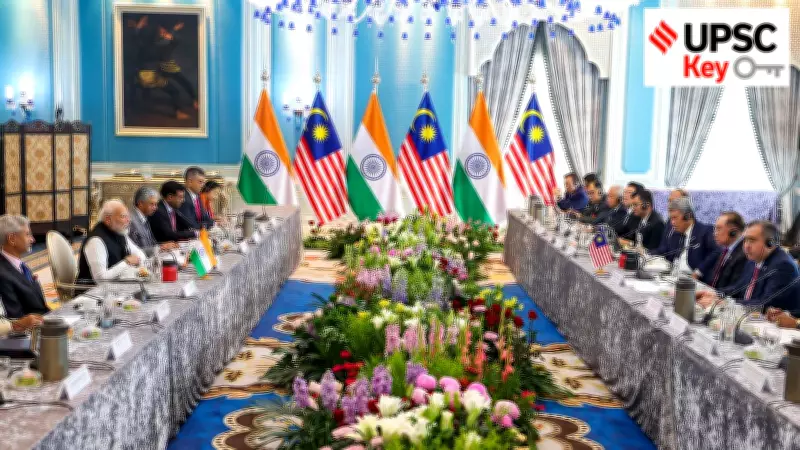
Prime Minister Narendra Modi's official visit to Malaysia in February 2026 marked a significant milestone in bilateral relations, emphasizing strategic trust and economic transformation. During delegation-level talks with Malaysian Prime Minister Anwar Ibrahim, Modi underscored India's unwavering stance against terrorism, stating, "no double standards, no compromise." The discussions culminated in the signing of 11 cooperation agreements spanning defence, digital payments, semiconductors, and disaster management.
Key areas of cooperation include:

- Enhanced collaboration in counter-terrorism, intelligence sharing, and maritime security.
- Expansion of defence ties, including the establishment of a Strategic Affairs Working Group and Su-30 Forum for technical expertise exchange.
- Integration of India's semiconductor design capabilities with Malaysia's manufacturing strengths, leveraging Malaysia's 13% share in global semiconductor trade.
The joint statement unequivocally condemned cross-border terrorism, reflecting Malaysia's shift towards prioritizing its relationship with India over previous alignments with Pakistan. This development is crucial for UPSC aspirants, as it ties into broader themes such as India's Act East Policy, ASEAN dynamics, and bilateral groupings affecting national interests.
PM CARES Fund and Parliamentary Scrutiny
The Prime Minister's Office has informed the Lok Sabha Secretariat that questions related to the PM CARES Fund, Prime Minister's National Relief Fund, and National Defence Fund are inadmissible under parliamentary rules. This decision is based on Rule 41(2) of the Lok Sabha's Rules of Procedure, which restricts queries on matters not primarily concerning the Government of India or under the control of bodies not responsible to it.
Critical points for UPSC preparation:
- The PM CARES Fund was established as a public charitable trust in March 2020 to address emergencies like the COVID-19 pandemic, funded entirely by voluntary contributions.
- Unlike the Consolidated Fund of India, it does not receive budgetary allocations, leading to debates over transparency and accountability under the RTI Act.
- Distinctions from other funds: PMNRF provides relief for natural calamities, while NDF supports armed forces welfare.
This topic intersects with UPSC syllabi on government policies, constitutional provisions like Article 266, and issues of governance and public accountability.
AI Impact Summit 2026: India's Global Leadership
India is set to host the AI Impact Summit from February 16 to 20, 2026, focusing on "People, Planet, and Progress" rather than immediate regulatory frameworks. This summit represents an evolution from previous global gatherings, such as the Bletchley Declaration in 2023, broadening discussions to include innovation and inclusivity.
Highlights for UPSC aspirants:
- The summit aims to generate actionable recommendations for long-term AI governance, emphasizing solutions for ground-level issues in the Global South.
- India will launch indigenous AI language models under the Rs 10,370 crore IndiaAI Mission, showcasing its ambition to become a major AI power.
- The event will feature over 500 AI startups and 500 sessions, addressing themes like AI's impact on work, trust and safety protocols, and industry-specific applications.
This aligns with UPSC topics on science and technology, bilateral agreements, and India's role in global groupings, highlighting ethical considerations and economic opportunities in AI.

Additional UPSC-Relevant Developments
Government Borrowings and Economic Implications: Recent auctions show state governments paying higher interest rates despite RBI repo rate cuts, due to rising debt levels and liquidity tightening. This underscores issues like the debt-GDP ratio, fiscal responsibility, and monetary policy transmission, key for economy-related questions.
Election Commission and Electoral Rolls: The EC clarified that micro observers in West Bengal's Special Intensive Revision have facilitative roles, with Electoral Registration Officers retaining decision-making authority. This touches on constitutional provisions like Article 324 and the Representation of the People Act.
India-US and EU Trade Agreements: Recent FTAs with the US and EU open new trade vistas, emphasizing market access while protecting sensitive sectors like agriculture. These deals relate to bilateral groupings, economic planning, and India's trade strategy in a multipolar world.
In conclusion, mastering these topics requires understanding their interconnections with UPSC syllabi, from current events to in-depth policy analysis. Aspirants should focus on factual accuracy, conceptual clarity, and the ability to critically evaluate implications for India's governance and global standing.