US Border Crisis: One Indian Child Detected Illegally Every Three Days
Pursuing the American dream is turning into a deadly and exploitative journey for many, with alarming data from the United States Customs and Border Protection revealing that, on average, one Indian child is detected entering or residing illegally in the US every three days. This statistic underscores a growing humanitarian crisis at the border, where vulnerable minors are increasingly caught in the crosshairs of human smuggling operations.
Steady Rise in Detentions of Indian Children
Between October 2025 and February 2026—the first five months of the US fiscal year—authorities identified 56 Indian children, including 39 unaccompanied minors and 17 accompanied ones. These figures expose a disturbing pattern in migration trends, where children are being used as pawns by smuggling networks to facilitate illegal entry into the United States.
Across all nationalities, a total of 4,247 unaccompanied children were apprehended at the US border from October to March, with 43 of them being Indian. Month-wise data indicates a concerning upward trajectory: seven Indian unaccompanied minors were caught each in October and November, eight in December, and a significant spike to 13 in January 2026. The numbers then dropped to four each in February and March.

Historical Context and Recent Spike
The January spike brought renewed attention to the tragic death of a family from Gujarat's Dingucha village, who perished in extreme cold while attempting to enter the US illegally via Canada. This incident highlights the perilous risks associated with such journeys.
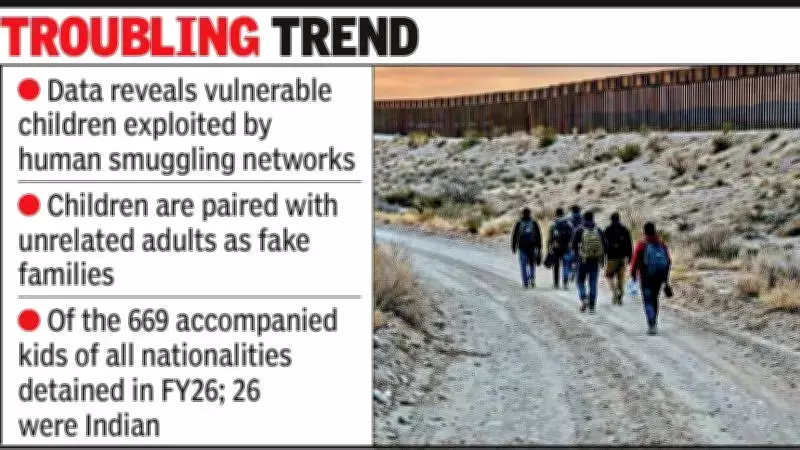
While the number of Indian unaccompanied minors had been declining—from 730 in FY2023 to 517 in FY2024 and just 91 in FY2025—the current data suggests a troubling reversal. Equally alarming is the rise in accompanied minors. In FY2026 so far, of the 669 accompanied children of all nationalities detained between October and March, 26 were Indian.
The monthly breakdown for accompanied minors shows four in November, six in December, two in January, five in February, and nine in March. In comparison, 261 Indian accompanied minors were detected in 2021, 55 in 2024, and 23 in 2025, indicating a fluctuating but persistent issue.
Exploitative Tactics by Smuggling Networks
Sources reveal an exploitative modus operandi employed by human smugglers: children are often paired with unrelated adults to form fake families, making it easier to gain entry into the US. "Once inside US territory, children are sent to border agencies, after which handlers posing as guardians claim them. This helps illegal immigrants secure shelter and eventually legal pathways," explained an official familiar with the operations.
This tactic not only endangers the children but also complicates enforcement efforts, as it blurs the lines between legitimate family units and fraudulent ones. The data underscores the urgent need for enhanced border security and international cooperation to combat these smuggling rings.
Broader Implications and Call for Action
The steady rise in detentions of Indian children at the US border points to deeper socio-economic issues driving migration, such as poverty, lack of opportunities, and the allure of better prospects abroad. It also highlights the need for comprehensive policies that address both the root causes of illegal migration and the protection of vulnerable minors.
As authorities grapple with this escalating crisis, the focus must remain on safeguarding children from exploitation and ensuring that those caught in these networks receive proper care and legal assistance. The data serves as a stark reminder of the human cost behind the pursuit of the American dream.