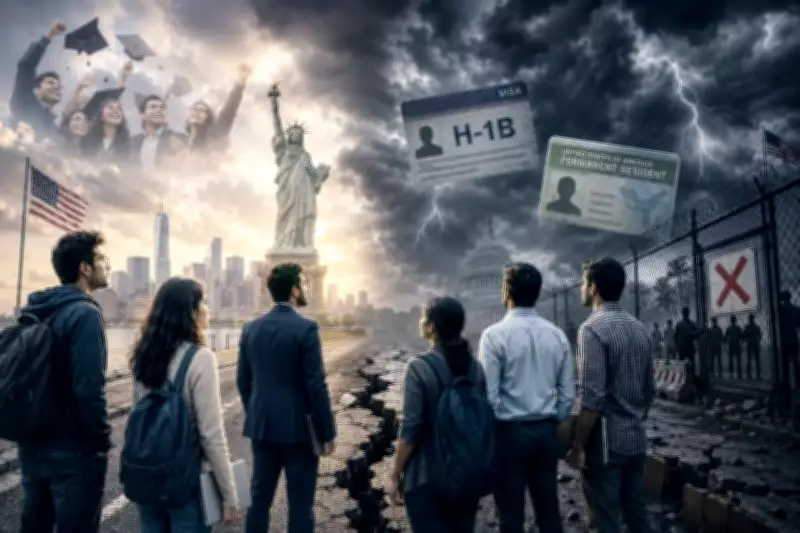
US President Donald Trump has frequently expressed admiration for Indian talent, yet his administration's policies suggest a reluctance to welcome it into America. The long-established pathway for Indians—study in the US, secure employment, and pursue a green card for permanent residency—is increasingly fraught with obstacles. Frequent policy changes, immigration restrictions, and heightened uncertainties are turning the American dream into a nightmare for many.
Growing Unpredictability for Students and Professionals
Students now face stricter visa application scrutiny, including checks on social media activity. Proposed changes to student visa categories could impose fixed time limits on stay. Experts highlight processing delays, uncertainty around work authorization, and challenges in transitioning from student status to long-term employment. For skilled professionals, the H-1B visa remains the primary route, but new rules add complexity. A recent US Department of Homeland Security report reveals that in FY 2025, 70% of approved H-1B petitions were for Indian nationals, followed by China at 12%. However, Trump imposed a $100,000 fee on new H-1B applications last year and replaced the lottery system with a weighted selection process. Although a US court struck down the fee as an unauthorized tax, the ruling is likely to be appealed, deepening uncertainty.
Challenges in the Green Card Process
Green card aspirants, especially those from countries with significant employment-based backlogs, endure lengthy waiting periods. A recent USCIS memo sparked concern by suggesting that temporary visa holders seeking green cards might need to return to their home countries to complete the process, though the administration later clarified no blanket policy change. Nonetheless, immigration experts warn that the guidance grants officers greater discretion, potentially increasing scrutiny. For Indians, who constitute a large share of employment-based immigrants and H-1B holders, this adds to the uncertainty surrounding legal immigration pathways.

Expert Insights on the Changing Landscape
Kuldip Kumar, Partner at Mainstay Tax Advisors, notes that skilled professionals face heightened scrutiny, higher filing costs, and evolving compliance requirements, making immigration more complex and less predictable. Rajiv Dabhadkar, Founder of the National Organization for Software and Technology Professionals, emphasizes that while the H-1B was never an open invitation, the new unpredictability is a significant risk. Workers can handle hard rules but not random policy changes, fee increases, and unstable processing. Similarly, green card applicants face prolonged waits, with the psychological toll mounting as the promise of long-term payoff diminishes.
Alternative Destinations and India's Role
Experts point to alternative destinations gaining traction. Germany, Australia, Singapore, UAE, Canada, and the UK are emerging as meaningful alternatives for Indian talent. Germany appeals to engineers, IT professionals, and healthcare workers, while Australia and Singapore remain preferred for higher education and skilled migration. The UAE Golden Visa, offering permanent residency-like benefits with low taxation, attracts entrepreneurs and high-net-worth individuals. Additionally, India's improving economic landscape and free trade agreements, including a potential India-EU FTA, could reshape access to European labor markets. Sebin Jinny, Partner at Vialto Partners, notes that US immigration tightening coincides with India's enhanced capacity to retain talent, as Global Capability Centers in cities like Bengaluru and Hyderabad move up the value chain, making the visa question a genuine trade-off rather than a default aspiration.

The American Dream: A Ladder with Missing Steps
Manish Daftari, Partner at Vialto Partners, observes that while denial rates for student, professional, and green card visas have not increased, administrative burdens have grown. Students face extended visa renewals every four years, and professionals see rising prevailing wages that discourage employer sponsorship. Minor criminal violations now lead to denials. Rajiv Dabhadkar concludes that the American Dream for Indians was rooted in predictability—a clear ladder from education to citizenship. That ladder hasn't collapsed, but missing steps create uncertainty. For those in cutting-edge fields like AI and biotech, the US still offers unmatched opportunities, but for others, the advantage has shrunk. High costs and visa uncertainty, juxtaposed with improving Indian cities and remote work options, prompt a reevaluation of whether the US move is worth it.