US Military Build-Up in Middle East Reaches Historic Levels Amid Iran Standoff
As diplomatic tensions between Washington and Tehran continue to escalate, President Donald Trump has orchestrated a formidable display of American military might across the Middle East and surrounding regions. According to a detailed report from the Wall Street Journal, the United States has now amassed the most significant concentration of air power in the Middle East since the 2003 invasion of Iraq.
Naval Power at the Forefront
The strategic repositioning of jets, warships, missile defense systems, and long-range bombers represents what the president has described as an "armada." This deployment serves as a clear signal that the United States is prepared to take decisive action should nuclear negotiations with Iran completely collapse. The current military posture closely resembles the build-up that preceded last June's strikes on Iranian nuclear facilities, but officials confirm this latest mobilization operates on a substantially larger scale.
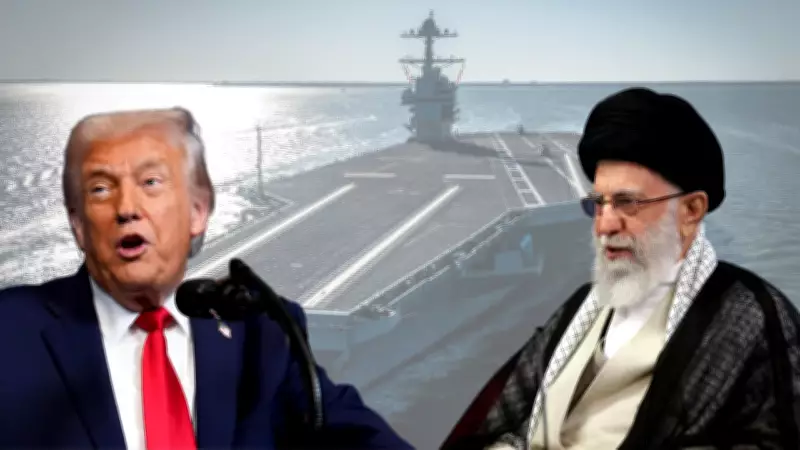
At the heart of this deployment stands the aircraft carrier USS Abraham Lincoln, accompanied by three warships equipped with Tomahawk cruise missiles and sophisticated air defense systems. Satellite imagery reviewed by The New York Times revealed the carrier operating off the coast of Oman in mid-February, positioning its F-35 stealth fighters and F/A-18 strike aircraft within striking distance of numerous targets inside Iran.

A second carrier strike group, led by the Navy's most advanced vessel, the USS Gerald R. Ford, is currently crossing into the Mediterranean Sea via the Strait of Gibraltar. United States officials indicate that its arrival will dramatically expand available strike options. Together, these two carriers provide the Pentagon with the capability to conduct sustained air operations without depending on bases in Gulf states, many of which remain hesitant to host offensive missions that might provoke Iranian retaliation.
In total, thirteen United States destroyers are now strategically positioned across the wider region, including in the Persian Gulf, the Red Sea, and the Northern Arabian Sea. At least one nuclear submarine remains deployed in the Mediterranean waters. This concentration of naval power grants Washington considerable operational flexibility, ranging from limited precision strikes on nuclear or missile facilities to a broader campaign targeting air defenses and Revolutionary Guard bases.
Reinforcing Air Power and Defensive Systems
The substantial naval presence is being reinforced by a significant surge of air assets. Satellite images show nearly thirty United States attack aircraft arriving in waves since mid-January at Muwaffaq Salti Air Base in eastern Jordan. Four electronic warfare planes, specifically designed to jam radar and communications systems, have also been deployed alongside at least five MQ-9 Reaper drones.
Flight tracking data indicates the movement of additional refueling tankers, reconnaissance aircraft, and cargo planes from the United States to Europe and the Middle East, sustaining the ongoing military build-up. Long-range bombers based in the United States are on heightened alert, and Diego Garcia in the Indian Ocean, a forward base for B-2 stealth bombers, has experienced an influx of surveillance, special operations, and refueling aircraft.
To shield American forces from potential retaliation, the Pentagon has dispatched additional Patriot and THAAD missile defense systems to the region. Approximately thirty thousand to forty thousand American troops are already stationed across the Middle East, further solidifying the United States military posture.
Diplomatic Efforts Under Intense Pressure
Despite the substantial military momentum, diplomatic channels have not been formally abandoned. Iranian Foreign Minister Abbas Araghchi recently described "good progress" following indirect talks in Geneva with United States envoys, including Jared Kushner and Steve Witkoff. White House press secretary Karoline Leavitt confirmed that "some progress" had been achieved but emphasized that "there are still a lot of details to discuss."

The core dispute continues to revolve around Iran's nuclear enrichment and missile program. The Trump administration insists that any agreement must effectively curb both activities. Tehran has consistently rejected any limitations on its missile capabilities, creating a significant diplomatic impasse.
Behind closed doors, President Trump convened top advisers in the White House Situation Room to carefully weigh next steps. Officials informed Axios that all required forces for potential military action would be fully in place by mid-March. One United States official stated that Iran must present a concrete package addressing American concerns by the end of the month to avoid further escalation.
Regional Dynamics and Strategic Calculations
Israel remains closely involved in the unfolding situation. Secretary of State Marco Rubio is expected to visit Prime Minister Benjamin Netanyahu later this month, with Israeli officials advocating for a broader campaign that could potentially weaken or even destabilize the Iranian regime.
Energy markets introduce another critical layer of strategic calculation. Approximately one-fifth of global oil trade passes through the strategically vital Strait of Hormuz. While Iran has repeatedly threatened to close this crucial waterway, it has avoided taking such action even during previous military clashes. Analysts suggest that markets are currently well supplied, which could potentially cushion the economic shock of limited military strikes.
Satellite imagery reported by Reuters shows Iran reinforcing sensitive sites, including burying tunnel entrances at Isfahan and fortifying facilities near Natanz. At Parchin, experts note that a newly constructed building has been encased in what appears to be a concrete shield and covered with soil, moves widely interpreted as efforts to blunt the impact of potential future air attacks.
For the present moment, Washington's message remains unequivocally clear: substantial military power has been assembled and stands ready for deployment. Whether this force will be utilized may ultimately depend on the outcome of the next round of diplomatic exchanges and how far both nations are willing to push a confrontation that could fundamentally reshape the Middle East for years to come.