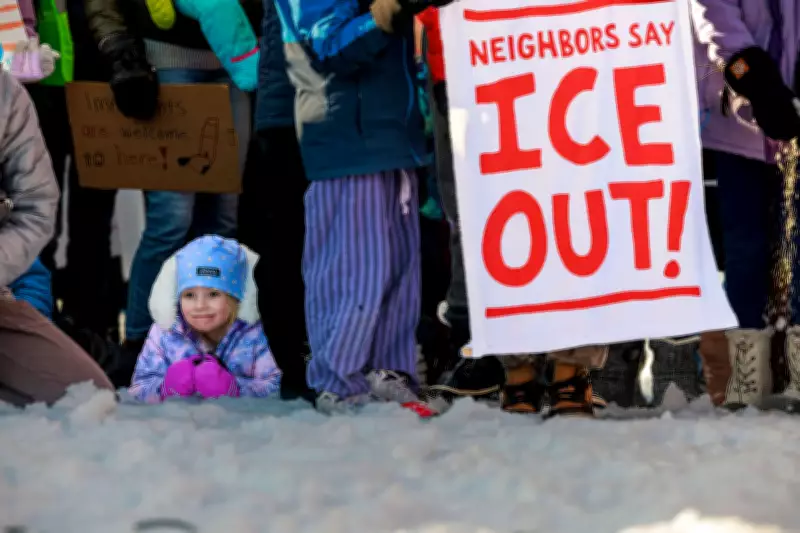
US School Districts File Legal Challenge Against Immigration Enforcement Policy
Educational institutions in the United States have become a focal point of legal contention following a significant shift in federal immigration policy. The policy alteration permits immigration enforcement actions to occur in and around school premises, a move that has sparked considerable concern among educators and administrators.
Legal Action Initiated by Minnesota Entities
Attorneys representing two prominent Minnesota school districts—Fridley and Duluth—along with Education Minnesota, the state's largest teachers union, have formally petitioned a federal court to intervene. They have requested a stay or preliminary injunction to block the implementation of this controversial policy, arguing that it has already produced detrimental effects on both students and daily school operations.
The legal filing was submitted to the United States District Court, marking a critical step in the ongoing debate over immigration enforcement in sensitive community locations.

Understanding the Policy Change
The root of the dispute lies in a decision by the US Department of Homeland Security to remove longstanding restrictions that previously designated certain areas as "sensitive locations." These locations, which included schools, school bus stops, churches, and hospitals, were traditionally treated as off-limits for immigration enforcement except under extraordinary circumstances.
By eliminating these protections, the policy change has granted federal immigration authorities substantially broader latitude to conduct enforcement operations in proximity to educational facilities, fundamentally altering the landscape of school safety and community trust.
Core Arguments Presented in Court
The districts and union initially challenged the policy in February, coinciding with a federal enforcement initiative known as Operation Metro Surge. In their legal arguments, they have emphasized that the policy has directly led to increased student absenteeism and has instilled widespread fear among students and their families.
Attorney Amanda Cialkowski, who is representing the plaintiffs, highlighted the uncertainty surrounding the potential scope of any court ruling. "It remains unclear whether a judicial decision would apply exclusively to Minnesota or extend to other jurisdictions. We must await the judge's determination," she stated, as reported by the Associated Press.
Judicial Proceedings and Government Response
During a recent hearing before Judge Laura Provinzino, the discussion centered on two key issues: whether the plaintiffs possess the legal standing to challenge the policy and whether they have experienced direct harm as a result of its implementation.
Justice Department attorney Jessica Lundberg contended that reinstating the previous guidance would not substantially alter enforcement outcomes. "Replacing the current guidance with the prior version would not yield a meaningful impact," she argued, noting that enforcement near schools was always a theoretical possibility under earlier frameworks.
Judge Provinzino acknowledged the urgency of the matter, promising a timely ruling. "I will issue a decision as promptly as possible while ensuring thorough consideration and accuracy," she affirmed.
Tangible Impact on Educational Environments
School officials have reported measurable declines in student attendance following the policy change and subsequent enforcement actions. Fridley Superintendent Brenda Lewis described the impact as profound, stating that the policy has "deeply affected" attendance rates because families no longer feel secure sending their children to school.
Lewis detailed specific consequences: the district has transitioned some students to virtual learning platforms and has documented the loss of 72 students since December. These students have either transferred to other districts, departed the country, or are currently held in detention centers.
In Duluth, Superintendent John Magas observed that the district began experiencing negative effects even before enforcement operations reached their area, indicating a broader climate of apprehension.

Attendance Data Reveals Alarming Trends
Statistical evidence underscores the severity of the situation. Across districts in the Twin Cities metropolitan area, absenteeism rates have surged noticeably.
- In St. Paul, more than 9,000 students were absent in mid-January, representing over a quarter of the district's total enrollment.
- Minneapolis Public Schools recorded more than 8,000 absences on the final school day of January, approaching 30 percent of its student body.
- Fridley schools reported attendance plummeting by nearly one-third, according to official court filings.
Broader Context and Implications
This policy revision is part of a comprehensive immigration enforcement strategy associated with the administration of former President Donald Trump. The issue has also permeated wider legislative discussions, particularly concerning funding allocations for the Department of Homeland Security.
The educational community and affected families now await the federal court's decision on the injunction request, which will have significant implications for school safety protocols and immigration policy enforcement nationwide.