

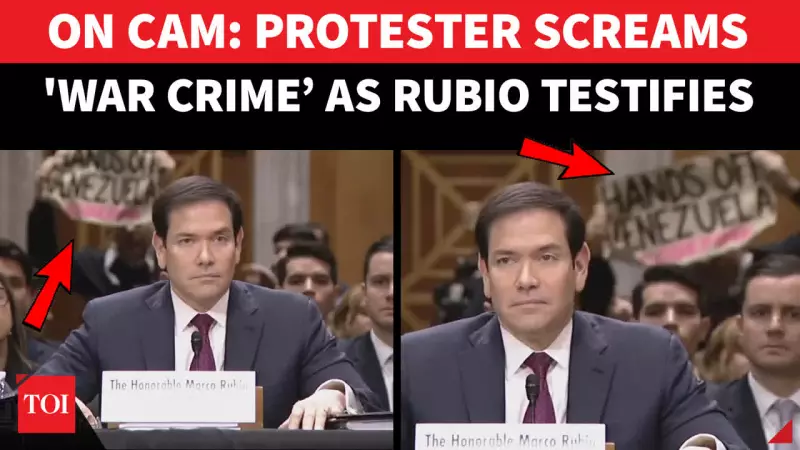
High Drama in US Senate as Rubio's Venezuela Testimony Faces Protest Interruption
A dramatic and tense moment unfolded on Capitol Hill this week when a crucial Senate hearing on United States foreign policy toward Venezuela was abruptly interrupted by a vocal protester. The incident occurred as U.S. Secretary of State Marco Rubio was testifying before the Senate Foreign Relations Committee, leading to a brief but intense disruption that highlighted the deep divisions over American military actions in Latin America.
Protester Shouts 'That's a War Crime!' During Key Testimony
During the Wednesday hearing, which focused on the Trump administration's controversial policies regarding Venezuela, a protester suddenly stood up and shouted loudly: "That's a war crime! Hands off Venezuela! Hands off Cuba!" The individual's passionate outburst directly challenged the official narrative being presented, creating a moment of high political theater in the normally staid Senate chamber.
The protester was quickly and efficiently removed from the hearing room by security personnel, but not before their message had been clearly delivered to everyone present, including Secretary Rubio and the assembled senators. This interruption came at a particularly sensitive moment in the testimony, as Rubio was defending the administration's military operation that successfully ousted Venezuelan President Nicolás Maduro on January 3 of this year.

Rubio Defends Controversial Military Operation and Presidential War Powers
Following the disruption, Secretary Rubio continued his testimony with renewed focus, strongly defending the Trump administration's decision to authorize military action against the Maduro regime. The Secretary of State argued that the operation was both necessary and justified, citing what he described as the Venezuelan government's human rights abuses and threats to regional stability.
Rubio went further in his testimony by arguing against any legislative attempts to limit presidential war powers, emphasizing the need for executive flexibility in responding to international crises. "The situation in Venezuela required decisive action," Rubio stated during the hearing, "and the administration's response has been both measured and effective in restoring democratic processes."
The Secretary of State's defense of the military operation comes amid ongoing international debate about the legality and morality of the United States' intervention in Venezuelan affairs. Critics have questioned whether the action violated international law, while supporters have praised it as a necessary step to address what they describe as a humanitarian crisis in the South American nation.
Broader Context of US-Venezuela Relations and Regional Implications
This Senate hearing and its dramatic interruption occur against a backdrop of heightened tensions between the United States and several Latin American nations. The protester's specific mention of both Venezuela and Cuba highlights how regional politics have become increasingly intertwined with U.S. foreign policy decisions.
The incident also underscores the domestic political divisions within the United States regarding military interventions abroad. While some lawmakers have praised the administration's actions in Venezuela, others have raised concerns about the precedent being set and the potential for mission creep in the region.
As the hearing concluded, questions remained about how this public confrontation might influence future policy discussions regarding Venezuela and broader American engagement in Latin America. The dramatic moment served as a vivid reminder that foreign policy decisions often provoke strong reactions both at home and abroad, with real consequences for international relations and domestic politics alike.






