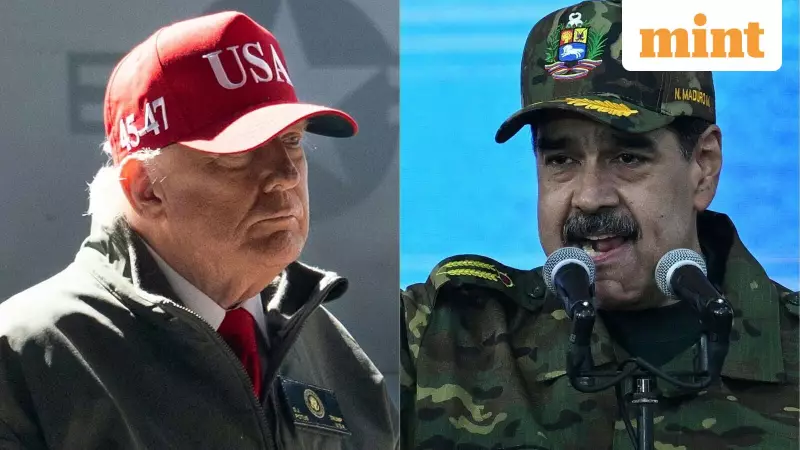
In an unprecedented escalation of tensions, the United States has taken Venezuelan President Nicolás Maduro into custody following a major military operation. US President Donald Trump announced the action, stating it was coordinated with American law enforcement agencies.
Operation and Arrest Details
President Nicolás Maduro and his wife, First Lady Cilia Flores, were reportedly flown to a New York air base and are now held at Brooklyn’s Metropolitan Detention Center. Both face serious charges related to drug trafficking and weapons offences. Trump publicly posted an image of a blindfolded Maduro aboard the USS Iwo Jima, symbolising the capture.
The dramatic events unfolded alongside reports of multiple explosions in Caracas in the early hours of Saturday, including near military installations. The operation marks a severe intensification of the long-standing conflict between Washington and the socialist government in Caracas.

Charges and Allegations
The legal basis for the action stems from a newly unsealed indictment filed in the Southern District of New York. Maduro, his wife, his son, and three other individuals are named. The charges against the Venezuelan president are severe and include:
- Conspiracy to commit narco-terrorism
- Conspiracy to import cocaine into the United States
- Possession of machine guns and destructive devices
- Conspiracy to possess machine guns and destructive devices
The indictment alleges that Maduro conspired with violent drug traffickers and narco-terrorist groups to flood the US with thousands of tonnes of cocaine. It claims that by 2020, up to 250 tons of cocaine were moved through Venezuela annually using boats, ships, and aircraft from covert airstrips. The document accuses the Venezuelan government of offering protection and logistical aid to cartels like the Sinaloa Cartel and the Tren de Aragua gang in exchange for proceeds.
Political Fallout and US Intentions
At a press conference at his Mar-a-Lago resort, President Trump declared that the US would now run Venezuela. “We will run the country until such time as we can do a safe, proper and judicious transition,” he stated. He signalled an intent to have major US oil companies return to rehabilitate Venezuela's crumbling oil infrastructure and did not rule out deploying troops, saying, “We’re not afraid to put boots on the ground.”
However, this move has sparked immediate controversy. Legal experts question the legality of capturing a foreign leader. US Senator Bernie Sanders criticised the action on social media platform X, stating, “President Trump does not have the constitutional authority to attack another country... he should focus on the crises at home, end his illegal military adventurism and stop trying to 'run' Venezuela for Big Oil.” Democrats have also demanded clarity, claiming they were misinformed during briefings.
Market and Geopolitical Implications
The strike has sent ripples through global commodity markets, though experts suggest the immediate impact on oil prices may be limited. Venezuela's current crude output is about 1 million barrels per day, roughly 1% of global supply. On Saturday, West Texas Crude slipped to $57.32 per barrel.
Market analysts like Sandeep Pandey of Basav Capital see the action as a move to protect the petrodollar system, which Venezuela challenged under former President Hugo Chávez. Trump's remarks about reclaiming oil rights nationalised years ago support this view. Anuj Gupta of Ya Wealth predicts the attack will trigger regional geopolitical tension, leading to a gap-up opening for gold, silver, copper, and crude oil when markets reopen. He expects Brent Crude to touch $62 to $65 per barrel.
The US has bolstered its Strategic Petroleum Reserve and increased domestic production, buffering against volatility. The long-term market impact will depend on political developments and whether US investment in Venezuela's oil sector is permitted, which could boost production over time.
The situation remains highly fluid. The Maduro administration retains power on the ground in Venezuela, showing little willingness to engage with Washington, making the practicalities of US control uncertain and setting the stage for further conflict.