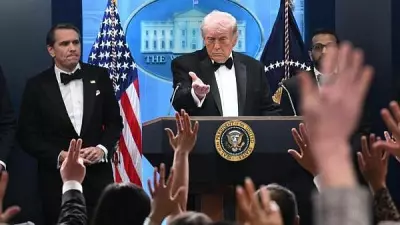
US Vice President JD Vance on Wednesday warned Iran of intensified military retaliation if it continues attacking commercial vessels in the Strait of Hormuz, stating that Washington would respond "harder than ever before" to safeguard freedom of navigation and global energy supplies.
Vance outlines 'simple deal' with Iran
Speaking about Iran's nuclear program and recent regional tensions, Vance said, "Their nuclear program was destroyed, their conventional military was destroyed." He described a basic agreement: the US would lift its blockade if Iran stopped shooting at ships. "But if you shoot at ships, we are going to punch back, and we're going to punch back harder than ever before. That was the deal!" Vance declared.
Vance alleged that Iran had resumed attacks on shipping despite agreeing to halt such actions. "They said they would stop shooting at ships, and what happened 24 hours ago? They started shooting at ships again! Now, they were good, they were well-behaved for about a week, but then they started shooting at ships," he said.

US maintains multiple options, says Vance
Vance stated that President Donald Trump has various options at his disposal but declined to disclose specifics of any potential future action. "The President maintains a lot of options. I'm obviously not going to tell you exactly what's going to happen tonight," he said. He emphasized that Washington's priority is ensuring the Strait of Hormuz remains open for global energy supplies, noting that this has contributed to falling gas and oil prices.
Warning Iran against attempts to block the strategic waterway, Vance added, "If they try to close it down, there's going to be a response from the American military. It's that simple! That's the deal!" He stressed that Iran must either comply or face continued strikes until the lane is opened and attacks on ships cease.
CENTCOM launches additional strikes
Meanwhile, US Central Command (CENTCOM) announced that its forces had initiated additional strikes against Iran to further degrade Tehran's ability to threaten freedom of navigation in the Strait of Hormuz. In a post on X, CENTCOM stated, "At the direction of the Commander in Chief, U.S. Central Command forces have started conducting additional strikes against Iran to further degrade their ability to threaten freedom of navigation in the Strait of Hormuz." The command added that the United States is holding Iran accountable for recent unjustified aggression against commercial shipping and civilian crews.
Power cuts and explosions reported in Iran
Following the announcement of fresh US strikes, Iran's southern port city of Chabahar experienced power cuts, according to CNN citing Iranian state media. Iran's state-run Islamic Republic News Agency (IRNA) reported that around 10 explosions were heard in Chabahar and nearby Konarak. Explosions were also reported in the Iranian city of Bushehr, home to the Bushehr Nuclear Power Plant, as well as on Abu Musa Island and near Tahrouyi village in Sirik, according to Al Jazeera.
Previous strikes hit over 80 targets
The latest strikes followed a US military operation on July 7, when CENTCOM said it had carried out offensive strikes against Iran, hitting more than 80 targets with precision munitions in response to alleged Iranian attacks on commercial vessels transiting the Strait of Hormuz. CENTCOM said the strikes targeted Iranian air defense systems, command-and-control networks, coastal radar sites, anti-ship missile capabilities, and more than 60 small boats operated by the Islamic Revolutionary Guard Corps (IRGC) in and around the Strait of Hormuz.
Washington alleged that Iran targeted three commercial vessels passing through the strategic waterway: the Marshall Islands-flagged M/T Al Rekayyat, Saudi Arabia-flagged M/T Wedyan, and Liberia-flagged M/T Cyprus Prosperity. Calling the alleged attacks a violation of the ceasefire agreement, CENTCOM stated, "The unwarranted aggression by Iranian forces is a clear and dangerous violation of the ceasefire and undermines freedom of navigation." CENTCOM forces remain postured and prepared to hold Iran accountable when the agreement is not adhered to or obeyed.