

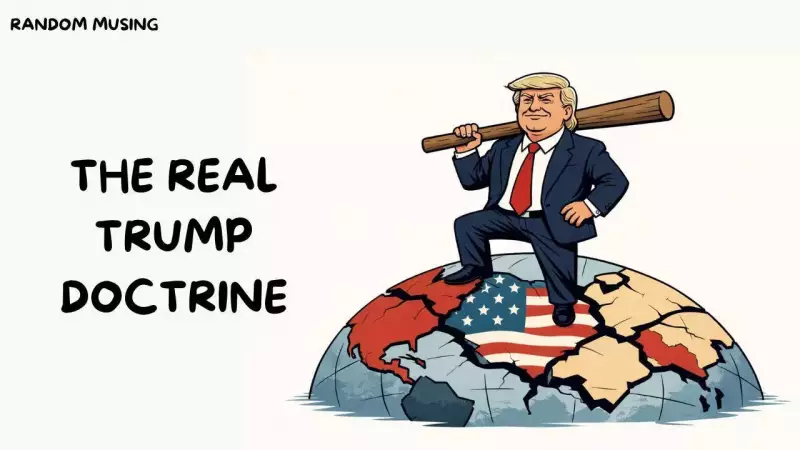
In the iconic film The Dark Knight, Alfred Pennyworth offers Bruce Wayne a chilling insight into the Joker's psyche. He describes a man who cannot be bought, bullied, or reasoned with—a man who simply "wants to watch the world burn." This description often feels eerily applicable to former US President Donald Trump. However, a closer look reveals a key difference: Trump's actions, however chaotic, are driven by identifiable motives like money, power, and a deep-seated desire for revenge. This complex blend of impulses forms the core of what analysts have struggled to define: the Trump Doctrine.
The Historical Legacy of American Doctrines
Since the era of James Monroe, every US president has sought to encapsulate their foreign policy vision in a defining phrase or doctrine. These doctrines have served as the philosophical justification for America's role on the global stage.
The Monroe Doctrine (1823) warned European powers against meddling in the Western Hemisphere. This was later expanded by The Roosevelt Corollary, which asserted America's right to intervene in the region to maintain stability. Taft's Dollar Diplomacy shifted focus to economic control through debt and banking.

In the 20th century, doctrines became tools for global strategy. The Truman Doctrine pledged to contain communism worldwide. The Eisenhower Doctrine focused on the Middle East, while the Kennedy-Johnson era practiced covert regime change. The Reagan Doctrine actively worked to roll back left-wing governments. The Bush Doctrine championed pre-emptive strikes, and The Obama Doctrine relied on drone warfare without ground troops.
The Three Pillars of the Trump Doctrine
Unlike his predecessors, Donald Trump made no pretence of being a force for moral good. He carried no colonial guilt and harboured no grand illusions about altruistically bettering the world. His doctrine, a stark departure from tradition, rests on three simple pillars.
1. Power Over Rules: The cornerstone of the Trump Doctrine is a fundamental rejection of the rules-based international order. For Trump, this concept is as meaningless as "a salad." His worldview is brutally straightforward: the nation with the biggest stick makes the rules. He views the globe as divided into spheres of influence—Xi Jinping has his, Vladimir Putin has his. As long as they stay within their lanes, they can do as they please, a vision reminiscent of the dystopian super-states in George Orwell's 1984.
2. The Art of the Deal: Every interaction is transactional. This pillar is best summed up by the iconic Akshay Kumar meme from Phir Hera Pheri: "Paisa laya?" (Did you bring the money?). Any country willing to cut a favourable deal is a friend. This explains Trump's simultaneous courting of nations as diverse as Israel, Saudi Arabia, and Pakistan. Loyalty is not to ideology, but to whatever arrangement improves his standing and, as he sees it, America's financial gain.
3. The Fuel of Revenge: Perhaps the most personal driver is vengeance. Drawing from a tradition that spans from Bollywood's Sardar Khan to Gladiator's Maximus, Trump cannot abide disrespect. When Barack Obama mocked him at the White House Correspondents' Dinner, Trump vowed retaliation, which he pursued by dismantling the liberal order Obama represented. The recent abduction of Venezuelan leader Nicolás Maduro, triggered by Maduro's mocking dance, is cited as a prime example. For Trump, an insult is a casus belli, and all mockers must eventually pay fealty.
A Doctrine Unvarnished
The Trump Doctrine is the unfiltered, geopolitical conclusion of America's historical pursuit of hegemony. While past presidents often cloaked their realpolitik in rhetoric about democracy and the greater good, Trump discarded the facade. His doctrine admits that international law has always been treated by US presidents with the disregard an alcoholic has for his liver. The difference is that Trump doesn't pretend otherwise.

In essence, the Trump Doctrine can be distilled into a single, crude mantra: We are America. We do what we want. It is a doctrine of raw power, transactional relationships, and personal grievance, leaving a distinct and disruptive mark on the history of American foreign policy.





