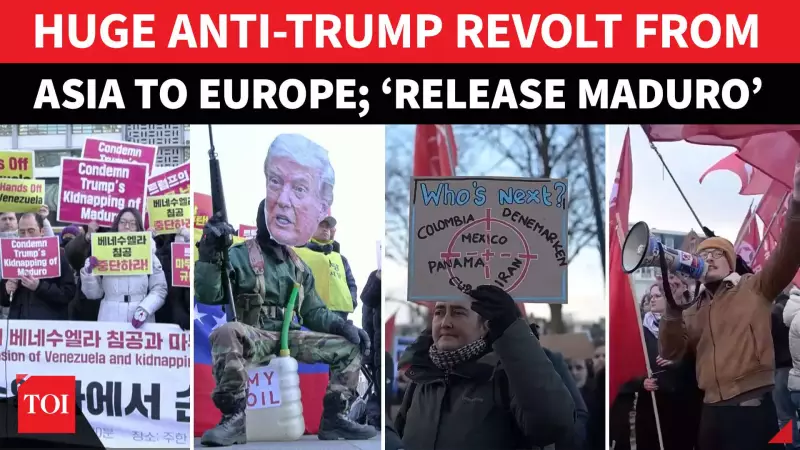
In a dramatic escalation of international tensions, widespread protests have broken out across the globe following the seizure of Venezuelan President Nicolás Maduro by United States forces. The operation, which occurred recently, has triggered a fierce wave of condemnation, uniting demonstrators from Asia to Europe and the Middle East in outrage.
Wave of Global Condemnation and Street Protests
The news of Maduro's capture acted as a spark, igniting immediate public demonstrations in numerous world capitals and major cities. Protesters took to the streets in diverse locations including Seoul, Amsterdam, New York, and Tehran. The unifying thread among the disparate crowds was a strong condemnation of the US action, which they labelled a blatant attack on national sovereignty and a violation of established international law.
Chants and placards reflected a deep-seated fear that this move by Washington sets an extremely dangerous precedent. The common sentiment echoed from these protests is a warning: this intervention could pave the way for future US military actions in other sovereign nations under similar pretexts. The visual of a sitting head of state being taken into foreign custody has resonated as a powerful symbol of overreach.

International Fallout and Diplomatic Tensions
As Nicolás Maduro is transferred to US custody, the repercussions extend far beyond street protests. Governments worldwide are now engaged in serious diplomatic questioning of Washington's growing reach and its willingness to execute cross-border military operations to achieve political ends. The act has stirred fundamental debates about the principles of state sovereignty in the 21st century.
Analysts and activists are voicing a mounting concern that Venezuela may not be the last country to face such direct action. This incident has amplified anxieties among nations that have historically had adversarial relations with the United States, with many now pondering if they could be next. The operation has effectively shifted the geopolitical landscape, introducing a new layer of uncertainty into international relations.
A Dangerous Precedent and an Uncertain Future
The global reaction underscores a significant erosion of international consensus. The operation, rather than isolating Venezuela, has in many ways isolated the United States diplomatically, drawing criticism from a broad spectrum of nations. The core accusation from protesters and several governments is that the US has a habit of acting unilaterally as a global policeman, disregarding multilateral frameworks.
The situation remains fluid and tense. Key questions now dominate global discourse:
- The legal basis and long-term plan for Maduro's detention.
- The potential for further destabilization within Venezuela and the wider Latin American region.
- The possibility of retaliatory measures from allied states opposed to the US action.
- The lasting impact this event will have on norms governing international conduct between nations.
This event, dated January 06, 2026, marks a pivotal moment, proving that actions in one hemisphere can instantly trigger a firestorm of protest and condemnation across multiple continents, challenging the very foundations of the current world order.