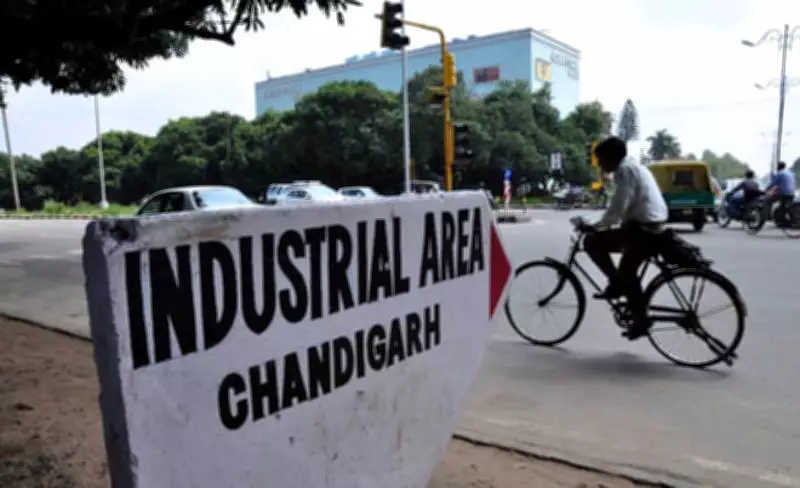
Industrialists in Chandigarh on Friday submitted their objections and suggestions on the proposed amendments to the Industrial Building Bylaws and Land Use Policy under the Chandigarh Master Plan (CMP)-2031. During a hearing before the screening committee constituted by the UT Administration, industry representatives welcomed the initiative to revisit and modernise the existing industrial policy framework but emphasised that any amendment must be practical, growth-oriented, and aligned with operational realities.
Key Demands on Floor Area Ratio (FAR)
Chander Verma, chairman of the Chandigarh Industrial Converted Plot Owners Association, objected to linking enhanced Floor Area Ratio (FAR) with concerns about additional pressure on civic infrastructure. He pointed out that no significant infrastructure improvements had taken place in the Industrial Area for several years, despite substantial revenue collected by the Administration through conversion charges, building permissions, and other levies.
Verma also demanded that converted industrial plots be granted an additional 0.50 FAR over and above the proposed limits. He explained that in converted plots, approximately 0.50 FAR is effectively consumed for essential services, utilities, circulation areas, and other mandatory requirements, leaving only 1.50 FAR for actual commercial activities. "Since plot owners have already paid conversion charges considering a permissible FAR of 2.00, restricting the usable commercial FAR to 1.50 would be unfair," he said.

Rationalisation of Charges and Competitiveness
Surinder Gupta, president of the Chamber of Chandigarh Industry, demanded that charges for additional FAR should be rationalised and kept on a par with neighbouring states of Haryana and Punjab to maintain the competitiveness of Chandigarh-based industries and businesses. He argued that higher charges would drive businesses away to other states.
Vertical Expansion and Simplified Procedures
Varinder Saluja, president of the Industry Association of Chandigarh, stressed that enhanced FAR should be allowed on existing industrial buildings. Making reconstruction a pre-condition for availing additional FAR would impose a huge financial burden on entrepreneurs and cause disruption to business operations. The associations urged the Administration to permit vertical expansion and regularisation through simplified procedures so that industrial units could utilise the enhanced FAR cost-effectively.
Practical Difficulties with Courtyards and Ground Coverage
Avi Bhasin, president of Laghu Udyog Bharti, highlighted practical difficulties caused by mandatory central courtyards, particularly during extreme weather conditions. Industrialist Arun Mahajan emphasised the need for allowing higher ground coverage in industrial buildings. He said industries involving heavy machinery, manufacturing processes, and storage operations could not practically shift major activities to upper floors. He also demanded that mixed land-use benefits available in Industrial Area Phase 3 be extended to Phases 1 and 2.
Uniform Policy Across Industrial Phases
The stakeholders argued that a uniform policy across all industrial phases would promote balanced development and remove existing disparities. The industrialists also demanded the immediate and unconditional withdrawal of all pending building violation and misuse notices.