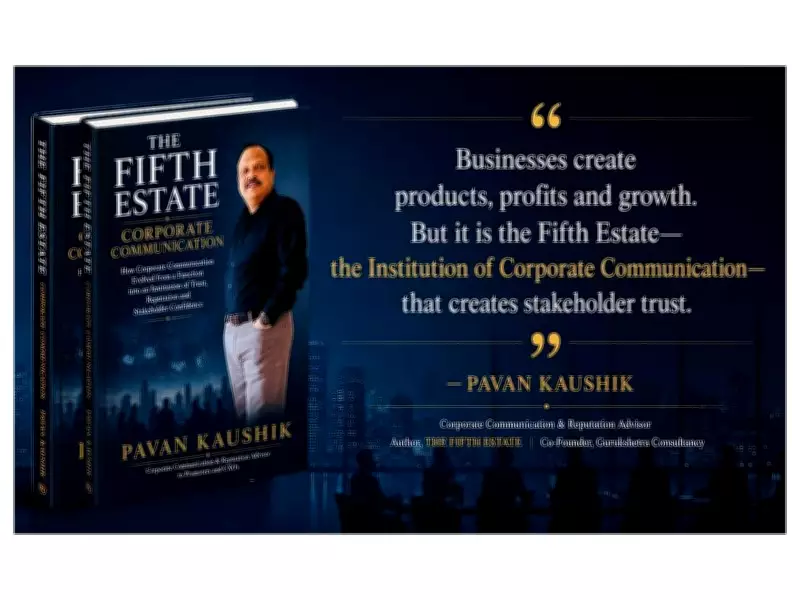
Corporate Communication & Reputation Advisor Pavan Kaushik has released his fourth book, The Fifth Estate, arguing that corporate communication has evolved into an institution that shapes organisational trust, credibility, and acceptance. The book serves as a boardroom guide for chairpersons, promoters, founders, CEOs, CXOs, and communication leaders.
Why Communication is Often Excluded from Strategy
Drawing on over 35 years of experience across mining, metals, energy, infrastructure, manufacturing, and sustainability sectors, the book examines where organisations go wrong on communication. It explores why communication is frequently excluded from strategic decision-making and how this oversight creates reputation, stakeholder, and business risks.
According to Kaushik, many organisations continue to underestimate communication despite operating in an era of heightened visibility, digital scrutiny, and growing stakeholder expectations. While businesses invest heavily in operations, finance, and technology, they often neglect the strategic value of communication until a crisis emerges.

The Fifth Estate Status: Earned, Not Granted
At the centre of the book is Kaushik's proposition that corporate communication deserves recognition as 'The Fifth Estate' due to its expanding influence on governance, stakeholder alignment, and organisational resilience.
"The Fifth Estate status of Corporate Communication has not been granted; it has been earned. More than 125 years of evolution, institutional relevance, stakeholder dependence and professional contribution have made Corporate Communication deserve recognition as an institution shaping trust, reputation and stakeholder confidence," said Pavan Kaushik.
The book argues that many promoters, founders, and CXOs continue to view communication as a support activity, even as reputation, trust, and stakeholder perception increasingly influence business outcomes.
Operational Excellence Alone is Not Enough
"Organisations are increasingly judged by what stakeholders understand, believe and trust about them. Operational excellence alone is no longer sufficient in an environment shaped by constant visibility, digital scrutiny and rising stakeholder expectations," Kaushik said.
The book examines leadership communication, crisis preparedness, stakeholder engagement, reputation management, community relations, and the growing importance of communication in governance and institutional credibility. It presents corporate communication as a strategic discipline that influences how organisations are understood, trusted, and accepted by stakeholders.
Relevance for Startups and SMEs
According to the author, the growing significance of corporate communication is no longer limited to large corporations but is increasingly relevant for startups, unicorns, MSMEs, SMEs, and rapidly scaling enterprises navigating complex stakeholder environments.
"Performance creates results. Communication creates understanding. Understanding creates trust. Trust ultimately determines whether organisations earn acceptance, credibility and long-term sustainability," said Pavan Kaushik.
Initiating a Boardroom Conversation
Through The Fifth Estate, Kaushik seeks to initiate a broader conversation among business leaders on why communication deserves a seat at the leadership table and why it should be viewed as a strategic leadership capability essential to modern organisational success.
The book argues that while businesses compete through products, technology, and capital, their long-term licence to operate increasingly depends on trust, understanding, and stakeholder confidence.
(ADVERTORIAL DISCLAIMER: The above press release has been provided by VMPL. ANI will not be responsible in any way for the content of the same.)