Dust: A Hidden Threat to Industrial Productivity and Health
Every day, lakhs of workers across India's mines, cement plants, and construction sites operate in environments where airborne dust is an accepted part of daily operations. But dust is more than an environmental concern—it is a productivity problem that degrades heavy machinery, a worker health issue driving absenteeism and liability, a compliance risk triggering costly shutdowns, an ESG deterrent for institutional capital, and a business continuity threat that undermines long-term licenses to operate.
The future of industrial growth in India will be defined not only by output but also by how responsibly industries manage what they release into the environment, according to Duztec, a company specializing in advanced dust control solutions.
India's Industrial Growth Story Has a Hidden Cost
As India moves toward its ambition of becoming a $5 trillion economy, much of that growth will be driven by large industries such as mining, infrastructure, heavy manufacturing, construction, and logistics. These sectors generate substantial fugitive dust emissions. For years, industrial performance was measured by output and speed, but regulators, environmental authorities, and communities now demand cleaner air and sustainable practices. The question is no longer whether dust control is necessary—it is how industries can implement effective dust management while maintaining productivity.

Duztec's Swedish-Engineered Solutions
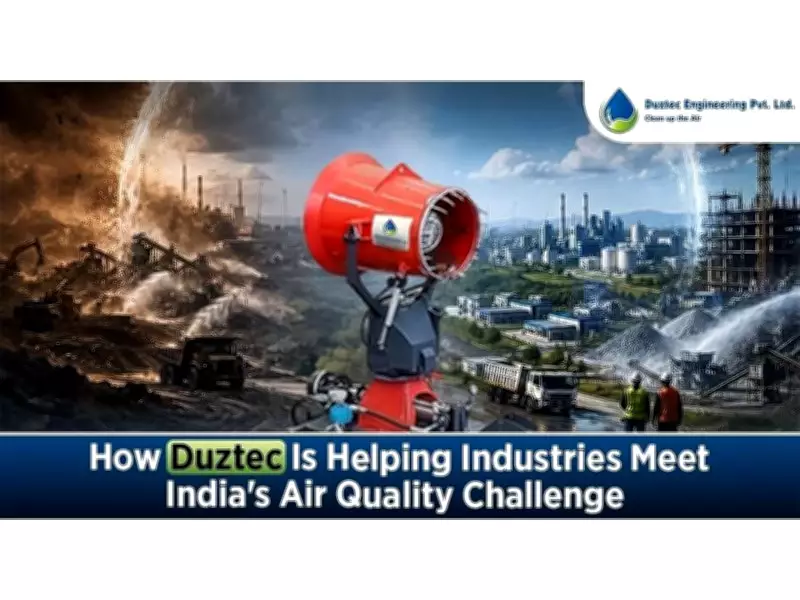
Duztec helps industries improve air quality through advanced dust control systems based on Swedish engineering principles. Its technologies include fog cannons, high-pressure dust suppression systems, mist beam systems, and fog curtain solutions. These control airborne dust at the source, improve worker safety, support environmental compliance, and enable more sustainable operations across mining, construction, cement, and manufacturing sectors.
The company emphasizes a shift from viewing dust as a compliance checkbox to a strategic priority. The new equation is: Dust = Compliance + Productivity + ESG + Reputation + Worker Safety. Forward-looking organizations are investing in smarter, efficient dust management that supports both operational performance and sustainability goals.
Why Swedish Engineering Sets the Global Benchmark
Sweden has built one of the world's most balanced industrial ecosystems, combining strong manufacturing and mining with high environmental standards. Its success stems from a practical engineering philosophy prioritizing efficiency, performance, and long-term sustainability. Four key principles guide this approach: precision (targeting particulates at the microscopic source), optimization (minimizing power and water consumption), sustainability (designing circularity and low environmental footprints), and long-term performance (engineering systems that withstand harsh industrial abuse).
As India's industrial sector expands and environmental expectations rise, this approach becomes increasingly relevant. The opportunity is no longer to choose between growth and sustainability—but to design operations that achieve both.
Duztec Builds India's Next-Generation Air Quality Infrastructure
Clean air is becoming a critical component of operational resilience, workforce well-being, and sustainable industrial growth. Duztec is helping Indian industries build cleaner, smarter operating environments through an integrated air quality management ecosystem. This ecosystem includes fog cannon dust suppression for vast open-cast areas, mist beam systems for localized high-precision distribution, high-pressure dust suppression at material transition points, fog curtain solutions around processing zones, and mobile dust control systems for dynamic sites.
The Hidden Cost of Dust
Many organizations underestimate the true business impact of airborne dust. The cost bleeds profitability through three vectors: increased equipment wear (abrasive particulates accelerate deterioration of bearings, conveyor belts, motors, and filters), reduced operational efficiency (dust disrupts automated handling, site visibility, and sensor performance), and workforce impact (poor air quality drives absenteeism, reduces productivity, and increases healthcare liabilities).

Modern dust control is moving from reactive manual activation to automated, intelligent systems. These integrate real-time environmental monitoring for PM2.5 and PM10, smart automation based on wind and humidity, AI-assisted controls to optimize water and power use, and predictive maintenance to prevent downtime. This paradigm shift moves industries from controlling dust to managing air quality scientifically.
The Cleanest Industries Will Become the Most Competitive
Competitive advantage is no longer built solely on output. The new formula is: Competitive Advantage = Productivity + Sustainability. Industries that manage environmental performance proactively will be better positioned to lead. They will strengthen operational resilience, attract global investment, adapt to changing regulations, retain skilled talent, and build stronger community relationships.
India's industrial growth story is still being written. Through Swedish-engineered innovation and advanced air pollution control solutions, Duztec is helping Indian industries align operational growth with environmental responsibility. As the company notes, the maturity of an industrial economy is measured not only by what it produces, but also by how responsibly it operates and the environmental legacy it leaves behind.
Disclaimer: The above press release has been provided by VMPL. ANI and The Tribune assume no responsibility for its content.