The Brussels sale of seven Chandigarh pieces for Rs 1.6 crore on June 18, coming barely a fortnight after a Chicago auction fetched over Rs 59 lakh for MLA Hostel furniture, is only the latest entry in a list that now runs into hundreds of items and decades of unchecked outflow.
What is being auctioned
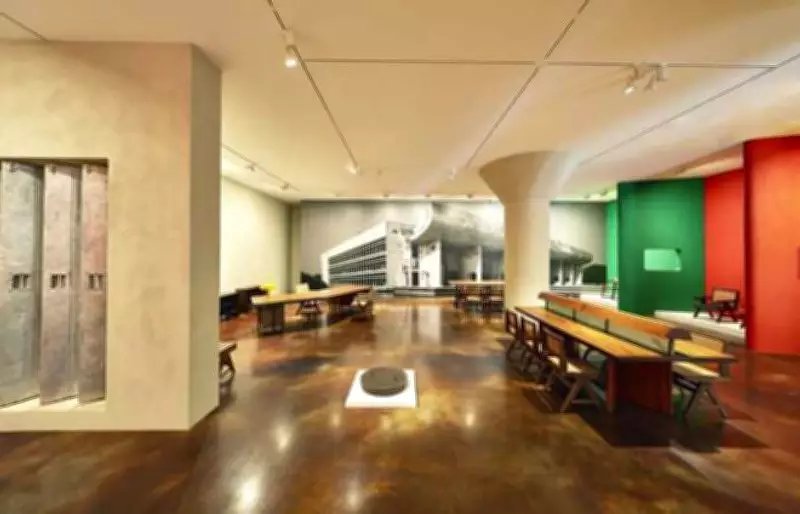
The furniture at the centre of these sales was never meant for a salesroom. As per a list compiled by the Chandigarh Heritage Inventory Committee in 2012, some 12,793 heritage items were identified across 190 categories — armchairs, lounge chairs, bookcases, coffee tables, teak stools, tapestries, murals and drawings — all designed by Le Corbusier and his team, including Jeanneret, in the 1950s and 60s. Large numbers of these pieces are still officially held by the Government Museum and Art Gallery in Sector 10, the Punjab and Haryana Civil Secretariat, the Vidhan Sabha, PGI, the Government Library, Punjab Engineering College and the Punjab and Haryana High Court. The pieces sold in Brussels this week were drawn from administrative buildings, Panjab University and the High Court, according to the auction catalogue itself.
Why it keeps happening
The simplest explanation lies in how this furniture came to be treated as junk in the first place. Jeanneret designed chairs, tables, stools and racks for government offices through the late 1950s, but the furniture was replaced in the late 1980s and early 1990s, and after being dumped in backyards or stores, most UT departments auctioned it off as scrap, unaware of its eventual international worth. That original act of disposal — treating priceless design as obsolete office furniture — is what put thousands of pieces into private hands long before anyone in Chandigarh understood their value.

By the time the world caught on, the city had no real legal lever to pull it back. The Archaeological Survey of India has stated in writing, on more than one occasion, that Chandigarh’s heritage furniture does not come under the definition of “antiquity” or “art treasure” as described in the Antiquities and Art Treasures Act, 1972, and that the ASI therefore has no scope to act. When Ajay Jagga of the Heritage Items Protection Cell sought intervention ahead of a December 2021 Paris auction, the ASI’s response was identical: the objects did not meet the statutory definition, so it could take no action. Without that legal classification, India has no domestic statute that automatically bars these items from being sold or shipped out, no matter how clearly their government provenance is stamped on them.
There is, on paper, an executive order that should have stopped this years ago. The Ministry of Home Affairs banned the export of Chandigarh heritage furniture through an order dated February 22, 2011. Yet that ban has had little practical effect abroad, since once an item leaves Indian soil — whether sold decades ago as scrap, smuggled out, or passed through several private collections — foreign auction houses see it simply as legally acquired property with a documented, even prized, provenance. The institutional markings that prove an item came from Chandigarh end up working against India: they raise the resale value rather than triggering its return.

Scale of loss
This is not an occasional embarrassment but a sustained pattern. According to the UT Heritage Protection Cell, items have gone under the hammer in at least 100 open auctions since 2009, fetching an estimated Rs 40 to Rs 50 crore in total, across buyer markets including France, England, Switzerland, Italy, Spain and Germany, with US and UK sales picking up in recent years. Individual sales have repeatedly made headlines: 15 items fetched Rs 3.34 crore in Paris in October 2021, including a pair of chairs that sold for Rs 78.22 lakh, the costliest Chandigarh pair sold till then, while a Panjab University library table fetched a staggering Rs 1.92 crore in Tel Aviv in 2018. A single France auction in October once realised Rs 3.81 crore for 20 artefacts, with one table alone selling for Rs 70.10 lakh, while in April 2024, seven items sold for about Rs 69.18 lakh in Chicago, and Sworders in the UK sold a Jeanneret collection for over £192,000 in July 2025. Even the relatively “small” sales add up: a single pair of chairs fetched Rs 8.13 lakh in New Zealand, and as recently as June 4 this year, seven items from the MLA Hostel fetched Rs 1.16 crore in the US, with a pair of lounge chairs alone going for Rs 37.40 lakh.
Who is involved
On the Indian side, the running thread across nearly every reported case for over a decade has been Ajay Jagga, a Chandigarh-based advocate and member of the UT’s Heritage Items Protection Cell, who tracks listings on international auction platforms and writes to the Ministry of External Affairs, the Ministry of Culture and, at times, foreign missions and ministries, ahead of each sale. He has also taken the legal route, filing a PIL in the Punjab and Haryana High Court for preservation of Chandigarh’s heritage property in its original form, on which the High Court issued notice to the Chandigarh Administration. On the institutional side, the Chandigarh Administration’s Heritage Items Protection Cell holds the inventory and custodial responsibility, while custody of specific items is often shared jointly between the Punjab, Haryana and UT governments, depending on which department originally held the furniture — a structure that complicates accountability whenever a piece goes missing or turns up abroad. Internationally, leading design auction houses — PIASA (Paris/Brussels), Wright (Chicago), Sworders and Cheffins (UK), among others — have built a recognised, lucrative Chandigarh furniture category that draws serious collectors, including, by some accounts, celebrity buyers.
Why it matters to residents
For lakhs of Chandigarh residents, this is not an abstract auction-house story. The furniture is woven into the city’s founding identity — the same modernist vision, by the same architects, that gave Chandigarh its grid, its Capitol Complex and its UNESCO World Heritage tag for the Capitol Complex buildings. Every chair or table that disappears into a private European or American collection is a literal, physical piece of that founding story leaving the city for good, often for a fraction of what it eventually fetches once resold by dealers. The emotional charge is compounded by the original injustice: items that the city itself once discarded as junk are now generating tens of crores for intermediaries abroad, while Chandigarh gets nothing — neither the money nor the furniture back.
What needs to be done, what next
Civil society demands, repeated across years of representations and reinforced in a recent Open House debate, have consistently centred on a few concrete asks: declaring all heritage items under the Art Treasures Act, which would ban their sale or export and expose violators to six months to three years of imprisonment; registering the original designs under intellectual property law to choke off the parallel trade in replicas and fakes; and using technology — QR-coded registries, tamper-evident CCTV, and public reporting mechanisms — to track items still inside government buildings. On the international recovery side, the two legal instruments most commonly invoked are the 1970 UNESCO Convention on the Means of Prohibiting and Preventing the Illicit Import, Export and Transfer of Ownership of Cultural Property, and the 1995 UNIDROIT Convention on Stolen or Illegally Exported Cultural Objects — both of which require active diplomatic engagement by India’s missions abroad to be of any use, engagement that has so far been inconsistent at best.
In his latest representation following the Brussels sale, Jagga has renewed three specific demands: an inquiry into the provenance and chain of custody of the items already sold, a standing mechanism for Indian missions abroad to object to future auctions as they are listed, and formal classification of Chandigarh’s surviving Jeanneret and Le Corbusier furniture as Art Treasure under the 1972 Act — the same demand that the ASI has rejected at least twice before. Whether this round of representations finally moves the needle, or simply joins the same paper trail as the ones before it, depends on whether the Ministries of External Affairs and Culture choose to revisit the ASI’s earlier position, and whether the Chandigarh Administration finally operationalises the dedicated storage and inventory mechanism it gave in-principle approval to years ago but which, as this week’s sale shows, has yet to stop a single scheduled auction.