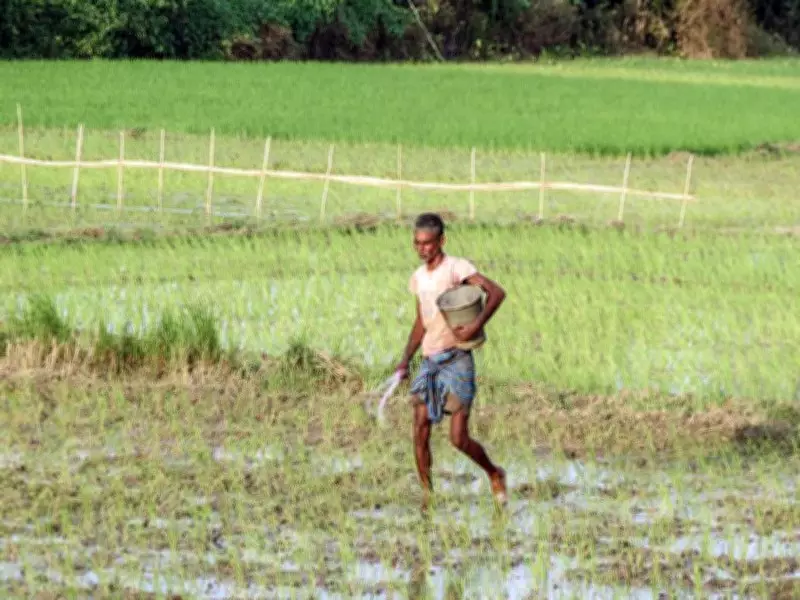
Approximately 52% of India remains rainfall-deficient despite a recent sequential improvement in monsoon coverage, according to a Dolat Capital report. The agricultural backdrop continues to face a sizable seasonal rainfall deficit, acute moisture stress in Central India, and limited reservoir replenishment.
Kharif Sowing Lags Significantly
Total kharif sowing stands at 350.9 lakh hectares, reflecting a meaningful lag of 92.0 lakh hectares compared to the early monsoon onset of the previous year. Against the five-year normal, the seasonal shortfall is considerably narrower at 22.5 lakh hectares. Pulses and coarse cereals are already above normal, while the deficit remains concentrated in oilseeds, cotton, and rice.
The report stated, "The current acreage position still points to a meaningful lag, with total kharif sowing 92.0 lakh ha below last year, although last year's early monsoon onset creates an adverse base for YoY comparison."

Rainfall Deficit and Regional Impact
All-India cumulative seasonal rainfall is 38% below normal due to dry conditions throughout June. Central India carries the sharpest seasonal deficit at 45%, followed closely by East and Northeast India at 40% below normal levels. The report noted, "The divergence between improving weekly rainfall and still-large seasonal deficits suggests that while the monsoon is gaining traction, cumulative soil-moisture conditions remain weak across several key cropping belts."
Crop-Specific Acreage Details
Rice acreage is at 60.2 lakh hectares, staying 6.3 lakh hectares below the five-year normal because subdued rainfall across eastern paddy belts limits transplanting activity. Oilseeds acreage is 17.2 lakh hectares below normal at 66.3 lakh hectares, while cotton sowing stays 12.9 lakh hectares below normal at 63.2 lakh hectares. Conversely, coarse cereals and pulses show expansion, standing at 60.1 lakh hectares and 37.2 lakh hectares respectively.
Water Storage and Future Outlook
Water availability mirrors the rainfall crunch, as all-India live storage capacities drop marginally to 26.0%. Eastern India experiences the worst water stress, with reservoirs functioning at just 19.4% capacity, representing a 23.4% deficit compared to normal volumes. Looking forward, the report noted, "The southward shift of the monsoon trough towards its normal position, alongside an emerging Bay of Bengal low-pressure system, is expected to drive heavier rainfall across Central India and Maharashtra. If sustained, this should accelerate inflows into key reservoirs and support a more visible recovery in storage levels through mid-July."