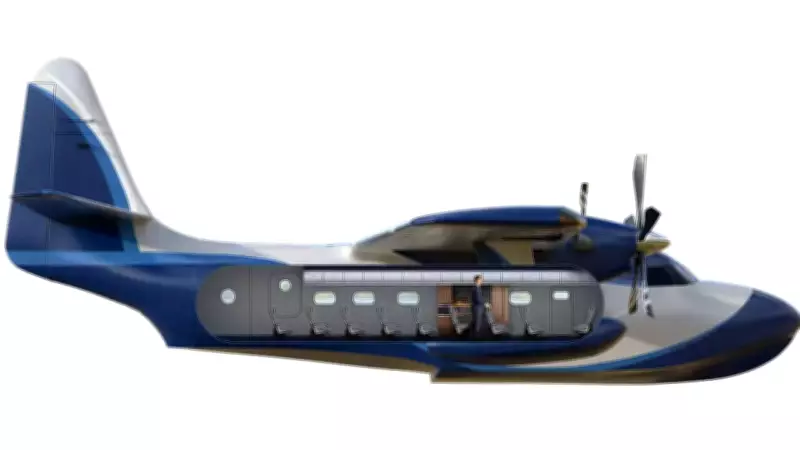
NEW DELHI: India's strategic push to enhance island connectivity through seaplanes is now drawing significant international attention, with major global players in amphibious aviation setting their sights on the Indian market. In a landmark development, Amphibian Aerospace Industries (AAI), a globally recognized FAA-certified aerospace original equipment manufacturer specializing in amphibious aircraft for both military and civilian applications worldwide, has forged a pivotal partnership with an Indian company through its subsidiary.
Introducing the Albatross 2.0 to Indian Skies
This collaboration aims to introduce the Albatross 2.0 to India—a transport-category amphibious aircraft certified by either the FAA or EASA, capable of accommodating more than 19 seats within the registered passenger transport sector. The first demonstration aircraft is anticipated to arrive in India within the next six months, marking a significant milestone in this venture.
Establishing Local Manufacturing and Assembly
AAI, operating as a subsidiary of Amphibian Aircraft Holdings (AAH), has entered into a comprehensive collaboration with Apogee Aerospace Pvt Ltd. This partnership is designed to position amphibious aviation as a strategically vital capability for India. Under this agreement, Apogee Aerospace has been appointed as AAI's exclusive authorized representative partner for the Indian subcontinent.

The scope of this partnership extends across multiple critical areas, including maintenance, repair, and overhaul services, comprehensive training and capability development programs, advanced simulation technologies, and end-to-end systems integration specifically for the militarization of the aircraft. Furthermore, the collaboration includes plans to establish aircraft tail-section manufacturing facilities in India, which will contribute to strengthening the global supply chain.
Leadership Perspectives on the Collaboration
In a joint statement, Khoa Hoang, Executive Chairman, and Gopi Reddy, President & CEO of Amphibian Aerospace Industries, expressed their enthusiasm for this initiative. They stated, "India is uniquely positioned to lead the next chapter of amphibious aviation, and this collaboration is a decisive step in that direction. With Albatross 2.0, we are bringing fully certified transport-category capability that can immediately serve India's military and paramilitary forces, government agencies, and strategic civil aviation needs."
They further emphasized, "Partnering with Apogee Aerospace allows us to go far beyond aircraft delivery, focusing on deep industrialization, systems integration, skills development, and long-term sovereign capability. Through this partnership, our focus is on deep industrial integration, indigenous capability development, and establishing India as a center for amphibious aviation operations, sustainment, and future growth."
Strategic Investments and Orders
Wing Commander MVN Sai (retd), CMD of Apogee Aerospace, highlighted the transformative potential of the Albatross platform. He remarked, "Albatross fundamentally redefines the point of launch and recovery of air power. The versatility of the platform enables operations across dimensions and verticals that previously required a combination of platforms to accomplish."
As part of this strategic collaboration, Apogee Aerospace has placed a substantial order for 15 Albatross 2.0 aircraft, valued at approximately Rs 3,500 crore. Additionally, Apogee will invest up to Rs 500 crore to establish tail-section manufacturing, maintenance and overhaul facilities, training and simulation infrastructure, and advanced systems integration capabilities within India.
These system integration facilities will play a crucial role in supporting the development and delivery of indigenized military variants of the Albatross platform for the Indian Armed Forces. In a further move to solidify this partnership, Apogee Aerospace has invested Rs 65 crore into Amphibian Aircraft Holdings, reinforcing long-term strategic alignment and a shared commitment to execution between the two organizations.