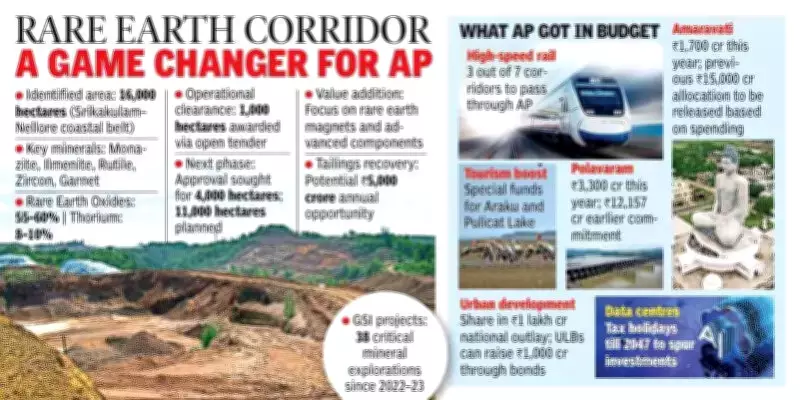
In a significant development that could reshape the industrial landscape of Andhra Pradesh, the state is on track to emerge as a premier hub for rare earth and critical minerals exploration. This transformation follows the Union government's strategic decision to establish dedicated mineral corridors, backed by robust policy frameworks and substantial financial support from the Centre.
Strategic Coastal Corridor for Mineral Exploration
The initiative gains momentum as Andhra Pradesh has already identified nearly 16,000 hectares along a coastal corridor stretching from Srikakulam to Nellore for critical mineral exploration. Officials have highlighted the region's abundant deposits of heavy mineral sands, which contain valuable resources such as Monazite, Ilmenite, Rutile, Zircon, and Garnet. These minerals are rich in Rare Earth Oxides, with concentrations ranging from 55 to 60 percent, and Thorium, comprising 8 to 10 percent. These elements are crucial inputs for advanced technologies across various sectors.
Operational Progress and Future Plans
Operationally, the state has moved beyond the planning phase, with clearances already granted for 1,000 hectares to a private player through an open tender process. This marks the initial phase of commercial exploration. According to Mukesh Kumar Meena, Principal Secretary for revenue, mines, and geology, the state government is now seeking Central approval to open an additional 4,000 hectares. Plans are also being drawn up to fast-track operations across the remaining 11,000 hectares in a phased manner once necessary clearances are received.

Focus on Value Addition and Downstream Processing
A key element of Andhra Pradesh's strategy is to emphasize value addition within the state. Rather than limiting activities to mining and raw ore exports, the focus is on developing domestic downstream processing capabilities. This includes the manufacture of high-value components such as rare earth magnets, which are critical for clean energy technologies, electric vehicles, wind turbines, electronics, and defence applications.
Environmental and Economic Opportunities
The state is also exploring the reprocessing of tailings and fly ash to recover rare earth elements. Preliminary assessments suggest this approach could unlock an economic opportunity of nearly ₹5,000 crore annually, while simultaneously addressing environmental concerns associated with legacy waste. This dual benefit aligns with sustainable development goals.
Support from Geological Survey of India
Complementing these efforts, the Geological Survey of India (GSI) has undertaken 38 mineral exploration projects in Andhra Pradesh since 2022–23. These projects cover graphite, lithium, and cobalt across multiple districts, aiming to strengthen the state's resource base and support future mining and manufacturing initiatives.
Industry Response to Union Budget Measures
Industry experts have welcomed the enabling measures introduced in the Union Budget, including customs duty exemptions on capital goods for critical mineral processing and extended tax benefits for exploration activities. These reforms are expected to improve project viability and accelerate execution. Dr. Hanuma Prasad Modali, Managing Director and CEO of Deccan Gold Mines Ltd, noted that the budget marks a decisive shift towards building a self-reliant mineral ecosystem. He emphasized that the focus on strategic manufacturing and critical minerals significantly enhances project economics and shortens the journey from discovery to production.
Positioning for National Ambitions
With its extensive coastline, robust port connectivity, and expanding industrial corridors, Andhra Pradesh is well-positioned to anchor India's Atmanirbhar Bharat ambitions in critical minerals. The state aims to achieve this through responsible, technology-driven, and sustainable mining practices, contributing to national mineral security and unlocking large-scale industrial and employment opportunities.