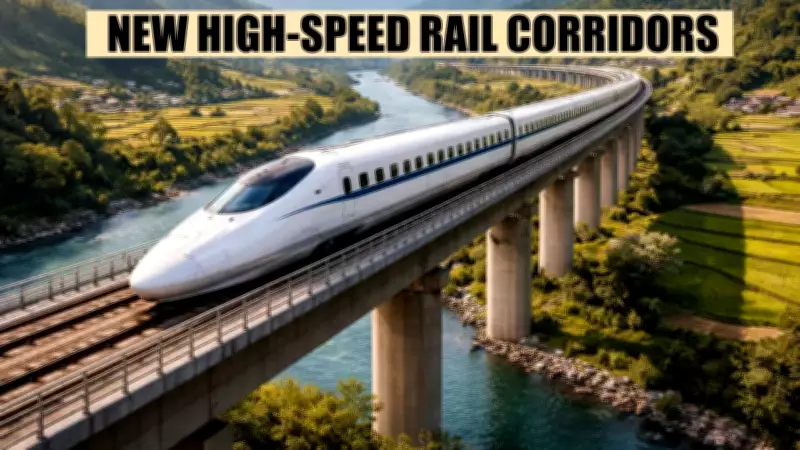
India's High-Speed Rail Revolution: 7 New Bullet Train Corridors Announced
The Union Budget 2026 has unveiled a transformative infrastructure plan with the announcement of seven new high-speed rail corridors, commonly known as bullet train routes. This ambitious initiative represents a monumental leap in India's transportation network, with a projected investment exceeding Rs 16 lakh crore and a total span of over 4,000 kilometers across the country.
What Defines High-Speed Rail?
High-speed rail systems operate on dedicated corridors with trains capable of reaching speeds greater than 250 kilometers per hour. These advanced networks are designed to connect vital economic centers, dramatically reducing travel times while enhancing connectivity between major cities.
The Seven New Bullet Train Corridors
Here are the detailed routes and projected travel times for India's new high-speed rail corridors:

Delhi-Varanasi Corridor
The Delhi-Varanasi high-speed rail corridor will revolutionize travel between these two culturally significant cities. The bullet train is expected to complete the journey in just 3 hours and 50 minutes, which is less than half the time taken by the current fastest train, the Vande Bharat Express, which requires approximately 8 hours.
Varanasi-Siliguri Corridor
This corridor will connect Varanasi to Siliguri via Patna, with an estimated travel time of 2 hours and 55 minutes. When combined with the Delhi-Varanasi route, this extension will create a seamless high-speed connection between Delhi and Siliguri, drastically shortening travel duration across northern and eastern India.
Chennai-Bengaluru Corridor
The Chennai-Bengaluru high-speed rail corridor will link two of South India's most important metropolitan centers. While specific travel time details require further clarification, this route promises significant time savings compared to current train services.
Bengaluru-Hyderabad Corridor
Connecting two major technology hubs, the Bengaluru-Hyderabad bullet train corridor is projected to reduce travel time to approximately 2 hours. This represents a substantial improvement over existing rail options, including the Vande Bharat Express currently operating between these cities.
Chennai-Hyderabad Corridor
Indian Railways estimates that the Chennai-Hyderabad high-speed rail corridor will bring travel time down to around 2 hours and 55 minutes. This marks a significant reduction from current train travel durations, enhancing connectivity between these important southern cities.
Mumbai-Pune Corridor
The Mumbai-Pune bullet train corridor will transform commuting between these two Maharashtra powerhouses. The projected travel time is an astonishing 48 minutes, making daily travel between the cities more feasible than ever before.
Pune-Hyderabad Corridor
This corridor will connect Pune to Hyderabad in just 1 hour and 55 minutes. When integrated with the Mumbai-Pune route, it will effectively bring Mumbai and Hyderabad closer together, creating a high-speed triangle between these three important economic centers.
India's First Bullet Train: Mumbai-Ahmedabad Corridor
While these seven new corridors represent future expansion, India's first high-speed rail project between Mumbai and Ahmedabad is already under construction. Once operational, this dedicated corridor will allow passengers to travel between the two cities in just 2 hours and 7 minutes, with trains expected to reach speeds of 320 kilometers per hour.
Economic and Transportation Impact
The implementation of these seven high-speed rail corridors represents one of India's most significant infrastructure investments in recent history. Beyond the immediate travel time benefits, these projects are expected to:

- Boost regional economic development
- Create substantial employment opportunities
- Reduce pressure on existing transportation networks
- Promote sustainable travel alternatives
- Enhance India's global infrastructure standing
The announcement of these seven new high-speed rail corridors marks a pivotal moment in India's transportation evolution. As these projects progress from planning to implementation, they promise to redefine inter-city travel while contributing significantly to the nation's economic growth and development.