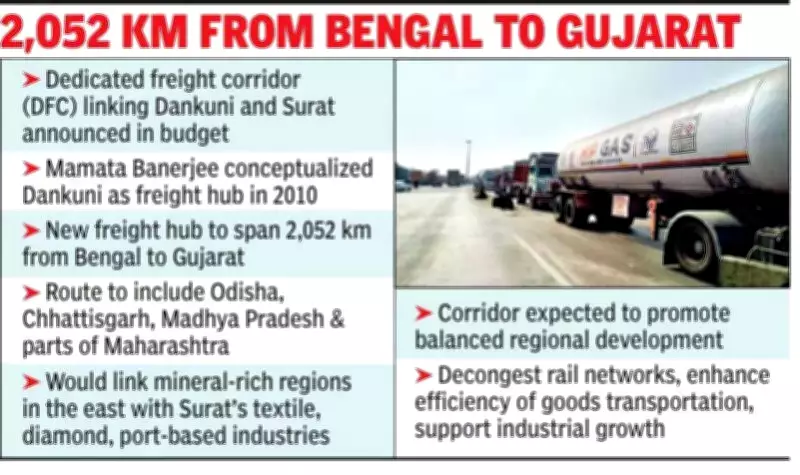
In a significant infrastructure announcement during her 2026-27 budget speech, Union Finance Minister Nirmala Sitharaman revealed plans for a new dedicated freight corridor (DFC) linking Dankuni in West Bengal to Surat in Gujarat. The announcement, made on Sunday, outlines a major railway project aimed at enhancing cargo movement across eastern and western India.
Details of the Proposed Freight Corridor
Railway Minister Ashwini Vaishnaw provided further details later in the day, stating that the corridor will span approximately 2,052 kilometers. It will traverse through Bengal, Odisha, Chhattisgarh, Madhya Pradesh, and parts of Maharashtra and Gujarat. This new DFC is expected to build upon the success of the existing Eastern Dedicated Freight Corridor (EDFC) and Western Dedicated Freight Corridor.
"To promote environmentally sustainable movement of cargo, I propose to establish new dedicated freight corridors connecting Dankuni in the east to Surat in the west," Sitharaman said during her 83-minute budget presentation.

Historical Context and Political Reactions
Interestingly, the concept of developing Dankuni as a freight hub was originally conceptualized by West Bengal Chief Minister Mamata Banerjee. Back in 2010, she launched the EDFC, which connects Ludhiana in Punjab to Dankuni, covering about 1,856 kilometers across multiple states including Punjab, Haryana, Uttar Pradesh, Bihar, Jharkhand, and Bengal.
However, Banerjee has been critical of the central government's budget, labeling it as having "nothing for the common man" and referring to it as a "Humpty Dumpty" budget for Bengal. Despite this, the new corridor announcement has drawn attention to her earlier vision for Dankuni's logistical importance.
Operational and Administrative Aspects
While the existing EDFC falls under the jurisdiction of Eastern Railway, the proposed Dankuni-Surat DFC would be managed by South-Eastern Railway. A South-Eastern Railway official mentioned that they are awaiting detailed maps and specific project information following the announcement.
The corridor aims to segregate freight traffic, allowing for high-speed operations at up to 100 kilometers per hour and supporting heavy-haul loads with a 32.5-ton axle capacity. This design is intended to facilitate faster and more efficient movement of key commodities such as coal, steel, and food grains.
Economic and Logistical Implications
Industry leaders and railway officials have welcomed the announcement, highlighting its potential to address long-standing challenges like the "flight of capital" from certain regions. The corridor is poised to significantly reduce both the cost and time required for transporting goods between Gujarat's textile hubs and eastern markets.
"With the slashing of the cost and the time of moving goods between the textile hubs of Gujarat and the east, Dankuni is most likely to become a logistical powerhouse," an official remarked. The project aligns with the government's broader vision of a Viksit Bharat (Developed India), emphasizing eco-friendly and efficient cargo transportation.
By creating a vital logistics link between western ports and manufacturing centers and eastern industrial hubs, the corridor is expected to boost economic activities across the involved states, fostering regional development and enhancing India's freight infrastructure.