

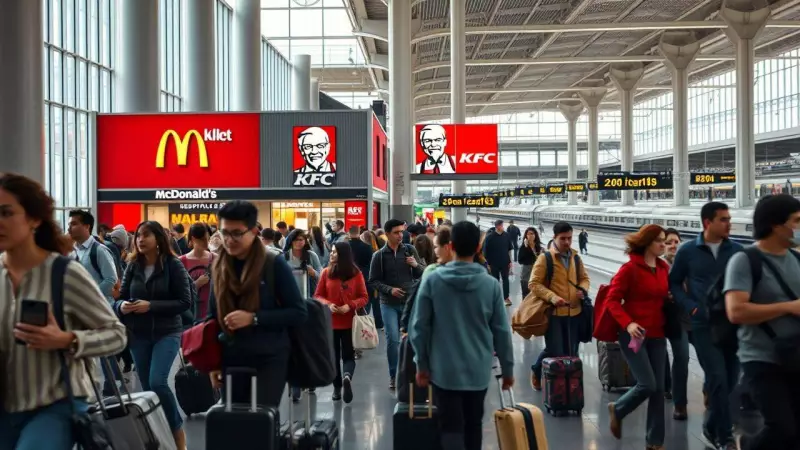
Get ready for a major upgrade to your train travel experience. Leading global and Indian quick-service restaurant (QSR) chains are set to bring your favourite meals directly to railway platforms across the country. In a significant policy shift, Indian Railways has opened its doors to established premium food and beverage brands, aiming to transform passenger amenities at stations.
Policy Shift Unlocks Massive Opportunity
Last month, the national transporter amended its Catering Policy of 2017, formally allowing premium brands to set up shop at stations. According to officials and industry executives cited in reports, major chains including McDonald's, KFC, Haldiram's, Wow Momo, and Baskin Robbins have already begun approaching the railways to understand the operational guidelines. The government has announced that these brands will be allotted five-year licences through e-auctions, applicable at over 7,000 railway stations nationwide.
The first of these premium food outlets are expected to become operational in 2026. A senior railway official stated the clear objective: “We want to bring the passenger experience at railway stations at par with airports.” Brands will have the flexibility to operate either company-owned stores or franchise models, but they will be required to maintain high standards of food quality and service while paying a fixed licence fee for the station space.

Railways: The Next Big QSR Growth Engine
Industry leaders believe the sales potential at bustling railway stations could eventually surpass that of airports, driven by sheer passenger volume. Sagar Daryani, President of the National Restaurants Association of India (NRAI) and co-founder of Wow! Momo, highlighted the volume-led opportunity. He noted that while airports may see higher average bills, railway stations offer unmatched scale.
“With the right model, railway outlets can generate very strong returns on investment, driven by volume-led sales, faster turnaround time, and hopefully lower entry costs,” Daryani explained. He predicts that as operational frameworks mature, railways will become a major growth engine for organised food brands.
Echoing this optimism, a spokesperson for Haldiram’s called the policy a game-changer: “This policy unlocks massive potential for the industry... if done right, this is going to be the next big QSR business opportunity as people of all ages and socio-economic groups travel via trains.” The company acknowledged that some details need finalisation and that they are working with the government on them.
Boosting Non-Fare Revenue for Railways
This initiative is a key part of Indian Railways' strategy to significantly increase its non-fare revenue. Currently, such revenue contributes only about 3% of its total income, a figure that lags far behind developed countries where it can account for around 30%. In FY24, Indian Railways reported non-fare revenue of Rs 588.07 crore, which grew to Rs 686.9 crore in FY25.
A Niti Aayog assessment has previously pointed to this significant untapped potential. The influx of premium brands paying licence fees is expected to provide a steady stream of income, aiding the railways' modernization and infrastructure efforts. Zonal railways have also been empowered to frame special conditions to ensure the commercial feasibility of these outlets while safeguarding passenger interests.
Industry executives anticipate demand patterns similar to those seen at airports, where beverages—including soft drinks, coffee, juices, and alcohol—dominate food and beverage sales, accounting for roughly 70% of revenue. The move to bring premium dining to stations marks a pivotal step in modernizing India's vast railway network, promising better choices for millions of daily passengers and a fresh frontier for the country's vibrant food service industry.






