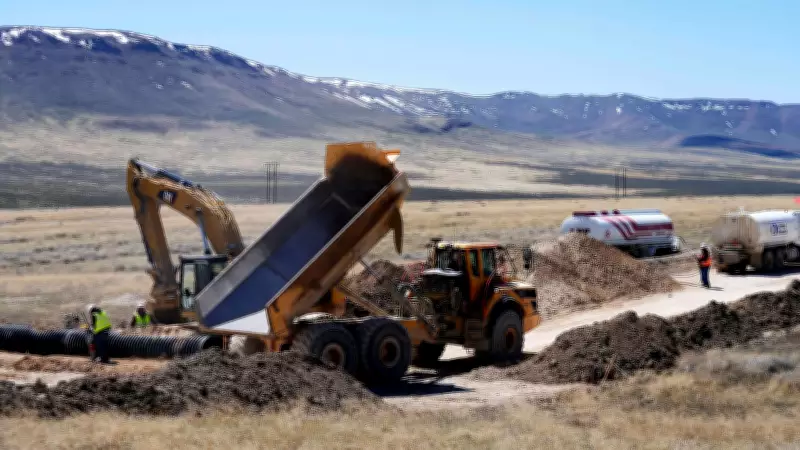
Nevada-Oregon Supervolcano Holds Trillion-Dollar Lithium Treasure
Geologists are focusing renewed attention on a vast high desert region in northern Nevada and southern Oregon, where an ancient supervolcano conceals what may be one of the planet's most significant lithium deposits. Beneath the McDermitt caldera, formed approximately 16.4 million years ago, researchers have identified extensive lithium mineralization within clay-rich sediments, with recent studies suggesting it could rank among the largest lithium clay deposits globally.
Massive Resource Estimates Revealed
At the Thacker Pass site alone, measured and inferred resources are estimated at a staggering 533 million tonnes of ore, grading about 0.29 percent lithium. This equates to more than 1.5 million tonnes of contained lithium. Broader geological assessments indicate the wider caldera may hold far greater quantities, potentially placing the in situ value in the trillion-dollar range under current market assumptions. Exploration drilling by multiple companies has identified lithium mineralization across roughly three-quarters of the basin, with government mineral resource assessments assigning similar potential throughout much of the remaining sedimentary sequence.
Geological Formation and Composition
The lithium is hosted in tuffaceous sediments that filled the caldera after its collapse. These sediments, largely derived from volcanic glass, accumulated in a closed basin environment and underwent chemical alteration through a process known as closed hydrologic system diagenesis. In the southern and western parts of the basin, entire sedimentary sections contain more than 1500 parts per million lithium. The most lithium-rich zone, found in lower sedimentary layers, averages around 3000 ppm and is dominated by claystone. Researchers have identified lithium mainly within illitic clay minerals, chemically similar to tainiolite, while higher in the sequence, lithium occurs in smectite clays at slightly lower grades.

Timing Challenges Hydrothermal Theories
According to a study published on MDPI, dating of authigenic potassium feldspar from mineralized layers yielded an age of about 14.9 million years, which is roughly 1.2 million years younger than the end of major magmatic activity in the caldera. This gap complicates a purely hydrothermal explanation tied directly to eruptive heat. Instead, evidence suggests lithium enrichment occurred during early basin sedimentation, with volcanic glass likely releasing lithium as it altered in alkaline groundwater within the closed basin. Some researchers argue that additional lithium may have entered the system from residual magma or volatile-rich fluids during the waning stages of volcanism, though the exact balance remains debated.
Strategic Importance for Battery Demand
Lithium remains a critical component in lithium-ion batteries used in electric vehicles and energy storage systems, with most global production currently sourced from brines and hard rock pegmatites. Clay-hosted deposits like McDermitt represent a smaller share of known supply but may become increasingly important as demand expands. Development work at Thacker Pass is progressing toward potential mining, with environmental review and regulatory processes ongoing. Analysts have attached valuations reaching $1.5 trillion, though actual economic recovery will depend on extraction costs, processing technology, and market dynamics.
The Thacker Pass deposit accounts for less than one percent of the surface area of tuffaceous sediments within the caldera. If comparable grades extend widely, the overall resource could exceed earlier global rankings, with current published figures already placing McDermitt among the world's largest in situ lithium resources. As the full economic and geological story continues to unfold layer by layer, this discovery underscores the growing strategic significance of domestic lithium reserves in meeting future energy needs.