When Tata Power evaluated a site in Gangaikondan, a small town on the outskirts of Tirunelveli in southern Tamil Nadu, to set up a solar manufacturing facility after the pandemic, the region did not have a strong manufacturing talent pool with experience in adjacent industries, unlike Chennai. Even Tamil Nadu had limited sectoral talent then, compared to established clusters in Gujarat and Uttar Pradesh.
Building Talent from the Ground Up
The company undertook a large-scale skilling exercise to build talent from the ground up, drawing largely from a 60-kilometre radius. "We were particular about hiring from the local communities, especially women, to create a meaningful impact in the region," said Parthasarathy Balaji, CEO of TP Solar, a wholly owned subsidiary of Tata Power Renewable Energy.
The skilling efforts began at least a year before the first phase of the ₹4,300-crore capex project became operational. Tata Power collaborated with the state skill development corporation and the industrial promotion body to conduct campus drives at educational institutions across the district. They recruited candidates with qualifications ranging from BE and BSc to diploma and ITI. But given the mismatch between academics and industry needs—a challenge particular to Indian cleantech and advanced manufacturing—Tata Power built bridge programmes.

Specialised Curricula and Training
The company assembled domain experts and designed specialised curricula, tapping internal technical and operations teams along with its non-profit Tata Power Skill Development Institute (TPSDI). One official noted that Tata Power refined pedagogical approaches and shared notes with Tata Electronics and other major facilities in Tamil Nadu. This was followed by training recruits on real-world machinery, both in India and overseas.
The move reflects a broader trend in the state, where major investments by Tata Electronics and Foxconn have been accompanied by extensive skilling programmes to address labour readiness at scale. Today, more than 3,000 employees work at the facility, producing about 12 megawatts of solar modules a day. The plant has a capacity of 4.3 gigawatts each of module and cell manufacturing, making it one of the largest single-site solar manufacturing facilities in India.
Empowering Women in Manufacturing
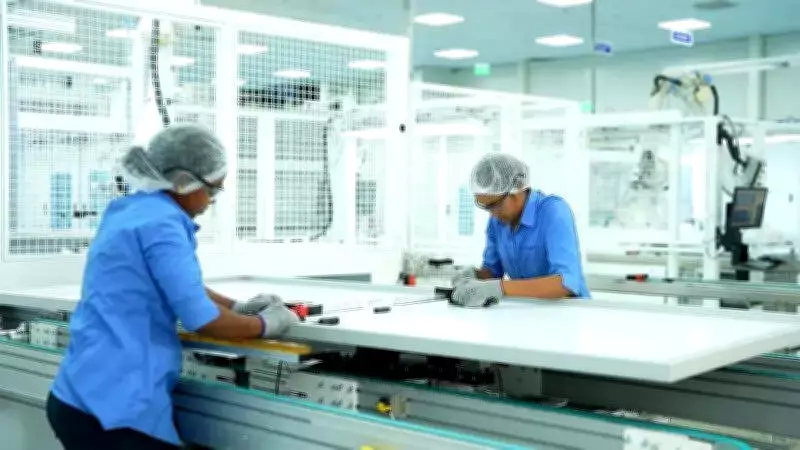
Of the shopfloor workforce, 80% are women, including those in bunny suits working in cleanrooms on the cell manufacturing lines, which involve more technologically intensive processes than module assembly. The facility employs women in roles such as production, engineering and quality inspection. Production, process engineering and maintenance roles are filled by local hires, while officers and senior executives are drawn from across the country. Balaji said this approach ensured the availability of locally trained talent while contributing to regional employment generation.
Localisation and Supply Chain Development
He added that Tata Power made significant efforts to introduce advanced processes and automation, and has currently achieved 55% localisation, boosted by in-house cell production. "This is the highest in India for any solar manufacturer, and it is going to increase gradually because we are improving supply chain resilience," he said. "Current major localised items include glass, aluminium frames, junction boxes and packaging. We are focussing on local supply chain development, most of which is not readily available in India. For instance, though Indian vendors make advanced glass, they did not have experience with modules. We are developing vendors through close qualification and partnership work to meet quality and consistency standards."
However, he acknowledged near-term cost gaps compared to imports, but expected improvement with scale. Tata Power targets 70–75% localisation in two to three years, which would include ingot and wafer manufacturing at its upcoming facility in Nellore, Andhra Pradesh.
(The reporter was in Tirunelveli at the invitation of Tata Power)