Tamil Nadu Government Unveils Major Textile Sector Support Package
In a significant boost to the state's textile industry, Tamil Nadu Chief Minister M K Stalin announced on Thursday a comprehensive support package during the International Textile Summit-360 and Exhibition in Coimbatore. Addressing the event via videoconference from Chennai, Stalin revealed that the government will provide a 20% capital subsidy for the purchase of state-of-the-art weaving and knitting machines, with an annual allocation of Rs 30 crore dedicated specifically for this purpose.
Dravidian Model Driving Industrial Growth
Stalin emphasized that under the Dravidian model of governance, key sectors including textiles, automobile manufacturing, information technology, and footwear production have experienced phenomenal growth. He proudly noted that Tamil Nadu has maintained its position as India's largest exporter of ready-made garments for five consecutive years, contributing an impressive 33% share to the country's overall textile trade.
The Chief Minister highlighted the government's proactive measures to mitigate challenges, particularly addressing the impact of the 50% tariff imposed by the United States. "The Tamil Nadu government is taking constructive steps to address this impact, such as identifying new markets and urging the Union government to remove the 11% import duty on cotton," Stalin stated confidently.

Substantial Investment and Recognition
The summit, inaugurated by Deputy Chief Minister and organized by the Tamil Nadu Department of Textiles in collaboration with the Confederation of Indian Industry (CII), witnessed substantial business activity:
- 55 memorandums of understanding (MoUs) worth Rs 915 crore were signed during the event
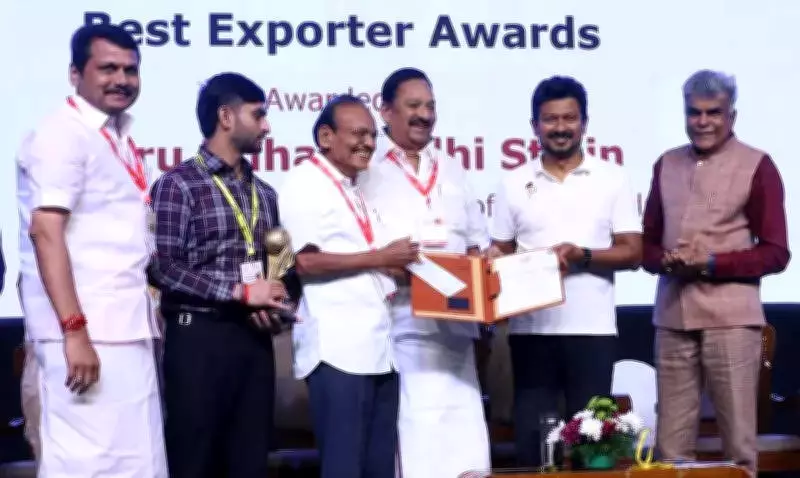
- Five companies recognized for best exports received prize money of Rs 2 lakh each
- Minister for Handlooms and Textiles R Gandhi was present throughout the proceedings
Comprehensive Financial Support Initiatives
Further strengthening the textile ecosystem, Udhayanidhi issued multiple orders for financial assistance:
- Interest subvention of Rs 11.7 lakh for modernizing old spinning machines
- Subsidy of Rs 67.49 lakh for power loom weavers' modernization
- Capital investment subsidy of Rs 10.92 crore for establishing new textile processing units
- State government share of Rs 1.3 crore for the integrated textile park project
- Allocation of Rs 138.32 lakh for six research projects focusing on technical textiles and synthetic fibers
Employment and Economic Vision
Udhayanidhi underscored the textile sector's critical role in employment generation, revealing that it provides livelihoods for 30 lakh people in Tamil Nadu. Remarkably, 42% of women working in India's textile sector hail from the state. "The Dravidian model government is implementing various schemes for the textile sector," he affirmed, expressing confidence that this industry will significantly contribute to achieving the ambitious target of a $1 trillion economy.
He further assured stakeholders that the government would reconsider and potentially increase the existing 6% subsidy, demonstrating ongoing commitment to sectoral development.
Policy Launch and Event Highlights
As a centerpiece of the conference, Tamil Nadu's new Integrated Textile Policy for 2025-2026 was officially released. The event featured several notable components:

- 100 exhibition stalls representing the complete textile value chain of Tamil Nadu
- Participation of over 1,500 textile delegates, creating substantial networking opportunities
- A fashion show highlighting products manufactured within the state
- 300 buyer-seller meetings facilitating business connections
Stalin expressed optimism about the summit's potential to attract international investments, particularly in light of recent India-European Union free trade agreements. The government's establishment of a separate textiles department further underscores the sector's strategic importance in Tamil Nadu's economic landscape.