

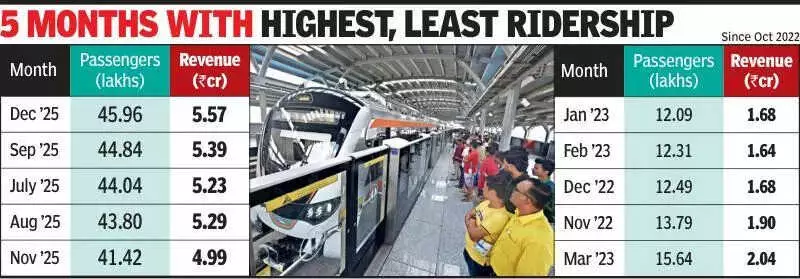
Ahmedabad's Metro network has achieved a significant milestone in daily commuter numbers, yet faces a puzzling financial trend. Despite crossing a daily ridership of 1.5 lakh passengers in December 2025, the average revenue collected per passenger has remained virtually unchanged, hovering just above Rs 12.
Ridership Growth vs. Stagnant Revenue: A Detailed Look
The data provided by the Gujarat Metro Rail Corporation (GMRC) paints a clear picture of growing popularity but static earnings per ticket. In 2023, the Metro served 2.5 crore passengers, generating Rs 32.1 crore in revenue. The following year, ridership jumped to 3.7 crore, with revenue rising to Rs 43.6 crore. By 2025, passenger count reached 4.8 crore, bringing in Rs 58.2 crore.
Officials revealed that from the service's inception in October 2022 until December 31, 2025, a cumulative total of 11.5 crore passengers travelled on the Metro, contributing Rs 140 crore in total revenue. A closer analysis of year-on-year figures shows the average per-passenger revenue was Rs 11.8 in 2024 and saw a marginal increase to Rs 12.6 in 2025. Notably, even after the addition of the Sachivalaya route, this key metric remained steady at Rs 12.03.

Network Expansion and Operational Challenges
The Metro network is poised for further expansion, with officials indicating the line is expected to reach Mahatma Mandir by Uttarayan. The Prime Minister is anticipated to flag off the final stretch from Sachivalaya to Mahatma Mandir. The system currently operates on two primary corridors:
- One line runs from Thaltej Gam to Vastral.
- The second line connects APMC to Gandhinagar and GIFT City via Motera.
Service frequency has improved on the busier Thaltej-Vastral stretch, with trains now arriving every seven minutes during peak hours, compared to about 12 minutes previously. This stretch carries the major chunk of ridership. The Gandhinagar stretch maintains a 12-minute interval, with officials noting that a significant portion of its passengers are students from educational institutes along the route.
Persistent Hurdles in Achieving Full Potential
Despite the growth in overall numbers, Metro authorities admit the service has struggled to attract passengers consistently. Trains often return empty on several connecting routes, pointing to underutilization beyond core segments. A major deterrent identified is the acute lack of parking slots around Metro stations in Ahmedabad.
Officials highlighted a contrast between Gandhinagar, where several plots could potentially be converted into parking areas, and Ahmedabad, where creating such spaces remains a significant challenge. The full impact of the network is yet to be realized, with Sachivalaya passengers still to board in large numbers. Authorities are also watching to see the ridership increase when the Metro eventually connects to the Gandhinagar railway station and Akshardham.
The story of Ahmedabad Metro is thus one of impressive ridership growth shadowed by stagnant per-passenger earnings and infrastructural hurdles that need addressing to ensure its long-term financial sustainability and commuter appeal.






