

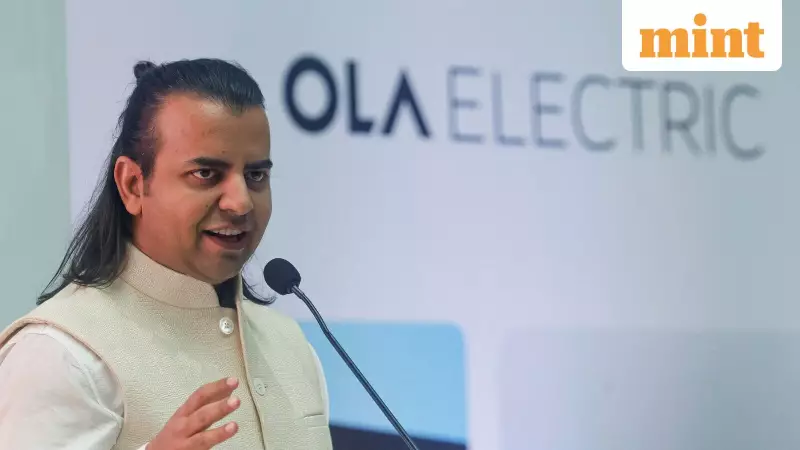
The story of Ola, from a ride-hailing pioneer to an electric vehicle (EV) aspirant, is now a cautionary tale about the perils of losing focus. Founder Bhavish Aggarwal's grand vision of creating a interconnected tech empire has hit serious roadblocks, with Ola Electric's core business sputtering and its stock price in a freefall.
The Ambitious Pivot and Its Cost
Since founding Ola Cabs in 2010, Bhavish Aggarwal has launched a series of businesses at a frenetic pace. His vision connected ride-sharing, food delivery, electric scooters, digital payments, and even AI models for Indian languages into one unified theory. However, this polymath ambition has blurred the company's strategic identity. The latest move—selling home inverters through retail stores originally built for electric scooters—highlights a scramble for revenue as the primary engine falters.
The data reveals a stark picture. Ola Electric's share of the electric two-wheeler market has collapsed from 36.7% in 2024 to roughly 16% by the end of 2025. Its "Futurefactory," once touted as a global game-changer, is now being redirected towards energy storage solutions. Meanwhile, market leadership has decisively shifted to established players like TVS, Bajaj, and its key rival, Ather Energy.

Operational Chaos and Investor Flight
The company's troubles extend beyond strategy to daily operations. Social media platforms are flooded with customer complaints about non-existent service centres, debilitating software bugs that render scooters unusable, and an utterly overwhelmed customer support system. This operational friction has severely damaged brand trust.
Investors have borne the brunt of this turmoil. Following its high-profile Initial Public Offering (IPO) in August 2024 at ₹76 per share, Ola Electric's stock has nosedived to around ₹40, marking a devastating 47% decline. This erosion of market capitalisation reflects a severe crisis of confidence.
The Fox vs. The Hedgehog: A Lesson in Focus
Analysts point to a chronic lack of focus as the root cause. The management philosophy from "Good to Great" distinguishes between the fox, who chases many ideas, and the hedgehog, who simplifies the world into one core concept. Aggarwal's approach resembles the fox, constantly leaping to new ventures without solidifying the previous one, thereby failing to build a durable operational moat.
While Ola engaged in grand narratives of being a national champion against global rivals, competitors like Ather Energy focused on the fundamentals: engineering, research & development, and controlled scaling. This disciplined, hedgehog-like approach has made Ather the benchmark in the premium electric two-wheeler segment today.
Key Takeaways for India's Startup Ecosystem
Ola's trajectory offers crucial lessons for other entrepreneurs. First, synergy is not a standalone strategy. Having a database of EV buyers does not guarantee they will purchase inverters; adjacency must be earned through excellence. Second, the cult of the founder-hero has limits. A company of Ola's scale needs to evolve from founder-led crisis management to system-driven governance. Finally, for hardware and infrastructure-heavy businesses in the 2020s, sustainable advantage lies in mastering unglamorous operations—supply chains, manufacturing quality, and service networks—not just disruptive ideas.
Ola remains a significant entity in India's EV landscape, and Aggarwal's boldness is an asset for the nation's industrial growth. However, the current chapter underscores that audacity, without relentless execution and strategic focus, is insufficient for long-term success.






