UPSC Essentials | Mains Answer Practice GS 2: Finance Commission and India-EU FTA (Week 140)
Written by: Nitendra Pal Singh
New Delhi, Feb 4, 2026 05:17 PM IST
Are you gearing up for the Civil Services Exam 2026? Strengthen your conceptual clarity and answer-writing skills with today's focused practice on two critical topics: the Finance Commission's role in fiscal federalism and the challenges posed by the European Union's evolving regulations for Indian small and medium-sized businesses (SMEs). This initiative is designed as a valuable addition to your UPSC CSE Mains preparation, covering essential static and dynamic aspects of the GS-2 syllabus.

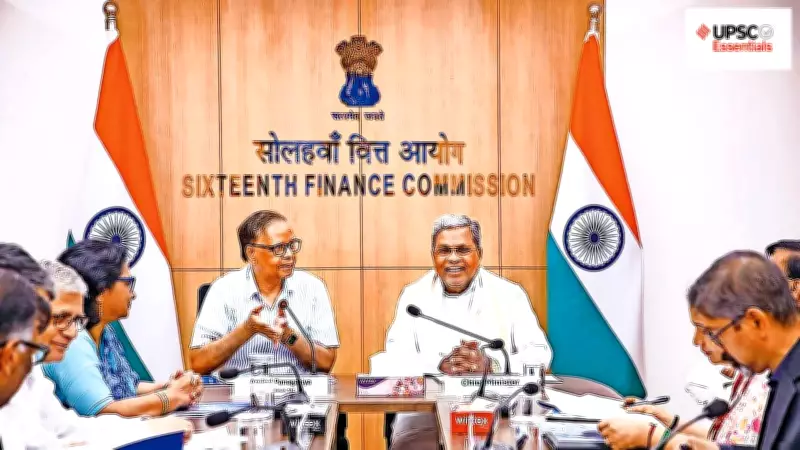
Question 1: Discuss how the Finance Commission helps keep fiscal federalism alive in India. Based on the 16th Finance Commission’s recommendations, examine how the southern states and other states have found a balance between fairness and efficiency.
Relevance: This question assesses your understanding of Centre-State financial relations, the ongoing debate between equity and performance, and contemporary federal challenges highlighted by the 16th Finance Commission. These elements are fundamental to the Polity and Governance section of the UPSC syllabus.
Note: This is not a model answer but a guide to structure your thought process and incorporate key points into your response.
Introduction:
- The Finance Commission of India is a constitutional body established under Article 280 of the Constitution.
- It is constituted by the President every five years or earlier as needed, comprising a Chairman and four members, to recommend on tax distribution and grants-in-aid between the Union and States.
Body: You may integrate the following points into your answer:
Role of the Finance Commission in Maintaining Fiscal Federalism:
- It recommends the distribution of net tax proceeds between the Union and States and allocates shares among States.
- It outlines principles for grants-in-aid from the Consolidated Fund of India to States, ensuring financial support for development and equity.
16th Finance Commission’s Recommendations (2026-2031):
- Vertical devolution remains unchanged, with states retaining a 41% share in the divisible pool.
- Horizontal devolution criteria have been revised, adjusting weights for factors like population and introducing state contribution to GDP as a new criterion.
- Southern states' share increased from 15.8% under the 15th FC to 17%, while states like Gujarat, Maharashtra, Punjab, and Jharkhand also saw gains. Conversely, Uttar Pradesh, Bihar, Madhya Pradesh, and Rajasthan experienced declines.
- Recommendations include discontinuing off-budget borrowings by states, capping deficits at 3% of GSDP, rationalizing subsidy schemes, and introducing sunset clauses for non-merit subsidies.
Conclusion:
- The Commission advocates for privatizing power distribution companies and closing or privatizing loss-making public sector enterprises.
- For FY 2026-27, the government has allocated ₹1.4 lakh crore as Finance Commission Grants, covering rural and urban local bodies and disaster management.
Points to Ponder:
- How do the 16th FC's changes promote a balance between rewarding economic performance and ensuring equitable development across states?
- What are the implications of the new criteria for long-term fiscal stability and cooperative federalism in India?
Question 2: Discuss how the EU’s evolving rules are challenging India’s small and medium-sized businesses (SMEs) to do business with the EU.
Relevance: This topic connects international relations with trade governance, focusing on non-tariff barriers and the impact of global regulatory frameworks like CBAM and sustainability mandates on India's export competitiveness, key for GS-II current affairs.
Note: This serves as a framework for your answer, not a definitive solution.
Introduction:

- The recently concluded India-EU Free Trade Agreement (FTA) aims to provide regulatory certainty in a dynamic global trade landscape, but EU's stringent rules pose significant hurdles for Indian SMEs.
- From food to engineering goods, EU regulations impose a heavy compliance burden, potentially undermining trade benefits.
Body: Consider these aspects in your response:
- The India-EU FTA offers a legal avenue to address EU standards, but unresolved regulatory issues could lead to trade asymmetry, disadvantaging Indian exporters.
- Indian SMEs are particularly strained by excessive environmental rules, such as the Carbon Border Adjustment Mechanism (CBAM), effective from January 1, which taxes imports from sectors like cement, steel, and aluminium based on carbon emissions.
- CBAM may expand to more commodities, affecting India's exports of aluminium, iron, and steel to the EU.
- The EU Deforestation Regulation (EUDR), extended to December 2026, requires proof that products are not sourced from deforested land, complicating exports of food items due to detailed compliance needs.
Conclusion:
- Upcoming regulations like the Corporate Sustainability Due Diligence (CSDD) Directive, effective from 2027, will require companies to assess human rights and environmental risks in their value chains.
- The proposed Industrial Accelerator Act might introduce local content norms, pressuring imports and challenging Indian SMEs lacking compliance infrastructure.
- India's current lack of aligned standards makes adherence to EUDR and similar rules a major obstacle for SME exporters.
Points to Ponder:
- How can Indian SMEs build capacity to meet EU's sustainability and regulatory demands without compromising their competitiveness?
- What role should the Indian government play in negotiating FTAs to protect SME interests against stringent international standards?
Engage with these questions to refine your answer-writing approach and deepen your understanding of these pivotal topics for the UPSC Mains exam.