India's rich scientific heritage is built upon the monumental work of visionary minds who propelled the nation onto the global stage of innovation. Their pioneering research in physics, space technology, and nuclear science has left an indelible mark, inspiring generations to come. Here, we celebrate seven such legendary figures whose contributions fundamentally altered their fields and brought immense pride to India.
Pioneers of Physics and Fundamental Research
The journey of modern Indian science is illuminated by giants of physics. Sir Chandrasekhara Venkata Raman made history with his discovery of the Raman Effect in 1928, which describes the scattering of light. This groundbreaking work earned him the Nobel Prize in Physics in 1930, making him the first Asian to receive a Nobel in the sciences.
Another colossal figure, Satyendra Nath Bose, made profound contributions to quantum mechanics. His collaboration with Albert Einstein led to the development of Bose-Einstein statistics and the conceptualization of bosons, a fundamental class of particles. His theories remain a cornerstone of modern physics.

Jagadish Chandra Bose defied boundaries with his revolutionary work. He demonstrated that plants respond to stimuli much like living organisms, pioneering plant physiology. Simultaneously, his experiments with microwave optics established him as a forerunner in wireless communication technology.
Architects of India's Strategic and Space Programs
The strategic development of post-independence India was guided by scientific luminaries with immense foresight. Dr. Homi Jehangir Bhabha is revered as the father of India's nuclear programme. He founded the Tata Institute of Fundamental Research (TIFR) and championed the peaceful use of atomic energy, setting the foundation for India's nuclear capabilities.
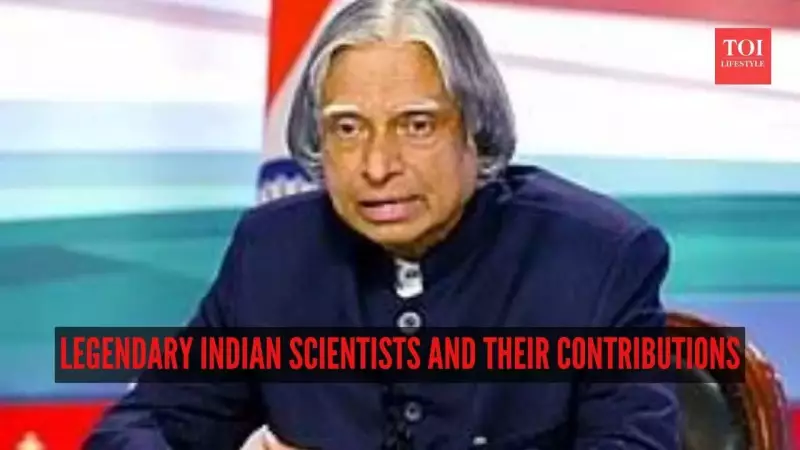
In the realm of aerospace and defense, Dr. A. P. J. Abdul Kalam, known as the 'Missile Man of India,' played a pivotal role. He was instrumental in developing key missile systems and strengthening national defense. His legacy continued as he served as the 11th President of India, tirelessly advocating for scientific advancement and youth empowerment.
The visionary behind India's cosmic aspirations, Dr. Vikram Sarabhai, is hailed as the father of the Indian space programme. He envisioned space technology as a tool for national development and was the driving force behind the establishment of the Indian Space Research Organisation (ISRO). His leadership enabled India to harness satellites for communication, education, and meteorology.
A Lasting Legacy for Future Generations
The collective contributions of these seven legends extend far beyond their individual discoveries. They built enduring institutions, fostered a culture of rigorous scientific inquiry, and demonstrated how fundamental research can translate into technological sovereignty and societal progress. Their stories are not merely chapters in history books but are living inspirations, proving that with curiosity and perseverance, Indian minds can solve global challenges and light the path forward for humanity.