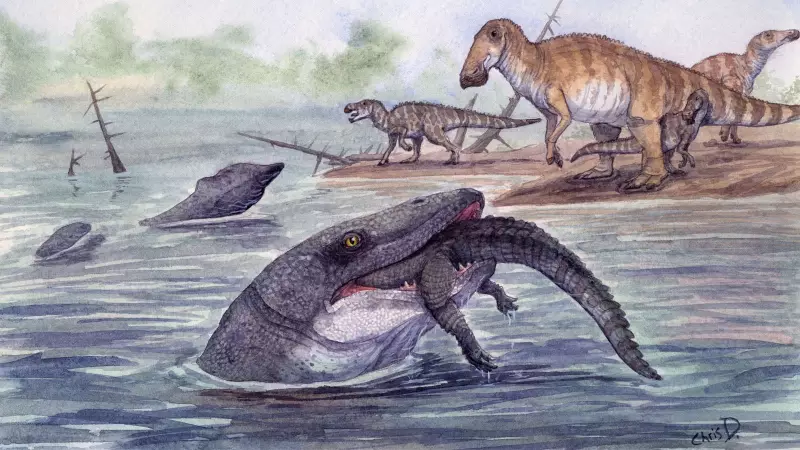
A groundbreaking fossil discovery in North Dakota is forcing scientists to rewrite the history of one of the prehistoric world's most formidable predators. New research reveals that mosasaurs, the giant marine reptiles that ruled the ancient seas, were not confined to salty oceans but had adapted to thrive in freshwater river systems in the final chapter before their extinction.
A Tooth That Tells a New Story
The entire revelation hinges on a single, perplexing fossil tooth unearthed in 2022 from a river deposit in North Dakota. The location itself was a puzzle. It was found alongside a Tyrannosaurus rex tooth and the jawbone of a crocodylian, in an area famous for fossils of duck-billed dinosaurs like Edmontosaurus. Since mosasaurs are universally considered ocean dwellers, their presence in a freshwater setting posed a clear and immediate question to researchers.
An international team led by scientists from Uppsala University took up the challenge. To solve the mystery, they conducted a detailed chemical analysis of the tooth's enamel. They compared the isotopic signatures of oxygen, strontium, and carbon from the mosasaur tooth with those from the nearby T. rex and crocodylian fossils, all dating from roughly the same period around 66 million years ago.

Chemical Fingerprints Point to Freshwater
The results were definitive. The isotope analysis painted a picture starkly different from a marine environment. The tooth showed elevated levels of the lighter oxygen isotope associated with freshwater rivers. Similarly, strontium ratios confirmed a non-oceanic source. The carbon isotopes added another layer to the story.
Unlike most mosasaurs, whose chemistry suggests deep diving, this specimen had elevated carbon values. This indicates the animal likely foraged closer to the water's surface and may have even scavenged on drowned dinosaurs that ended up in the river. The conclusion was inescapable: this mosasaur lived and died in a freshwater habitat.
Additional mosasaur teeth from slightly older sites in the same region showed identical freshwater signals. This crucial evidence strengthened the finding, confirming that some populations of these reptiles occupied river systems during the final million years before the catastrophic extinction event that ended the dinosaur era.
Environmental Change Drove the Adaptation
Researchers propose a compelling explanation for this dramatic habitat shift. They point to major environmental changes occurring at the time, centered around the Western Interior Seaway. This vast inland sea once split North America into two landmasses.
As immense amounts of freshwater flowed into this seaway, its salinity gradually decreased. A layered system likely developed, with less dense freshwater sitting atop denser saltwater. Air-breathing animals like mosasaurs could comfortably inhabit this upper freshwater layer, while gill-breathing marine species remained trapped in the saltier depths below. This created a new ecological niche that some mosasaurs evolved to exploit.
The size of the North Dakota tooth suggests the animal was colossal, potentially reaching lengths of up to 11 metres – comparable to a modern bus and rivaling the largest killer whales. The image of such a gigantic predator patrolling ancient river systems completely overturns the long-held view of mosasaurs as strictly open-ocean animals.
This discovery reveals mosasaurs as far more adaptable and resilient hunters than previously thought. They were capable of colonizing new habitats and exploiting new food sources as their world underwent profound change. This adaptability persisted right until the very end, when an asteroid impact brought their world, and the age of dinosaurs, to an abrupt close.