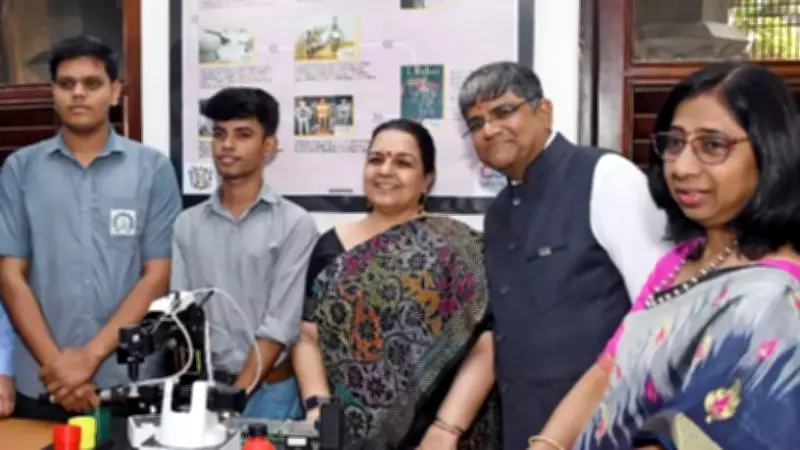
In a significant development for vocational training in Maharashtra, the Rotary Club of Bombay (RCB) has officially inaugurated the state-of-the-art RCB–ITI innovation lab at ITI Mumbai. This facility is specifically designed to be Industry 4.0 ready, representing a crucial milestone in modernizing skill education to meet the fast-evolving demands of advanced manufacturing and technology sectors.
A Collaborative Effort for Future-Ready Education
The inauguration ceremony highlighted a powerful partnership between the Government of Maharashtra and civil society organizations. This initiative is focused on creating sustainable and inclusive career pathways for the youth, ensuring they are equipped with relevant skills for the future job market.
Government Commitment to Skill Upgradation
During the inauguration, Manisha Varma, IAS, emphasized the lab's role in preparing youth for future challenges. "The RCB–ITI Innovation Lab is a state-of-the-art facility aimed at making youth future-ready and significantly enhancing their employability," she stated. Varma further explained that the Maharashtra government is deeply committed to upgrading skill education to align with industry requirements and improve employment outcomes for young people.

She revealed that this collaboration marks the first partnership between the Rotary Club of Bombay and an ITI in Mumbai, with a Memorandum of Understanding (MoU) signed between the Government of Maharashtra and RCB in August 2025. The current lab will serve as a model incubation and innovation centre that can be replicated across other ITIs throughout the state, creating a scalable framework for vocational education enhancement.
Ensuring Equitable Access to Advanced Training
One of the most noteworthy aspects of this initiative is its commitment to inclusivity. Varma confirmed that the program is being conducted entirely free of cost, with the majority of beneficiaries coming from underprivileged backgrounds. This approach ensures equitable access to advanced skill education, breaking down financial barriers that often prevent deserving students from accessing quality vocational training.
Industry 4.0 Integration in Vocational Education
Bimal Mehta, President of the Rotary Club of Bombay, elaborated on the lab's educational philosophy. "The RCB–ITI Innovation Lab reflects our commitment to future-proofing vocational education. By integrating Industry 4.0 technologies into hands-on learning, we aim to equip students with skills that are relevant, resilient, and industry-ready," he explained.
The lab is built around a comprehensive 'learn–build–apply' pedagogy that emphasizes:
- Project-based learning approaches
- Comprehensive faculty training programs
- Direct industry mentorship opportunities
This educational model is designed to be both scalable and replicable, allowing for expansion to other vocational institutions across Maharashtra and potentially beyond.
Strategic Location and Institutional Framework
The RCB–ITI Innovation Lab has been commissioned at ITI Mumbai, an institute operating under the Directorate of Vocational Education & Training (DVET) of the Government of Maharashtra. The institution also functions under the broader framework of the Director General of Training (DGT), Ministry of Skill Development and Entrepreneurship, Government of India.
This strategic positioning strengthens DVET's mission of building a skilled workforce across Maharashtra by integrating cutting-edge technology into traditional vocational training. Located at Elphinstone Technical High School and Junior College in Dhobi Talao, ITI Mumbai 01 trains approximately 700 students annually, making it one of South Mumbai's most important vocational education institutions.
The establishment of this Industry 4.0 ready innovation lab represents a forward-thinking approach to vocational education that bridges the gap between traditional skill training and modern technological requirements. By fostering collaboration between government bodies, non-governmental organizations, and educational institutions, this initiative creates a sustainable model for preparing India's youth for the challenges and opportunities of the Fourth Industrial Revolution.