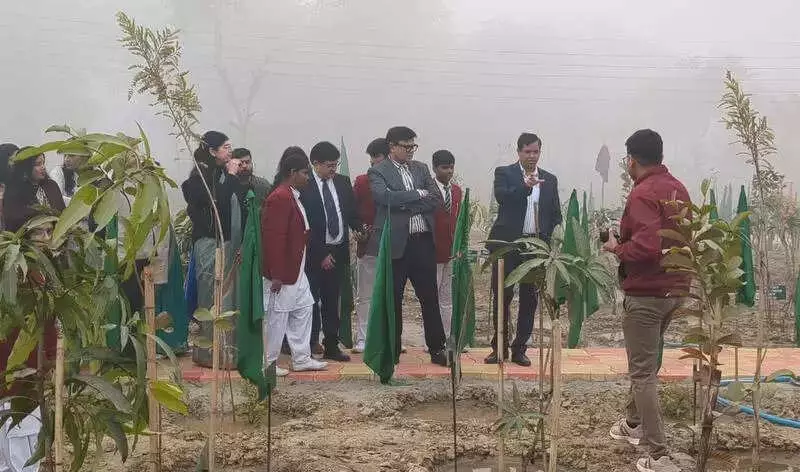
In an effort to combat the city's deteriorating air quality, students of Jawahar Navodaya Vidyalaya in Dadri undertook a significant plantation drive, putting 850 new saplings into the ground. However, the well-intentioned event, held on Sunday at the school's premises in Dhoom Manikpur, GB Nagar, has ignited a debate as it coincided with official advisories cautioning against prolonged outdoor exposure for children.
The Green Initiative and Official Participation
The plantation drive was organized as part of a long-term garden project for the school. Authorities confirmed that the saplings included fruit-bearing and flowering varieties, aimed at creating a sustainable green space. The event saw the presence of key officials, including Sanjay Kumar, Secretary of the Department of School Education and Literacy, and school principal Ramveer Singh.
During his interaction, Secretary Sanjay Kumar engaged with the students, inquiring about the quality of the saplings, irrigation methods, and plans for their maintenance. He emphasized the crucial role young people play in environmental conservation, framing the activity as a step towards building long-term ecological awareness.

Parental Backlash Over Safety Concerns
Despite the environmental benefits, the drive faced criticism from several parents. Their concern stemmed from the timing of the event, which occurred while the Graded Response Action Plan (GRAP) measures are active across Delhi-NCR due to severe air pollution. These measures include advisories for schools to avoid physical attendance and limit students' exposure to the unhealthy outdoor air.
"When children are being told to stay home and attend classes online because the air is unsafe, calling them for a plantation drive defeats the purpose of the advisory," a parent stated, requesting anonymity. Parents questioned the logic of bringing children to campus for an outdoor program when health warnings are explicitly in place.
School's Defence and Parallel GRAP Directives
In response to the criticism, school officials maintained that student safety was a priority and that the time spent outdoors was strictly limited. An education department official explained, "Tree plantation is a long-term measure to combat pollution and build environmental awareness among students, and the fruit garden will be maintained as part of the school's ecological initiatives."
Meanwhile, highlighting the severity of the pollution crisis, authorities in Noida and Ghaziabad announced a shift to online and hybrid learning modes for schools and coaching centres on the same Sunday. The GB Nagar education department issued an official order following directives from the District Magistrate and the Commission for Air Quality Management.
As per this order, which remains effective from December 14 until further notice, classes from pre-nursery to Class V will shift completely to online mode. For students in Classes VI to IX and Class XI, a hybrid format has been introduced, allowing both physical and online participation where digital facilities are available.
The juxtaposition of these two events—a mass plantation drive and the enforcement of strict online schooling protocols—underscores the complex challenge of balancing immediate health protections with long-term environmental solutions in India's pollution-plagued capital region.