Rajasthan Education Department Deploys AI to Evaluate 35 Lakh Students' Reading Skills
Jaipur: In a groundbreaking initiative, the Rajasthan education department has conducted a comprehensive assessment of more than 35 lakh students studying in grades 3 to 8 across government schools. This evaluation was part of the Oral Reading Fluency (ORF) campaign, which leveraged advanced artificial intelligence tools to analyze and measure students' reading capabilities with unprecedented precision.
First-of-its-Kind AI Integration in Government Education
The department officially released detailed information about this statewide campaign on Monday. The ORF program was initially launched as a baseline survey in May of last year, marking the very first instance where artificial intelligence has been systematically integrated into government-led efforts to enhance foundational literacy and reading proficiency among schoolchildren.
The follow-up end-line assessment for this innovative campaign was carried out from January 19 to 29 this year, with the final results currently pending release. This structured approach allows educators to track progress and measure the effectiveness of targeted teaching interventions implemented between the two assessment phases.

How the AI-Powered ORF Initiative Works
Oral Reading Fluency is an artificial intelligence-based educational initiative designed to meticulously analyze and evaluate students' reading skills through voice recording technology. Under this program, each participating student is provided with engaging, level-appropriate reading material via a dedicated mobile application.
Students are then required to read this tailored content aloud within a specific, predetermined timeframe. The AI system records their reading sessions and analyzes various parameters including pronunciation, fluency, pace, and comprehension indicators to generate a detailed assessment of their reading abilities.
Four-Tier Classification System Reveals Student Proficiency Levels
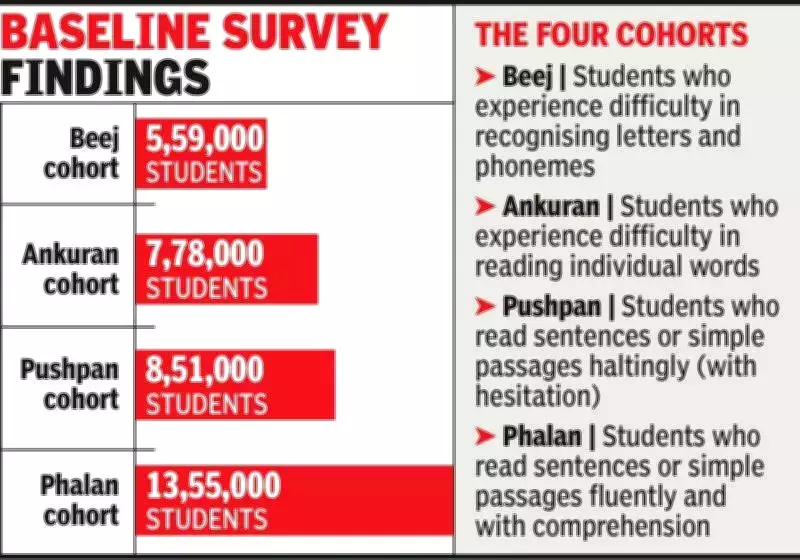
Based on the comprehensive data gathered through the baseline survey, students were systematically classified into four distinct categories according to their reading proficiency:
- Beej (Seed): This category includes 5,59,000 students who demonstrate difficulty in recognizing basic letters and phonemes.
- Ankuran (Germination): Comprising 7,78,000 students, this group experiences challenges in reading individual words accurately.
- Pushpan (Flowering): This category contains 8,51,000 students who can read sentences or simple passages but do so with noticeable hesitation and halting delivery.
- Phalan (Fruiting): The largest group with 13,55,000 students, these learners can read sentences and simple passages fluently while demonstrating solid comprehension skills.
Data-Driven Teaching Strategies for Improved Learning Outcomes
A senior education department official explained the practical application of this assessment data: "The results from our baseline survey provided crucial insights into the current standing of our students' reading abilities. This information has enabled us to implement targeted teaching methodologies in schools specifically designed to enhance both reading fluency and comprehension skills."
The official further emphasized that the primary focus remains on strengthening comprehension abilities, ensuring that students not only read words correctly but also understand concepts thoroughly, which forms the foundation for all subsequent learning across subjects.
This innovative use of artificial intelligence in mass educational assessment represents a significant step forward in Rajasthan's efforts to improve literacy outcomes through technology-driven, data-informed teaching strategies.