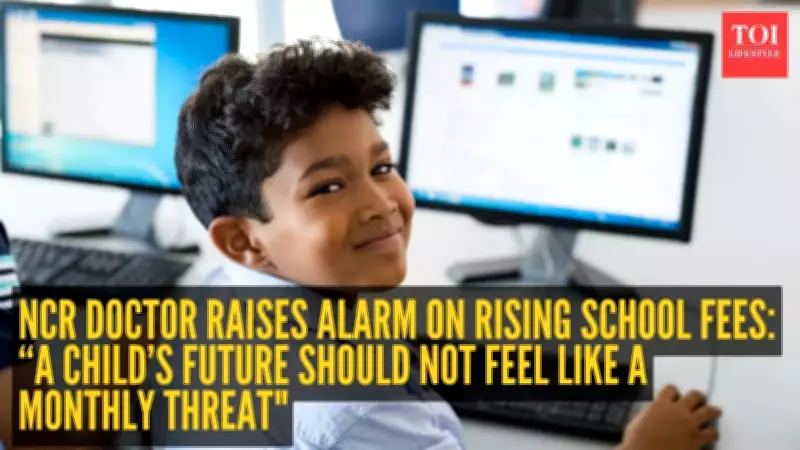
School education in India is witnessing a consistent upward trend in costs each year, placing significant financial pressure on countless families across the nation. What was traditionally viewed as an essential foundation for children's development is increasingly transforming into a persistent economic concern for households.
Social Media Post Ignites Widespread Conversation
A recent post on the social media platform X by Dr. Shraddhey Katiyar, a medical professional based in Noida, has brought this critical issue into sharp focus and catalyzed a broader online dialogue. In his thought-provoking message, Katiyar articulated how escalating school fees systematically impact families on a monthly basis.
He expressed, "A child's future should not feel like a monthly threat. Education was meant to uplift families, not exhaust them. To create thinkers, not debt managers. Parents don't hesitate to spend on their children. They hesitate because they have no choice."

The Silent Acceptance of Annual Fee Increases
Katiyar highlighted a concerning pattern where school fees typically rise annually, yet parents seldom voice opposition or question these increments. Instead of challenging the system, numerous families opt to make personal adjustments to accommodate the growing expenses.
These adaptations often involve reducing discretionary spending, postponing important family plans, or taking on additional employment opportunities. The doctor also scrutinized the common justification provided by educational institutions for these hikes.
While schools frequently cite enhanced educational quality as the reason for increased fees, parents continue to observe overcrowded classrooms and undercompensated teaching staff. This discrepancy leaves families experiencing ongoing financial stress despite their increased financial contributions.
Parents Question Educational Value and Quality
The response to Katiyar's post revealed a chorus of similar sentiments from concerned parents and observers. One user commented, "Too many unnecessary expenses. Quality of teaching is low, and lavish schools are a priority, it seems."
Another participant wondered why affected families don't organize collectively to address their grievances, stating, "Why don't these middle-class people ever get out collectively? There are many issues that ruin their lives, yet they never show up together?"
Critical Perspectives on the Education System
Some responses offered more fundamental criticisms of the current schooling framework. One individual remarked, "Our school system is mostly a waste. Not sure about the IBs of the world, but most of the others are just running, making money, without putting any substantial effort towards the kids. They feel like a factory delivering low-quality output, which is not going to be useful."
The discussion expanded to include viewpoints from parents who are reconsidering conventional educational pathways. One contributor shared, "We are brainwashed to believe school is mandatory, no matter how expensive or useless. Not me. I'll homeschool my kids via NIOS/open boards and through real learning, AI, books, and apprenticeships. Schools are dumb factories and money-laundering mafias."
Others emphasized that parents rarely evaluate whether the substantial fees they pay correspond to the actual learning outcomes their children achieve. A notable observation read, "And we never question if the quality matches the price tag, or if there might be a better way."
This growing conversation reflects deepening concerns about the affordability and effectiveness of formal education in India, as families grapple with balancing financial realities against their aspirations for their children's futures.