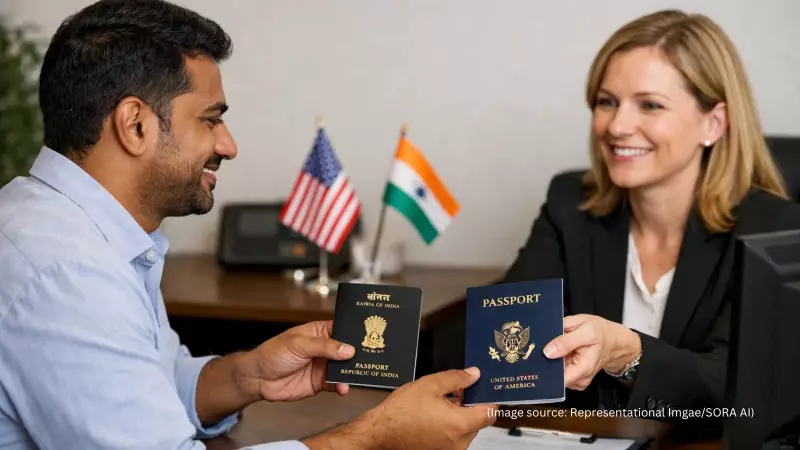
In a detailed analysis that has sparked widespread discussion online, investment banker and financial advisor Sarthak Ahuja has highlighted a concerning trend: a significant and rising number of Indians are formally renouncing their citizenship. According to his findings, shared in a viral LinkedIn post, approximately 2.2 lakh Indians now give up their passports every year, seeking futures abroad.
The Stark Numbers Behind the Exodus
Ahuja's data paints a clear picture of acceleration. Over the past 15 years, close to 2 million Indians have relinquished their citizenship. The pace has quickened dramatically, with nearly half of this total—about one million people—making the move in just the last five years. While the annual average stood at around 1.3 lakh between 2011 and 2019, it has now surged to the current figure of 2.2 lakh per year.
This exodus is not just about numbers; it represents a significant transfer of human capital. Ahuja points to the migration of highly skilled professionals as a critical facet. He notes that an estimated 7,500 Indian doctors are practising overseas, nearly 67% of professors prefer employment outside India, and roughly one-third of IIT graduates eventually move abroad.

Beyond Growth: The Push Factors Driving Indians Away
Ahuja delves into the core reasons behind this trend, arguing that India's status as one of the world's fastest-growing economies masks deep-seated issues. The economic gains, he suggests, are not distributed equitably. He provides a striking perspective: if the top 5% of income earners are excluded from calculations, the nation's per capita income almost halves. This fuels a perception that merit and effort are rewarded more fairly in foreign job markets.
"Which is why people leave for education, then take up jobs abroad, and after completing the requisite term, switch over their citizenship," Ahuja wrote. He adds a poignant, quality-of-life driver: "And then of course, the charm of clean air, water also excites them." The post identifies widening economic gaps, limited domestic career growth, and everyday infrastructural challenges as major push factors.
Shifting Destinations and Global Backlash
The traditional favourites for Indians seeking new citizenship remain the United States, Canada, Australia, the United Kingdom, and Germany. However, Ahuja notes a growing resistance in some of these nations. "This is why the US, Canada, and UK now have such a negative stance on immigration because they feel Indians are coming to eat our jobs," he observed.
Consequently, the landscape of opportunity is changing. Ahuja advises that the countries now actively welcoming Indian professionals have shifted. "If you have to focus on going overseas now… the countries inviting Indians have switched over to the likes of UAE, Saudi Arabia, Germany, Italy, Australia, Finland, Japan, and New Zealand," he stated. He also highlighted that the most viable pathways for securing jobs abroad are currently in IT and Medicine, rather than Commerce or Liberal Arts.
A 'Trust Deficit': Public Reaction and Call for Action
The LinkedIn post resonated deeply, amassing numerous comments that reflected a mix of concern and analysis. One user succinctly framed the issue as, "It's not a brain drain. It's a trust deficit." Another detailed comment called for concrete policy changes, stating that polluted cities, congestion, poor infrastructure, and high taxation are pushing skilled talent away. The user argued for liberalised taxation and prioritised civic infrastructure to reverse the trend, emphasising that "mere intent and policy documents are not enough."
A third perspective framed the migration as a rational choice for professionals seeking environments where their "skills compound faster, with structure, respect, and clearer institutional support." The collective reaction underscores a complex narrative that extends beyond simple economics to encompass governance, quality of life, and professional dignity.