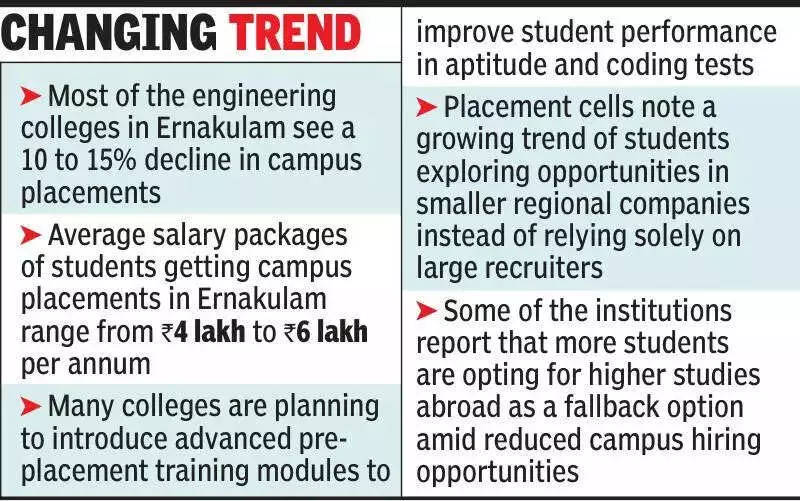
Campus recruitment across engineering institutions in Ernakulam district has registered a marginal downturn this academic year, mirroring a broader trend of cautious hiring of fresh graduates by major corporations. While traditional engineering streams managed to hold their ground, the typically high-flying computer science and allied disciplines faced a more noticeable slump in placement percentages.
Skill Over Volume: IT Firms Get Selective
According to placement officials, the dip is attributed to a combination of factors. A significant one is the increased student intake, particularly in computer science programmes, across colleges in the district. This has led to larger batches graduating, intensifying competition for a finite pool of job openings. Bejoy Varghese, placement officer at the Federal Institute of Science and Technology (Fisat), observed that IT companies have become notably "choosy." He explained that the focus has sharply shifted to rigorous, skill-based evaluations. "IT firms are prioritising candidates who excel in their assessments. We are seeing a scenario where students offered packages of Rs 5 lakh are being put through tests designed for roles worth Rs 7 lakh," Varghese stated.
He added that the post-pandemic hiring boom from startups, which previously provided a cushion, has now subsided. This cooling-off period has further tightened the job market for fresh engineering talent in the tech domain.

Core Engineering Branches See Consistent Demand
In a contrasting trend, traditional or core engineering branches like mechanical, electrical, and civil have maintained steady placement numbers. College representatives noted that the expansion of computer science batches indirectly helped keep demand robust in these fields. With intake in core branches remaining stable over the years, industries seeking graduates in these disciplines are actually reporting a shortage of qualified candidates. Jose Mathew, who oversees placements at Albertian Institute of Science and Technology (Aisat), confirmed the sustained demand. "There is significant and consistent demand for mechanical, electrical, and civil engineering graduates. However, the salary packages have not seen a proportional increase. The higher compensation brackets are still largely dominated by computer science students," Mathew said.
College-Specific Impacts and AI Influence
The trend is evident at the institutional level as well. At Model Engineering College, Ernakulam, placement officer Aparna Devi highlighted a specific case where a major recruiter that hired 42 students last year recruited only 12 this year. She pointed to two key reasons: "One factor could be the increased adoption of artificial intelligence (AI), leading companies to require fewer employees for certain tasks. Secondly, we had two additional batches this year, which naturally increased the number of students vying for placements."
Despite the current slowdown, engineering colleges in Ernakulam are optimistic about a recovery. They are hopeful that the upcoming recruitment cycle, beginning in April 2026, will yield better outcomes as companies recalibrate their hiring strategies post-slowdown.
Interestingly, officials from the Cochin University of Science and Technology (Cusat) reported a different experience, noting that campus recruitments at their university have remained steady this year without any significant decline compared to previous years.