

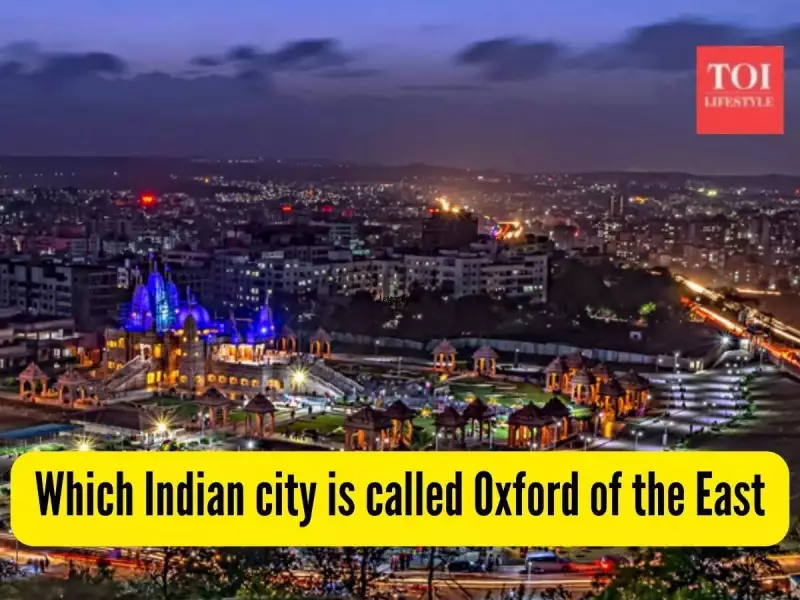
Among India's bustling metropolitan centers, one city has consistently been crowned with an illustrious academic title: the "Oxford of the East." This honor does not belong to the intellectual hubs of Bengal, Uttar Pradesh, or Bihar, nor is it claimed by financial capital Mumbai. The city that proudly bears this nickname is Pune, in Maharashtra, a place where education is woven into the very fabric of its identity.
The Historical Roots of an Academic Powerhouse
Pune's journey to becoming an educational mecca began in the 19th century under British rule, transforming from a quiet Maratha stronghold into a nurturing ground for scholars. The foundation was laid with the establishment of pioneering institutions. The College of Engineering (COEP), founded in 1854, stands as one of Asia's oldest technical schools. This was followed by the iconic Fergusson College in 1885, which produced legendary freedom fighters and thinkers like VD Savarkar and Gopal Krishna Gokhale.
The momentum continued with the rise of the Savitribai Phule Pune University (SPPU), which grew into a colossal institution overseeing hundreds of affiliated colleges. Later, establishments like Symbiosis International University added global flair with their programs in law, management, and media. It was this dense concentration of knowledge that reportedly struck India's first Prime Minister, Jawaharlal Nehru, during a visit in the 1950s, leading him to coin the famous phrase that compared Pune's tree-lined avenues buzzing with intellectual energy to Oxford's scholarly ambiance.

The Vibrant Ecosystem of Learning and Life
What truly sets Pune apart is the incredible density and diversity of its educational landscape. Today, over 1,400 colleges dot the city, ranging from premier research labs at IIT to film institutes polishing Bollywood dreams. World-class campuses like COEP, Brihan Maharashtra College of Commerce (BMCC), and SPPU exist shoulder-to-shoulder in a compact urban sprawl.
This ecosystem attracts a diverse student population from every corner of India, from North to Kanyakumari, and from across the globe, including Africa and the Middle East, turning neighborhoods into vibrant, mini-United Nations. The culture is defined by a "study hard, play harder" attitude. Life revolves around bookstores on FC Road, street food stalls, all-night study sessions over chai, and cafes overflowing with debate clubs and poetry slams. The mild weather, with winters perfect for late-night cramming under starlit skies, adds to the charm.
Education here extends beyond classrooms. The city pulses with a creative heartbeat in areas like Koregaon Park and Deccan Gymkhana, where theater groups rehearse, indie bands perform, and the Osho Ashram attracts both philosophers and engineers. Literary festivals and food trucks serving vada pav alongside global fusion cuisine complete a melting pot of cultures where learning is a holistic part of life.
A Legacy of Leaders and Lasting Impact
Pune's claim to the title is solidified by its alumni, who have shaped modern India and the world. Before leading Google, Sundar Pichai was a student here. The city has been the launching pad for countless IAS officers, judges, CEOs, and activists. Its model is one of accessibility—with affordable hostels, a vast range of courses, and an inclusive environment, it makes high-quality education available to a broad demographic.
While Allahabad University (founded in 1887) also stakes a historical claim to the "Oxford of the East" label, having molded leaders like Nehru himself and Lal Bahadur Shastri, Pune dominates the conversation as a complete city-wide ecosystem. Prayagraj (formerly Allahabad) shines for its historical university grandeur, but Pune owns the living, breathing academic network.

In today's world of online degrees and edtech apps, Pune stands as a powerful reminder of why physical educational hubs endure. The experience is tactile—scribbling notes in libraries, forging lifelong bonds over midnight Maggi, and discovering oneself amid a community of strangers. The "Oxford of the East" is not a relic of the past; it is a living legacy, alive in every graduate hustling toward their dreams, continually adapting with hybrid learning and global partnerships. Its title is not just a nickname; it is a testament to a city that manufactures ambition, one student at a time.





