Julian Schnabel's 'In the Hand of Dante' is an exhausting cinematic experience that prioritizes spectacle over story, leaving its narrative as collateral damage in a relentless pursuit of self-proclaimed genius. The film, now streaming on Netflix, hurls symbolism, philosophy, and grandeur at the screen with evangelical fervor, but the story itself quietly slips through the cracks.
A Wandering Narrative in Two Timelines
Much like the 'selva oscura' — the 'dark wood' that opens Dante's 'Divine Comedy' — the film wanders in circles. It drifts hazily and hyperactively between two timelines that seem destined to converge, with Oscar Isaac carrying both on his shoulders. In a sepia-soaked New York, bathed in the conspicuously eerie calm before 9/11, Isaac plays Nick Tosches, a swaggering, self-important writer whose hobbies include missing deadlines and solving problems with violence. His insufferable nature serves a meta purpose: part intention, part symptom of a film too enamored with its own importance.
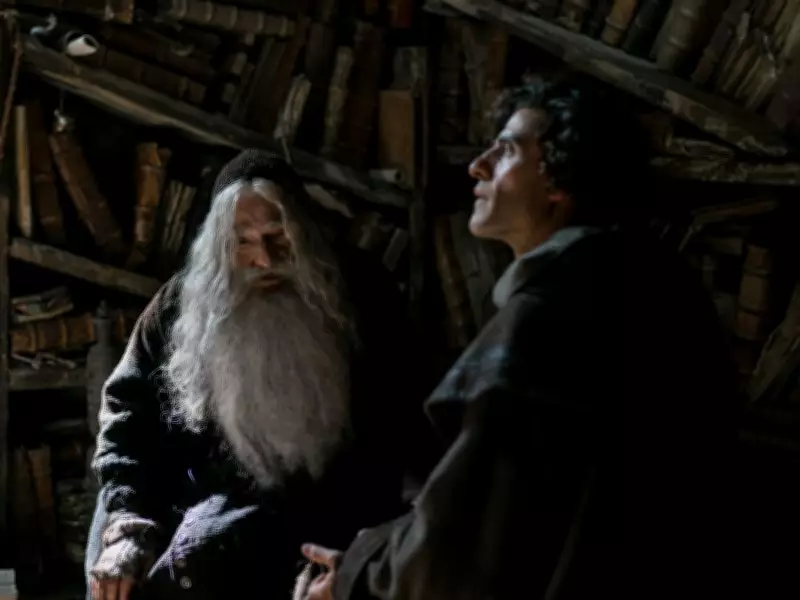
Then there is Florence in the early 14th century, alive with color, rebellion, and wisdom. Here Isaac transforms into Dante Alighieri himself: father of the Italian language, patron saint of exile, and inventor of literary redemption. Adapted from the real-life Tosches' novel of the same name, the film follows the author as he joins forces with stereotypical New York mobsters to recover and authenticate the original manuscript of the 'Divine Comedy,' intending to sell it on the black market.

Performances: Isaac Shines, Butler Intimidates
Among the mobsters are Joe Black (John Malkovich) and Louie (Gerard Butler), a hitman whose cruelty feels less like characterization than a contest with the screenplay to see who can be more gratuitous. As Tosches travels through Italy and the US, Louie paints their trail crimson with a body count so excessive that even dogs are denied mercy. Blood becomes the film's preferred punctuation mark. Isaac elegantly maps the descent and uneasy reconciliation of Tosches and Dante, while Butler delivers the film's most hypnotic performance, playing Louie with an almost inhuman menace.
Gal Gadot plays both Nick's assistant and lover Giulietta, and Dante's wife Gemma. While Beatrice — a woman Dante met only twice, once when he was all but nine — became immortal in his verse, Gemma was famously denied even a mention. The film attempts to lend that omission poetic weight, but Gadot never quite finds the ache, grace, or conviction either role demands. Smaller turns from Sabrina Impacciatore, Martin Scorsese, Al Pacino, and Jason Momoa add welcome intrigue.
Visual Grandeur Without Emotional Depth
Visually, 'In the Hand of Dante' is among the finest. Venice resembles a Renaissance canvas; New York, a noir photograph left to fade with time. The film has everything — superb performances, exquisite cinematography, and flashes of terrific dialogue — but ultimately succumbs to its fatal hamartia: the absence of an aching heart. There is a delicious irony in that. Dante's 'Divine Comedy,' for all its theological labyrinths, is one of literature's most rigorously structured journeys, every circle and canto serving an emotional purpose.
'In the Hand of Dante' mistakes complexity for depth. It reaches for paradise but remains hopelessly lost in its own dark wood.