By R Prashanth Vidyasagar
Most Bengalureans already carry a version of Halasuru in their memory. For many, it is the school-days version, when a trip to Bazaar Street was inevitable before the academic year began. Uniforms, textbooks, stationery and, somewhere between errands, a stop at Sri Guru Sweet Mart for Mysore Pak or a chiroti with warm badam milk.
Today, the metro glides above familiar streets as gopuras rise beyond the tree canopy. Tree-lined avenues stand alongside glass-clad hotels and modern developments. Yet beneath this changing skyline, heritage homes and centuries-old stories endure—hidden in plain sight, often overlooked despite their rich cultural and historical significance. As part of our Bengaluru Suthona series, we joined Raksha Nagaraj of Bengaluru Prayana on the Halasuru Heritage Trail. Walk slowly. This is a neighbourhood best experienced in the details.

Before the Cantonment
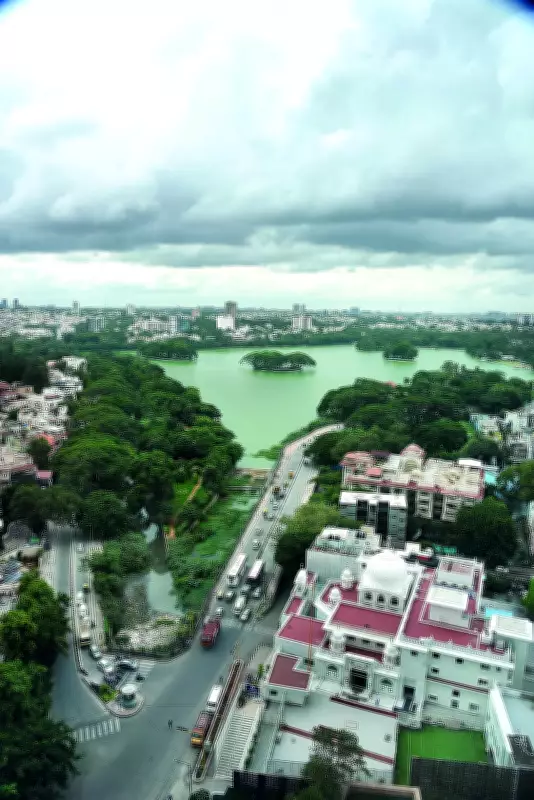
In the mid-16th century, Vijayanagara emperor Achyutaraya gifted Halasuru to Kempegowda I, the founder of Bengaluru. His son, Kempegowda II, is believed to have built the lake — the only surviving tank attributed to the Gowda rulers within the city. Following Tipu Sultan’s defeat at Srirangapatna, Tamil-speaking soldiers, traders and workers arrived and settled in the area. Their presence survives in street names such as Damodar Mudaliyar Street, Annaswamy Mudaliar Road and Sadhashiva Mudaliar Road.
Holy Trinity Church
Built in 1851 for the British regiment stationed in the area, Holy Trinity Church holds reminders of a different chapter in Halasuru’s history. Look closely at the steps and you’ll find the inscription “0 BM” — a benchmark of the Great Trigonometric Survey of India, the monumental project that eventually helped determine the height of Mount Everest. The church bell, cast by London’s Mears Foundry in 1847, came from the same foundry that later produced Big Ben.
The Temple Older Than the City
The Shri Someshwara Swamy Temple predates Bengaluru itself. Its sanctum and pillared hall date back to the Chola period, around the 10th century. A damaged goddess sculpture discovered during civil works was traced to the even earlier Ganga period, suggesting that the site has been sacred for well over a millennium. Walk along and you’ll find the story of Girija Kalyana — Shiva’s marriage to Parvati — unfolding panel by panel. Inside stand 48 pillars, no two alike.
The House with the Thinnai
On Car Street stands a low-slung, lime-washed house with a tinnai — the raised verandah that opens directly onto the street. It is a surviving example of vernacular architecture, shaped by local materials, climate and everyday life. The thinnai, a hallmark of traditional Tamil homes, arrived here with migrant communities more than two centuries ago. Most such houses have disappeared. When you come across one that remains, it is worth pausing to appreciate what it represents.
The Mystery Figure on the Pillar
One pillar features a striking bearded figure clad in tiered, ribbed robes. The posture and attire are distinctly unlike those of most Indian depictions from the period. Scholars have offered several interpretations: a Yavana, one of the Nava Nathas, or perhaps a Chinese merchant, whose ribbed robe aligns with representations found in Vijayanagara-era sculpture. The identity remains uncertain. Yet the very presence of such a figure in a temple at the heart of Bengaluru hints at centuries of cultural exchange and movement.
Even as Halasuru evolves, the neighbourhood’s historic dhobi ghat remains an active part of everyday life. The dhobi ghat along the lake’s edge continues to function much as it has for generations. Stone washing platforms built to serve the cantonment’s laundry needs remain in use, with clothes still beaten clean against the same slabs.
Nearby stands Sri Guru Singh Sabha, Bengaluru’s largest Sikh shrine. Sikh soldiers who arrived with the cantonment regiments laid the foundations of the community, later joined by traders and their families. The gurudwara’s daily langar welcomes everyone, reflecting a principle that has remained unchanged since its inception.

Murphy Town Market offers another glimpse of everyday Halasuru. Vegetables, flowers, tea stalls and familiar faces keep the market moving at its own pace, largely untouched by the rhythms of apps and delivery services.
Halasuru rarely announces itself. Its stories reveal themselves gradually: a lake built by the Gowdas, a name rooted in the landscape’s past, a temple older than the city’s founding narratives, and a church bell cast in London that still rings above a former cantonment.