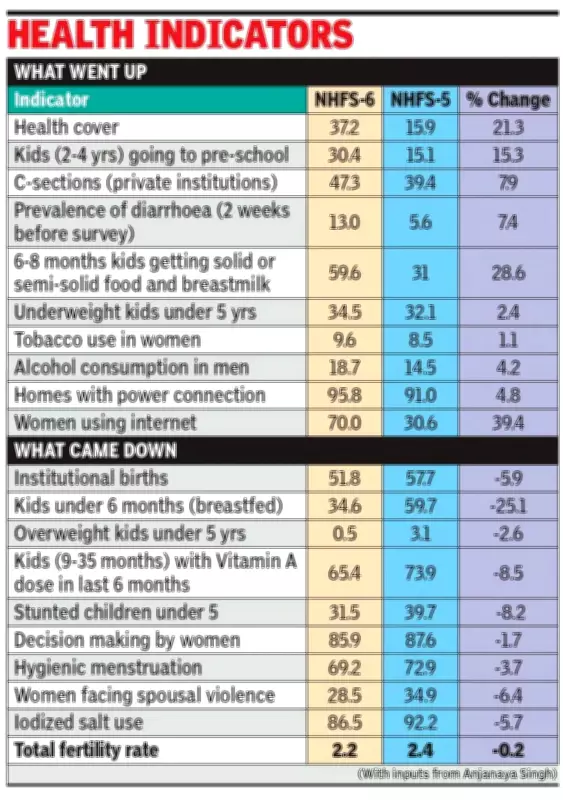
Lucknow: The latest round of the National Family Health Survey (NFHS-6) has highlighted significant gains for Uttar Pradesh across several social and health indicators, pointing to the impact of sustained efforts. However, a deeper dive also brings to the fore the gaps and areas that require improvement.
Overall Progress and Gaps
Mission Director of the National Health Mission, Dr. Pinky Jowel, stated, “The survey, in effect, offers both reassurance and a reminder of the work still ahead. And we are ready for fine tuning.” While key parameters of quality of life in a household, such as availability of electricity connection, water supply, and banking services, have inched closer to saturation, social security through health insurance cover remains an area needing improvement.
Health Insurance Coverage
Data showed that health insurance coverage in the state doubled from 15.9% to 37.2%, reflecting a jump of 21.3 percentage points. However, it remains far behind the national average of 60.2%.

Digital Inclusion
The rise in the number of internet users in the state, particularly among women (up from 30.6% to 79%), indicates that the state has caught up with the digital age.
Women's Condition
NFHS-6 has several good updates on women’s condition, but there is still ground to cover. Spousal violence has gone down from 34.9% to 28.5%, but one in four women is still subjected to this ill-treatment. A jump of five percentage points in women getting paid in cash for work (from 15.5% to 21.1%) is good news. Eight out of 10 women have a bank account, five out of 10 own a house or land, and one in two women uses a mobile phone. However, a marginal decline in the number of women having a say in household decision-making and the use of hygienic menstrual protection call for a fine-tuning in strategy.
Early Marriage and Teenage Pregnancies
The number of women aged 20-24 who admitted to getting married before the legal age came down from 15.8% to 13.7%, which is below the national average. However, this positive trend is dampened by the rise in teenage pregnancies from 2.9% to 3.5%, with higher prevalence in rural areas. This contradiction raises concerns over access to reproductive healthcare, contraception, and continued education for girls. Delaying marriage has not necessarily translated into delayed motherhood. Underage marriages among men also came down from 23% to 19.5%.
Child Health Indicators
Many indicators of child health are heartening. The percentage of fully vaccinated children has gone up from 69% to 81%, reflecting improvements across individual vaccination categories. However, intake of Vitamin A dose among toddlers has reduced. Severe malnutrition and stunting (height for age) have also come down. The proportion of overweight kids decreased from 3.1% to 0.5%. Breastfeeding within the first hour of birth increased significantly from 23.9% to 43.1%, but exclusive breastfeeding for six months came down from about 60% to 34.6%. Toddlers getting adequate diet increased from 5.9% to 17.1%, but the fact that four out of five babies were not getting their due nutrition is worrying.
Nutrition Dichotomy
The survey underlines a growing nutrition dichotomy. The share of adults with BMI below normal has increased from 19% to 22.2% in women and from 18% to 23.5% in men. The proportion of adults who are overweight or obese has also gone up, from 21.4% to 26.7% in women and from 18.5% to 21.8% in men. Adding to this concern is the rise in blood sugar levels in the working population, from 10% to 15.5% in women and from 11.6% to 19.5% in men. Consumption of tobacco among men and women and alcohol consumption in women further exacerbate the worry.

Maternal Health and Deliveries
Caesarean deliveries have increased in UP, but the rise has come largely from private hospitals (from 39.4% to 47.3%). Government facilities continue to remain below the WHO benchmark of 10-15%, despite a slight increase (from 6.2% to 6.5%). This trend points to unequal access to emergency obstetric care. Families using private hospitals appear more likely to access surgical intervention when needed, while poorer women dependent on public facilities may still be missing out on timely procedures. Institutional deliveries in the state also went up from 83.4% to 85.9%, but the fact that 14% of babies are still born within the community is worrying.
Anaemia and IFA Consumption
Anaemia continues to remain central to the nutrition and maternal health challenge. Despite wider healthcare access, it remains stubborn across women and children. One indicator from NFHS is the consumption of iron folic acid (IFA) tablets during pregnancy. Though the state recorded gains, the gaps behind are a dampener. One in three women in the state consumes IFA tablets for 100 or more days. The denominator increases to five when looking at the number of women who consumed IFA for 180 or more days.