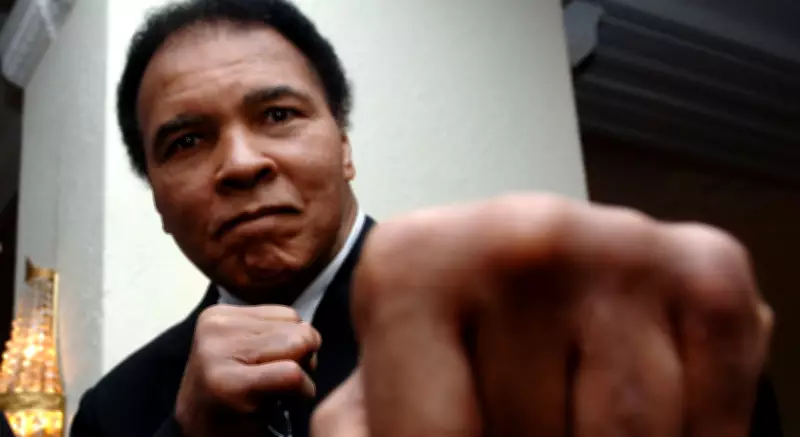
Muhammad Ali spent most of his life appearing untouchable. Even those who never watched boxing knew what he embodied: speed, presence, noise, confidence, and movement. He called himself "The Greatest" and made it sound less like arrogance and more like undeniable truth.
This quote carried even greater weight due to its timing. It did not come from Ali standing over a defeated opponent or shouting into cameras after a title fight. It surfaced years later, after Parkinson's disease had altered his body's rhythm and gradually stripped away many physical gifts that once defined him. The man who built his legend on movement eventually struggled to move. The voice that once filled arenas grew quieter and slower. Yet the essence of this quote is that Ali did not dwell on those losses with bitterness. He acknowledged them plainly and immediately turned toward something else: getting up again anyway.
Ali understood what it meant to lose pieces of yourself
Ali was born Cassius Marcellus Clay Jr. in Louisville, Kentucky, in 1942, growing up in an America still shaped by segregation. His father painted signs and billboards while his mother worked as a domestic worker. Nothing about his childhood suggested he would become one of the most famous athletes on earth. Boxing entered his life almost accidentally after his bicycle was stolen when he was 12. Furious, he told local policeman Joe Martin that he wanted to "whup" the thief. Martin, who trained young fighters, advised him to first learn how to fight. That small moment changed everything.

Ali quickly rose through amateur ranks before winning Olympic gold in Rome in 1960. He built one of the greatest careers sport has ever seen: defeating Sonny Liston to become heavyweight champion, fighting Joe Frazier in the "Fight of the Century," reclaiming the title against George Foreman in the legendary "Rumble in the Jungle," and surviving the brutal "Thrilla in Manila." He retired with 56 wins, five defeats, and 37 knockouts, becoming the first boxer to win the heavyweight title three separate times. But the quote that resonates most deeply today did not come from those victorious years. It came from the period after the lights dimmed and daily life became harder.
Parkinson's changed the things that once came naturally
Ali was diagnosed with Parkinson's syndrome in 1984 at just 42, only a few years after retiring from boxing. One of the earliest signs reportedly appeared in 1980, when he experienced tingling in his hands and changes in his speech. Over time, tremors became more visible, his movement slowed, and speaking itself became difficult. Doctors reportedly told Ali he might have only around 10 years to live after diagnosis, yet he lived for more than three decades with the disease.
For someone whose entire identity had been built around speed and expression, those changes could have easily broken him emotionally. Many people experience a version of that feeling in ordinary life, even if unrelated to sport or illness. There are moments when your own body suddenly stops cooperating as it once did. A parent who used to carry children upstairs without thinking now pauses halfway due to back pain. Someone recovering from surgery realizes they can no longer move through the world with the same ease they once took for granted. An athlete ages. A worker develops chronic fatigue. A musician loses dexterity in their hands. Someone dealing with depression wakes up and discovers even getting dressed feels heavier than before. What makes those moments painful is not only the physical limitation itself but the memory of effortlessness.
Ali understood that feeling intimately. His quote does not deny the grief inside it. He openly admits that things once effortless had become difficult. But he also refuses to let that reality become the end of the story. That is the important distinction.

He stayed present even when the world saw decline
As Parkinson's progressed, Ali gradually became quieter in public life but never completely disappeared from it. One of the most unforgettable images of his later years came during the 1996 Atlanta Olympics. Standing before the world with visibly trembling hands, Ali lit the Olympic flame in a moment that carried more emotional weight than many of his victories inside the ring. The world was no longer watching the fastest heavyweight boxer alive. It was watching someone choosing dignity in front of millions while physically struggling. Years later, he also appeared at the opening ceremony of the 2012 London Olympics, helping carry the Olympic flag despite his worsening condition.
Behind the scenes, Ali continued trying to stay socially engaged. Friends and visitors often described him using facial expressions, eye contact, humor, and even magic tricks to communicate when speech became harder. His wife, Lonnie Ali, once explained his mindset in a way that perfectly matched the spirit of this quote. "I learn every day from this man: the courage, the strength, and the grace that he lives with his illness," she said shortly before his death. "For most people, it would put them in bed and put covers over them. They would give up. He does not stop. He continues to live life, and that's very important." That part matters because resilience is often misunderstood. People imagine it as loud motivation or dramatic speeches. Most of the time it is much quieter than that. Sometimes resilience is simply continuing to participate in life after life no longer feels easy.
Ali stopped measuring life only through strength
Doctors initially believed Ali's condition had been caused entirely by repeated punches during his boxing career, though later specialists suggested he likely suffered from young-onset idiopathic Parkinson's disease that may have been worsened by boxing rather than directly caused by it. What remained remarkable was not just how long he lived with the illness—more than 30 years after diagnosis—but how he chose to use that period of his life. In 1997, alongside neurologist Dr. Abraham Lieberman, Ali helped establish the Muhammad Ali Parkinson Center at the Barrow Neurological Institute in Phoenix. Through fundraising efforts, public advocacy, and events such as Celebrity Fight Night, Ali's work reportedly helped raise more than $100 million for Parkinson's research and patient care. Dr. Lieberman later explained: "Muhammad felt he had a mission. Muhammad rose from a young boy in Louisville to the heavyweight champion of the world. This Center was part of it. This was his mission."
That is another layer inside this quote that often gets overlooked. Ali was no longer defining his value purely through physical dominance. He adapted. The role changed, but the sense of purpose did not disappear. Even as Parkinson's gradually affected his movement and speech, he still chose to live life fully, remain present in public, support Parkinson's research, inspire people, and use whatever strength he still had to make life better for others. The body that once overwhelmed opponents inside the ring could no longer move the same way, but Ali still believed each day carried value and responsibility. That mindset sits at the heart of the quote.
A lot of people struggle with that transition in everyday life. There are people who built their identity around being productive, physically capable, financially successful, or endlessly dependable for others. Then illness, age, burnout, or circumstance interrupts the version of themselves they were used to being. Ali's life offers a different way of looking at that transition. Just because certain abilities fade does not mean your presence loses meaning.
The most powerful part of the quote is the simplicity of it
The quote does not promise miraculous recovery. It does not pretend suffering is beautiful. It does not say positivity fixes everything. It simply says: things are harder now, but I still wake up and live, and that is why it continues to resonate so strongly. Ali openly admitted that the things which once came naturally to him—his movement, his voice, his physical sharpness—had become difficult because of Parkinson's disease. But rather than spending his remaining years only mourning what he had lost, he focused on the fact that he could still wake up, still live, still experience another day. That is where the line "each day is a gift from God" carries its real meaning.
Muhammad Ali spent years proving he could survive punishment inside a boxing ring. But the later years of his life showed a different kind of strength: learning how to keep living with faith, dignity, and gratitude after the body that once carried you through the world no longer moves the same way. For many people facing illness, aging, or limitation in ordinary life, that battle feels more familiar than any heavyweight title fight ever could.