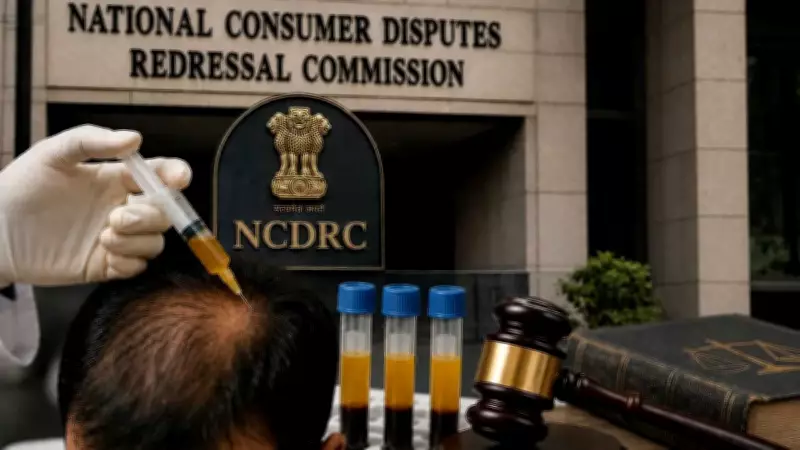
The National Consumer Disputes Redressal Commission (NCDRC) has ruled that the failure of Platelet Rich Plasma (PRP) treatment to achieve the desired hair regrowth cannot automatically be considered medical negligence or a deficiency in service. The commission set aside compensation awarded by a consumer forum, stating that doctors cannot be held liable solely because a medical procedure does not produce expected outcomes, as per a Bar and Bench report.
Background of the Case
A bench comprising Presiding Member AVM J Rajendra and Member Justice Anoop Kumar Mendiratta delivered the ruling. The case originated from a complaint filed by Mumbai-based advocate Sushil Mukesh Gaglani, who underwent three PRP sessions in 2013 to stimulate hair growth. The treatment was administered by dermatologist Dr. Madhuri Agarwal and plastic surgeon Dr. Satish Kishoranand Arolkar. Gaglani alleged that Chetan Purushottam, an executive of Lifecell International Private Limited (which supplied the PRP kits), assured him of positive results.
After the treatment failed to produce hair regrowth, and the complainant claimed he experienced pain and bleeding during the procedure, Gaglani approached the consumer forum alleging medical negligence, unfair trade practices, and deficiency in service. He further contended that he was misled into believing the therapy would guarantee hair growth and that Lifecell did not have a license to conduct PRP or stem cell procedures.

Earlier Forum Decisions
The Mumbai District Consumer Forum initially directed the opposite parties to refund Rs 59,525 and pay Rs 10 lakh as compensation. The Maharashtra State Consumer Disputes Redressal Commission later reduced the compensation to Rs 6 lakh while upholding the finding of unfair trade practice and deficiency in service. However, the NCDRC overturned both orders, allowing revision petitions filed by Lifecell, Purushottam, and the two doctors, while dismissing the complainant's revision petitions seeking restoration of the higher compensation.
Key Reasons for Overturning Compensation
The bench observed that PRP therapy is a recognized medical procedure and that lack of desired results alone cannot establish medical negligence. The commission emphasized that medical outcomes vary from person to person, and unsuccessful treatment cannot automatically be treated as proof of deficiency in a doctor's service.
A significant finding was that the district and state consumer forums had wrongly treated PRP therapy and stem cell therapy as the same procedure. The NCDRC clarified that PRP involves drawing the patient's own blood, processing it, and injecting platelet-rich plasma into the scalp to stimulate hair growth. This process cannot be equated with storing blood in blood banks or manufacturing blood components for sale.
The bench further noted that the complainant had not produced any expert evidence to show that the doctors deviated from accepted medical standards during the treatment. It also noted that Gaglani, being an advocate, had access to Lifecell's brochure and website and had signed the consent form before undergoing the procedure, weakening allegations of coercion or misrepresentation.
The NCDRC also rejected allegations against Lifecell International, holding that dermatologists and plastic surgeons are competent to administer PRP treatment unless a contrary protocol is notified by the Ministry of Health and Family Welfare.
Implications of the Ruling
This ruling reinforces the principle that medical practitioners are not guarantors of successful outcomes. It underscores the importance of informed consent and the need for patients to understand the inherent uncertainties of medical procedures. The decision also highlights the distinction between PRP therapy and stem cell therapy, clarifying regulatory boundaries.