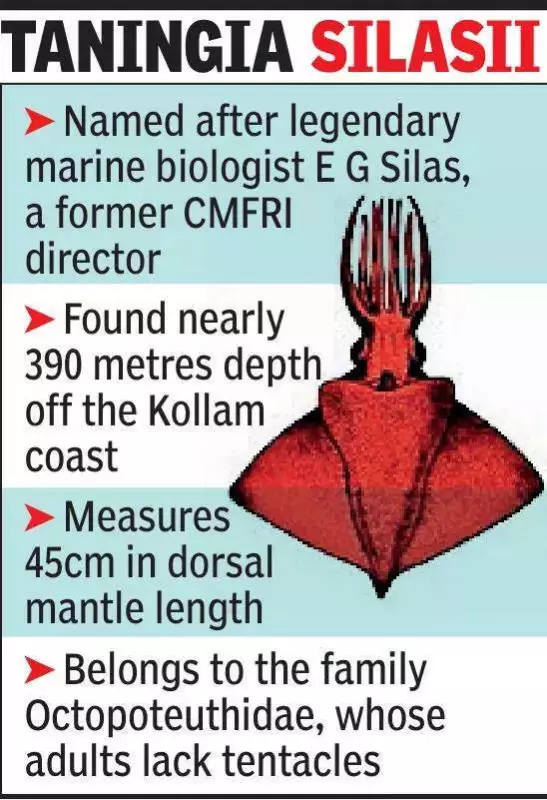
In a significant breakthrough for marine science, a team of Indian researchers has identified a previously unknown species of deep-sea squid lurking in the depths of the Arabian Sea. This discovery marks only the second confirmed species within the globally rare genus Taningia, adding a fascinating new chapter to India's marine biodiversity records.
A Rare Find in the Deep Blue
The groundbreaking discovery was made by scientists from the Central Marine Fisheries Research Institute (CMFRI) in Kochi. The specimen, which has been formally named Taningia silasii or the Indian octopus squid, was collected from a depth of nearly 390 metres off the coast of Kollam in Kerala. The finding has been officially documented in the prestigious international journal, Marine Biodiversity.
Led by researcher Geetha Sasikumar, along with colleagues Sajikumar K K, Shijin Ameri, and Toji Thomas, the team has been studying cephalopods in the Arabian Sea for over ten years. "We have been studying cephalopods in the Arabian Sea for more than a decade, and this squid was something we had never encountered," Sasikumar revealed. Until now, the only known species in this genus was Taningia danae, which inhabits Atlantic waters.

Genetic Confirmation and Unique Features
The identification of Taningia silasii as a distinct species was confirmed through advanced DNA barcoding. The analysis showed a genetic divergence of more than 11% from its Atlantic cousin, solidifying its status as a new species. "Previously, squids of the genus Taningia were considered monotypic. DNA barcoding showed more than 11% genetic divergence from the Atlantic species, confirming the specimen as a distinct species," Sasikumar explained.
This new species belongs to the family Octopoteuthidae, a group of true deep-sea squids whose adults are known for an unusual trait: they lack tentacles. Sajikumar K K elaborated on the creature's intriguing anatomy, stating, "Although called the 'octopus squid', it is in fact a squid that possesses only eight arms and lacks the two long tentacles typically seen in other squid species." The collected specimen measured 45cm in dorsal mantle length. Remarkably, members of this family can grow to enormous sizes, with the Atlantic species reaching up to 2.3 metres (7.5 feet) in length and weighing around 61.4kg.
A Tribute to a Pioneer
The newly discovered species carries a name of great significance for Indian marine science. It has been christened Taningia silasii in honour of the legendary marine biologist E G Silas, a former director of CMFRI and a pioneer of cephalopod research in India. This naming pays a fitting tribute to his foundational work in the field.
This discovery underscores the vast, unexplored biodiversity of India's deep-sea ecosystems. With nearly 400 different species of squids described worldwide, inhabiting environments from shallow coasts to deep trenches, the find highlights the critical importance of continued deep-sea exploration and research. The identification of Taningia silasii not only enriches global scientific knowledge but also positions Indian researchers at the forefront of marine biological discovery.