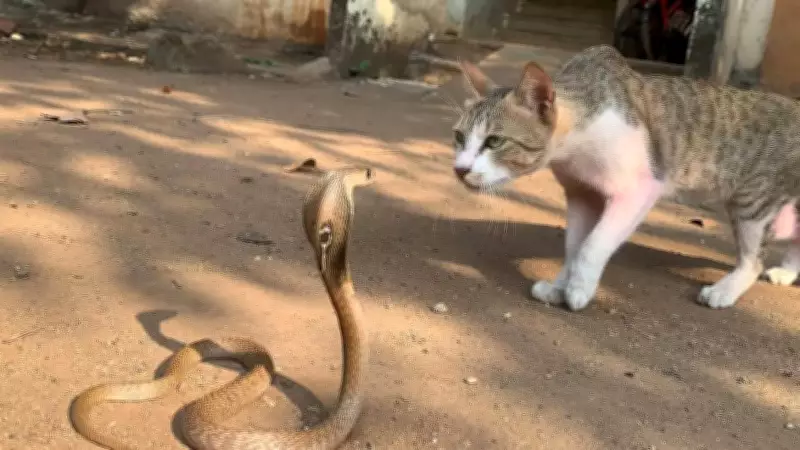
Fights between cats and snakes are often a mesmerizing spectacle for onlookers. The snake lunges unexpectedly, only for the cat to leap away just in time, avoiding the strike by mere inches. This prompts many to wonder whether cats are actually faster than snakes. Indeed, while both species exhibit quick response times, the snake holds a slight edge due to its marginally quicker reaction.
The Reaction Time
According to a study by Enviroliteracy, reaction time refers to the speed with which an animal responds to stimuli such as motion, sounds, and physical contact. Throughout evolution, cats have developed sharp reflexes as both predators and prey. Their brains are trained to react extremely fast. Research and observations indicate that a cat's reaction time ranges from 20 to 70 milliseconds.
Snakes also move very quickly. The need for rapid actions to capture prey and defend against predators drives their speed. A snake's strike occurs within 44 to 70 milliseconds, and the strike speed can reach several hundred miles per hour. Notably, snakes benefit from highly specialized muscles that propel their head forward.

Who's Faster?
A cursory examination suggests that cats are merely a tiny step ahead of snakes in this competition. However, a cat's superior reaction speed provides a significant advantage, allowing it to act in time. As soon as a snake begins any movement, the cat detects it through its eyes, ears, and whiskers.
Additionally, cats' success is linked to their body features. Their bodies are designed for speed and agility. The flexibility of a cat's spine enables it to move in different directions, while strong legs provide powerful bursts of speed to evade threats. In contrast, a snake's strike is always aimed forward, leaving it unable to redirect its movement mid-strike.
Furthermore, cats employ a special technique when fighting snakes. They never rush directly toward the snake but stay at a distance, testing the snake's reactions. The cat strikes the snake several times with its paws, then jumps away before the snake can retaliate. This behavior is a serious assessment strategy rather than play.
Why Are Cats Faster?
Paw usage is another advantage. Cats can attack quickly without risking their head and body, as they simply extend a paw and withdraw it immediately. This forces the snake to react without endangering the cat. This strategy is used by both domestic and wild cats.
Nevertheless, the assumption that cats have been bred for centuries as effective snake killers should not lead to the belief that they cannot be harmed. Venomous snakes are highly dangerous adversaries, and cats can still be bitten if they miscalculate or become distracted.
Several elements, such as species, size, and surroundings, affect the outcome of such encounters. A cat's size may limit its ability to defend against larger, venomous snakes. Conversely, a snake in a confined space is more likely to deliver a bite. Therefore, not all cats escape snake encounters uninjured.
Scientific research suggests that cats' fast reflexes evolved due to the necessity of survival in dangerous environments. Quick reactions aid in hunting and escaping threats. Encounters with snakes clearly showcase this adaptation.
Generally, cats prevail over snakes in terms of reflexes. Their quick reaction time, agile movement, and careful approach enable them to avoid snake strikes. However, snakes rank among the fastest animals in terms of attacks, and no cat can be completely safe from snake bites despite its reflexes.
Disclaimer: Reaction times vary depending on the species, age, size, health, and environmental conditions of both the cat and the snake.