

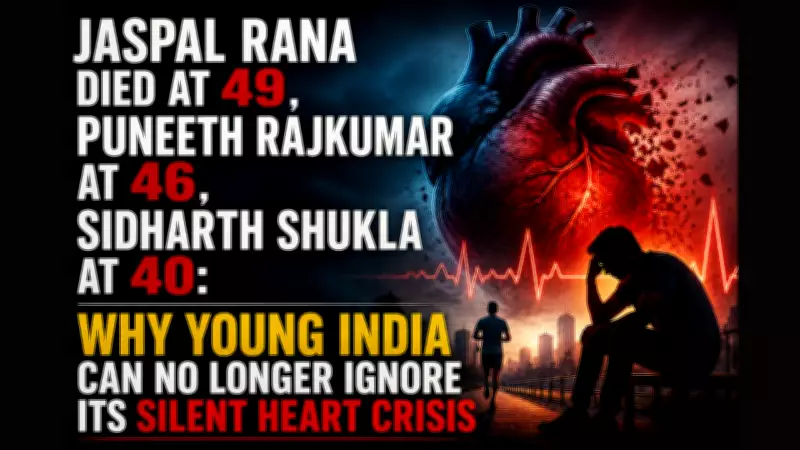
On the morning of June 12, 2026, India lost Jaspal Rana. The 49-year-old shooting legend and coach had been on a flight back from the ISSF World Cup in Munich when he fell ill mid-air. By the time the plane landed in New Delhi, his condition had worsened significantly. Doctors placed a stent. However, he passed away at Max Hospital in Saket, Delhi, leaving behind a career that had given India some of its greatest sporting moments and a generation of shooters who wouldn't exist without him. He was 49. This is not a rare story anymore. It is, in fact, becoming a frighteningly common one.
Sidharth Shukla, the Bigg Boss 13 winner, died on September 2, 2021. He was 40. He had reportedly felt uneasy before going to bed and didn't wake up the next morning. He was known for his fitness. Puneeth Rajkumar, the beloved Kannada superstar known to millions as "Appu," died that same year on October 29 at 46 after suffering a heart attack. He had been to the gym that morning. Singer KK collapsed after a live concert in Kolkata and died on May 31, 2022, at 53 from a heart attack. In June 2025, actress Shefali Jariwala, the face of an entire generation's music video memories, died at 42 from what was reportedly a cardiac arrest.
The First Sign Can Be the Last One
Dr. Sanjeev Chaudhary, Chairman of the Department of Cardiology at Marengo Asia Hospitals in Gurugram, says: "Coronary artery disease is increasingly affecting individuals in their 30s and 40s. Multiple factors contribute to this shift, including smoking, diabetes, hypertension, obesity, dyslipidemia, chronic stress, poor sleep, physical inactivity, and unhealthy dietary habits. In South Asians, a strong genetic predisposition further accelerates the development of atherosclerosis at a younger age."

But here's the part that should make everyone stop scrolling: you may not feel any of it happening. Dr. Chaudhary flagged the presence of what he calls "silent" risk factors. "Many young adults may appear fit and active yet harbor elevated lipoprotein(a), familial hypercholesterolemia, insulin resistance, or subclinical coronary plaque. Consequently, the first manifestation of heart disease may be an acute myocardial infarction or sudden cardiac death." Translation: the first symptom can be the fatal one.
Research confirms that sudden cardiac death occurs five to eight years earlier in Indians than in Western populations. So the idea that heart disease is something your parents or grandparents worry about is outdated and dangerous.
Being Fit Is Not the Same as Being Heart-Healthy
One of the most persistent and deadly misconceptions is that if you exercise regularly, you're protected. Dr. Rahul Mehrotra, Chief of NIC and Clinical Cardiology at Artemis Hospitals, addressed this directly: "One of the biggest misconceptions is that people who exercise regularly are immune to heart attacks. Physical activity is good, but it doesn't offset other risk factors like high cholesterol, genetics, high blood pressure or diabetes."
He went further. "Some people also concentrate so much on muscle-building exercises that they forget about aerobic activities that directly help heart health. Too much exercise, especially if you're not getting enough sleep or rest, can put extra strain on your body. In some cases, undiagnosed heart conditions can make strenuous exercise dangerous."
And then there's the stress factor. Dr. Mehrotra pointed out something that blood tests simply cannot catch. "A simple blood test can tell you your cholesterol or your blood sugar but not your stress. Excessive work hours, relentless digital activity, reduced leisure time, and mounting mental stress can quietly impact your heart health gradually." The modern lifestyle has essentially created a perfect environment for cardiac disease to develop invisibly, especially in people who believe they're doing everything right.
Are Young Heart Attacks Actually Increasing?
Dr. Mehrotra was careful to draw a distinction here. He noted that while medical studies have long shown that 10 to 15 percent of heart attacks occur in people under 40, there isn't yet strong scientific evidence of a dramatic surge in numbers. "What may have changed is the awareness," he said. "Incidents of this nature are getting more media coverage and instant reporting, particularly if it involves a celebrity or public figure."

But awareness is not the same as comfort. Whether the numbers are rising sharply or just becoming more visible, the outcome is the same for the person who didn't get screened in time. And the alarming reality is that nearly 10 percent of cardiovascular deaths in India are attributed to sudden cardiac death, with individuals aged 30 to 50 increasingly at risk.
You Are Not "Too Young" for a Heart Screening Anymore
Dr. Chaudhary was direct about what Jaspal Rana's passing should prompt the rest of us to do: "Cardiovascular risk assessment should begin early. Regular screening of blood pressure, blood sugar, lipid profile, body weight, and family history, coupled with healthy lifestyle choices, remains the most effective strategy to prevent premature heart attacks and save lives."
Dr. Mehrotra echoed this, recommending annual health check-ups for adults over 35 that include cholesterol, blood sugar and blood pressure checks. "A heart attack can happen to anyone at any time, even healthy people. Regular health screenings, stress management, quality sleep and healthy lifestyle choices are still the best defenses against heart disease."
The athletes who died looked fine. The executives who dropped mid-run looked fine. Jaspal Rana was on a flight home from a World Cup. He was still working. He looked fine too. The point isn't to frighten anyone into paralysis. It's to make one thing clear: the assumption that you're too young for a heart problem is no longer one your body is going to honour. The screening appointment you've been putting off because you feel okay, that's the one that matters most.





