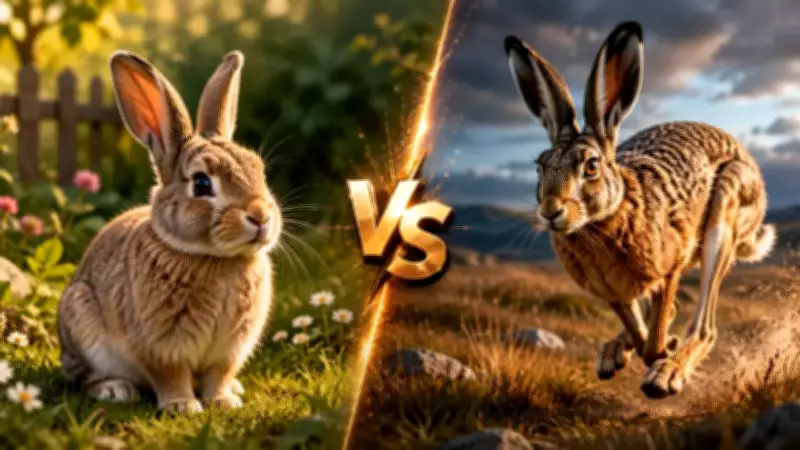
At dusk, a rabbit crossing a garden and a hare sitting upright in a field can appear surprisingly similar from a distance. Both belong to the same branch of the mammal family tree and share familiar features such as long ears, strong hind legs, and a plant-based diet. Yet their lives are quite different. Their bodies are shaped for distinct landscapes, their young arrive under very different circumstances, and their behaviors reflect separate survival strategies. The confusion between the two is understandable, especially during brief sightings. However, spending a little more time observing them reveals distinctions that are hard to miss. What seems like a close match at first glance is actually a story of two animals that evolved along separate paths.
Rabbit vs Hare: A Quick Comparison
| Parameter | Rabbit | Hare |
|---|---|---|
| Size | Smaller and more compact | Larger and more slender |
| Legs | Shorter hind legs | Longer and more powerful hind legs |
| Ears | Shorter ears | Longer ears, often black-tipped |
| Eyes | Usually brown | Often amber-colored |
| Shelter | Lives in burrows and warrens | Uses shallow ground scrapes called forms |
| Habitat | Gardens, woodland edges, scrub, grassland | Open farmland, meadows, grasslands |
| Social behavior | Often lives in groups | Usually solitary |
| Speed | Fast over short distances | Faster, suited to open-country running |
| Young | Born blind and hairless | Born furred with eyes open |
| Name of young | Kits or kittens | Leverets |
| Breeding | Large litters several times a year | Smaller litters, multiple breeding attempts |
| Defense | Escapes to underground shelter | Relies on camouflage and speed |
| Distribution | Found worldwide except Antarctica | Mainly Europe, Asia, and parts of Africa |
| Human relationship | Common pet and domestic animal | Rarely domesticated |
| Lifespan | Generally shorter in the wild | Often slightly longer in the wild |
Understanding the Differences Between Rabbits and Hares
Size and Build
The difference in body shape is often the first thing noticed. Rabbits appear compact and rounded, carrying their weight close to the ground. Hares look longer and leaner, with a frame built for covering open terrain. Even when standing still, a hare gives an impression of length that a rabbit rarely does.
Legs and Movement
Long hind legs are a feature of both animals, although hares take the design further. Their limbs are proportionately longer and generate remarkable bursts of speed across open country. Rabbits can move quickly as well, but their movements tend to be shorter and directed towards nearby cover rather than prolonged runs.

Ears and Eyesight
Large ears help both species detect approaching danger. In hares, the ears are often noticeably longer and may carry black markings near the tips. Their elevated posture in open landscapes makes early detection important. Rabbits rely on keen senses too, though they usually remain closer to shelter.
Eyes and Facial Features
A rabbit's eyes are commonly dark brown and sit within a softer-looking face. Hares often have brighter amber eyes that stand out against their fur. Combined with a narrower head and longer muzzle, this creates a noticeably different expression once the two animals are viewed side by side.
Shelter and Living Arrangements
Rabbits are closely associated with warrens. These underground networks protect from weather and predators and may be shared by many individuals. Hares rarely dig extensive shelters. Instead, they rest in shallow hollows among vegetation, depending on concealment rather than construction for safety.
Habitat
Many rabbit species thrive in varied surroundings, from woodland edges to grasslands and even urban spaces. Hares generally favor more open landscapes where visibility is greater. Large fields, rough pasture, and agricultural land suit their lifestyle, allowing them enough space to spot threats and escape.

Social Behavior
Rabbits are often sociable creatures. Colonies can contain numerous individuals living within the same warren system and interacting regularly. Hares are far less communal. They may gather loosely where food is plentiful, though they spend much of their lives alone and maintain greater personal space.
Speed and Escape Tactics
When alarmed, rabbits usually head straight for cover. Their objective is simple: reach the safety of a burrow before a predator closes the distance. Hares operate differently. They often remain motionless until the last moment and then explode into rapid, twisting runs across open ground.
Young and Early Life
The contrast between newborn rabbits and hares is striking. Rabbit kits enter the world blind, hairless, and entirely dependent on their mother. Leverets arrive with fur already covering their bodies and their eyes open. Within a short time, they can move independently, an advantage in exposed habitats.
Breeding Patterns
Rabbits are known for producing large numbers of offspring. Several litters may be raised within a single year when conditions are favorable. Hares also breed multiple times annually, though litter sizes are generally smaller. Both species depend on reproduction to offset the heavy pressures of predation.
Defense Against Predators
Predators see both rabbits and hares as valuable prey. Their responses, however, differ considerably. Rabbits place faith in underground refuge and nearby cover. Hares depend on vigilance, camouflage, and extraordinary speed. Each strategy reflects the environment in which the animal spends most of its life.
Distribution and Relationship with People
Rabbits have traveled widely with human activity and now occur across much of the world. Many breeds have been developed for companionship, farming, and exhibition. Hares remain largely wild animals. Although familiar across parts of Europe and Asia, they have never developed the same domestic relationship with people.
Lifespan
Neither animal enjoys an easy existence in the wild. Predators, disease, and environmental pressures remove many individuals before old age. Hares often survive slightly longer on average, though longevity varies considerably according to habitat quality, food availability, and local predator numbers.
Rabbit vs Hare: How Evolution Shaped Two Distinct Survivors
The rabbit and the hare share common ancestry but represent two distinct ways of living. One relies on community life and underground shelter, while the other trusts open ground, sharp senses, and powerful legs. Their differences reach beyond appearance, shaping everything from breeding behavior to survival tactics. Understanding those distinctions makes it easier to appreciate why these familiar mammals occupy separate places within the natural world despite looking, at first glance, remarkably similar.